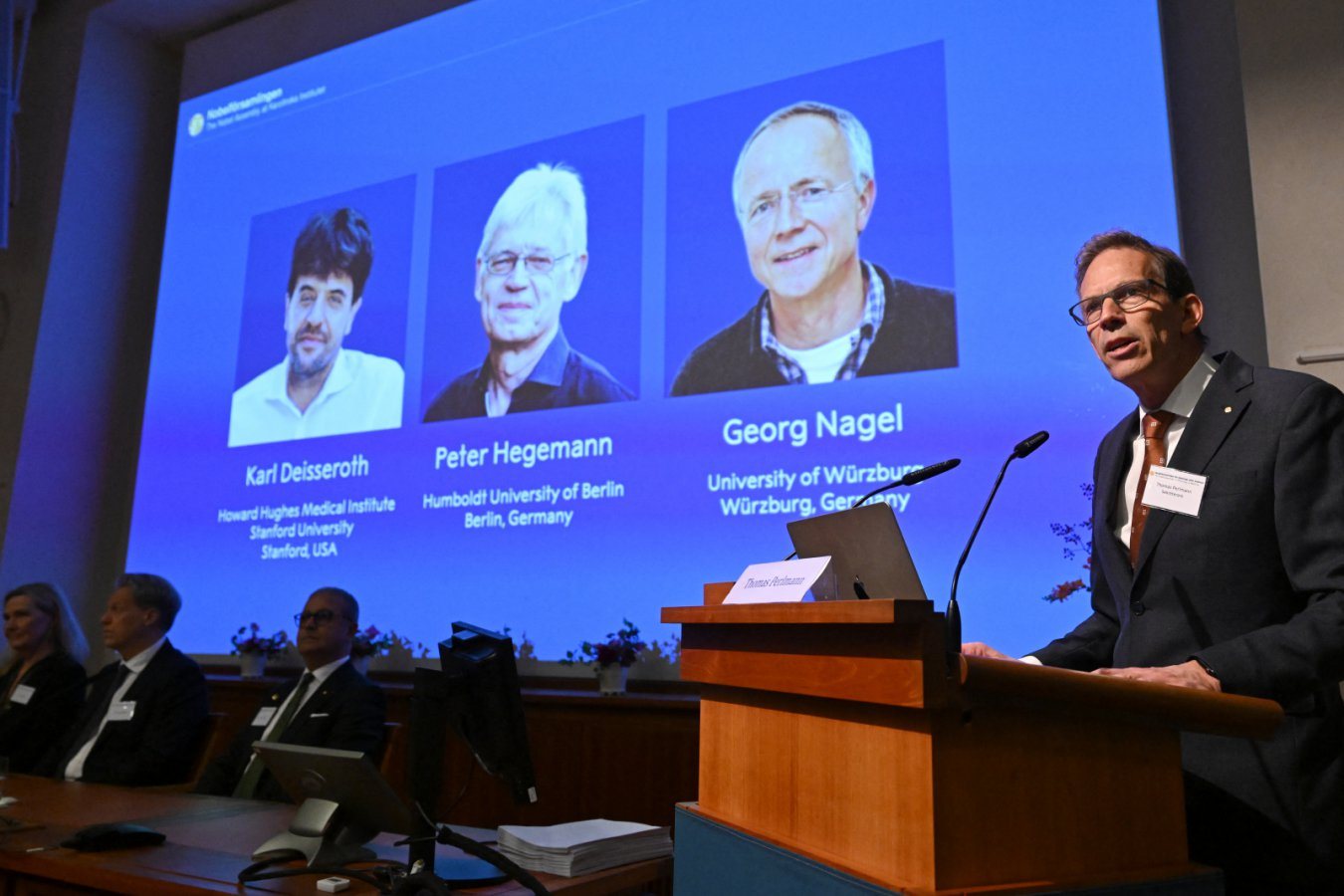
The 2026 Nobel Prize in Physiology or Medicine has been awarded to Karl Deisseroth, Peter Hegemann and Georg Nagel for the development of optogenetics, a technique that uses light to control nerve cells. The announcement was made by the Nobel Committee at the Karolinska Institute in Stockholm.
Optogenetics allows researchers to activate or silence specific groups of neurons with light, providing an unprecedented window into how brain circuits drive behavior. «It's a tremendous step forward to be able to link nerve cells and their function to specific behaviours,» said Anna Wedell, a member of the Nobel committee. «It's a completely new dimension of understanding of the function of the brain.»
The story began in the 1990s, when Peter Hegemann, then at the Max Planck Institute for Biochemistry in Germany, investigated how a single-celled alga called Chlamydomonas swims toward light. He identified a light-sensitive protein as the key. In the 2000s, Hegemann teamed up with Georg Nagel, then at the Max Planck Institute for Biophysics in Frankfurt. They showed that this protein acts as a switch, opening a channel that lets ions flow through when exposed to light. They named it channelrhodopsin.
«They had just discovered the switch neuroscientists had long dreamed of,» said Abdel El Manira, a neuroscientist and member of the Nobel Committee, during the announcement. The discovery of channelrhodopsin was a major breakthrough in itself, but Karl Deisseroth, at Stanford University, took it further. He genetically engineered rats to produce channelrhodopsin in their nerve cells, making those cells activatable by light. This work, published in 2005, enabled researchers to study the function of specific groups of neurons.
«For the first time, causal links between specific brain circuits and behaviour had been achieved,» El Manira said. «The technology transformed neuroscience. Optogenetics was rapidly and widely adopted all over the world.» Since then, more light-sensitive proteins have been discovered that respond to different colors, allowing even more precise control of engineered nerve cells.
The technique is now moving toward clinical applications. Therapies based on optogenetics are being developed, including an approach to restore some sight to people who are blind because they have lost the light-detecting rod and cone cells in the retina. Optogenetic techniques can make nerve cells in the retina respond directly to light, though this requires wearing special goggles. Several clinical trials are ongoing with this approach, said Per Svenningsson, chair of the Nobel Committee.
One limitation of optogenetics is that light cannot penetrate far into the body. To address this, several groups around the world are trying to develop equivalent methods based on ultrasound or magnetism. These efforts could extend the reach of the technology beyond the brain and retina.
The prize recognizes decades of work that began with a basic question about algal behavior and grew into a tool that has reshaped neuroscience. By linking specific neurons to specific behaviors, optogenetics has given scientists a way to test causal relationships in the brain that were previously inaccessible. The three laureates will share the prize, though the committee did not disclose the exact split. Their work continues to inspire new research and therapeutic possibilities.
15