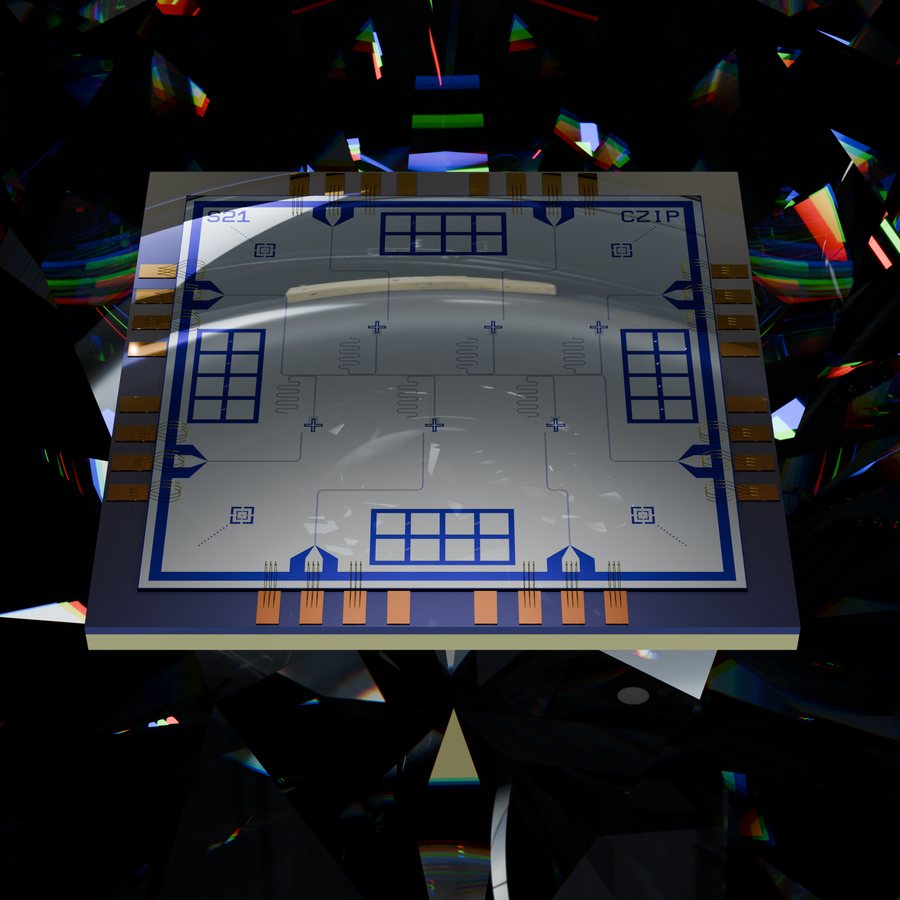
Trapping the particles responsible for exotic quantum behaviour does not necessarily destroy that behaviour, according to a new theoretical study that shows unusual spin effects can survive confinement in a quantum magnet.
Quantum spin liquids are unusual magnetic phases in which the spins stay disordered even near absolute zero. In an ordinary magnet, the standard excitations are magnons, collective waves in which many atomic spins tilt together. Spinons are stranger. They are emergent quasiparticles that arise from the coordinated behaviour of many strongly interacting spins. In a quantum spin liquid, quantum entanglement allows spinons to separate and travel without immediately recombining. A conventional magnon carries spin 1, but two independently moving spinons can each carry spin 1/2, a process known as fractionalisation. Spinons are generally produced in combinations that preserve the system's overall quantum numbers.
These properties make quantum spin liquids valuable for studying fundamental ideas, including entanglement, fractionalisation and particle confinement. Researchers say some of these systems may also inform future approaches to quantum computing, magnetic devices and the transport or storage of quantum information, although practical applications remain a long-term prospect.
Researchers have long expected confinement, which prevents spinons from moving independently, to suppress exotic quantum behaviour. The new work indicates that this expectation does not always hold. The team found that Polyakov confinement can transform a Dirac quantum spin liquid into a symmetry-protected topological state. In this new state, the spinons can no longer move freely through the interior, yet unusual and protected spin behaviour remains along its edges.
The researchers supported their claim using field theory and variational Monte Carlo simulations. They also proposed that this state could arise in a model magnet with spins arranged on a triangular lattice. Their calculations predict that applying a weak magnetic field would produce a recognisable redistribution of spin near the edges, offering a possible experimental signature for detecting the state.
The study, led by Li-Wei He and colleagues and published in Reports on Progress in Physics, suggests that unusual quantum effects can persist in unexpected ways even when the particles responsible for them become trapped.
37