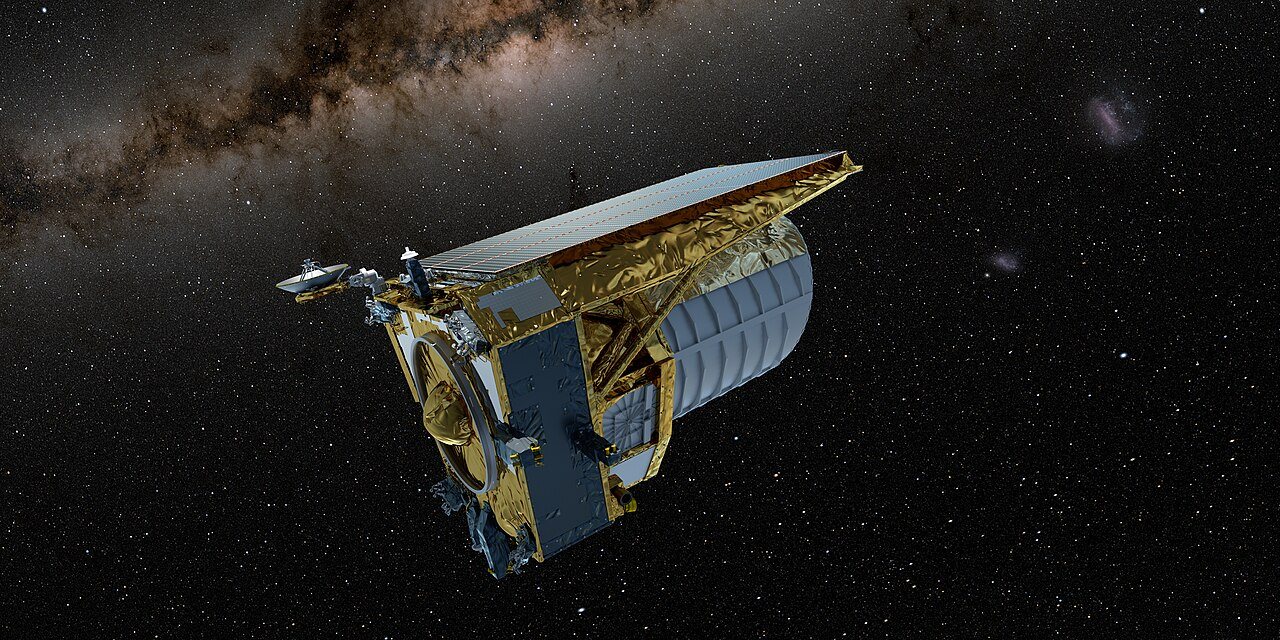
The European Space Agency's Euclid space telescope has discovered its first previously unknown comet, a long-period object that takes more than 300,000 years to complete one orbit around the Sun. The finding, announced after follow-up observations by telescopes on several continents, marks an unexpected result for a mission designed to map billions of galaxies and probe the nature of dark matter and dark energy.
The comet, officially designated C/2026 S1 (Euclid), appeared in a series of sixteen images Euclid captured between September 16 and 24, 2026, while the telescope was observing the Euclid Deep Field North. That region is one of three deep fields the mission is scrutinizing in exceptional detail, in addition to its broader but shallower survey of roughly a third of the sky. The comet is currently located between the orbits of Jupiter and Saturn, about 1.3 billion kilometers from Earth, and shines at magnitude 20.7, far too faint to be seen with the naked eye.
The signal was first flagged by Mikko Pöntinen, a doctoral student at the University of Helsinki and a member of the Euclid collaboration's solar system objects working group. Pöntinen said he was excited to see his software report a «streak» spread across several images, the signature of a fast-moving object. By predicting its position, he was able to identify the comet in five separate sets of images. Closer inspection revealed a fuzzy cloud around it, indicating an active body releasing dust and gas — a coma.
After checking catalogs of known comets and asteroids without finding a match, the team reported the discovery to the Minor Planet Center, the organization tasked by the International Astronomical Union with collecting data on small bodies in the solar system. The center issued an alert to observers worldwide, and telescopes in Switzerland, Austria, Hungary, Romania, Canada, the United States and Hawaii observed the object between late September and early October. Those observations confirmed its cometary nature, announced in a circular on October 8.
The comet travels on a highly elongated elliptical orbit that is perpendicular to the plane in which the planets of the solar system lie, rather than along that plane. Euclid captured it in a long exposure of about nine minutes on September 20, during which the comet appears as a streak because of its motion across the field of view, surrounded by its coma of gas and dust.
Euclid was not designed to catch fast-moving objects such as asteroids and comets, and it has previously observed some known comets. This is its first discovery of a comet never seen before. The telescope deliberately avoids the region most densely populated by asteroids and comets to limit dust glow in its deep-sky images, and it usually does not revisit the same patches of sky, making it difficult to catch an object moving between fields. Bruno Altieri, a Euclid archive scientist at ESA and a member of the team behind the discovery, said the mission is expected to find very few comets, so it was a fortunate coincidence that the comet's orbit and Euclid's scanning schedule allowed it to be captured in multiple images.
The speed with which the discovery was identified and verified also suggests Euclid can spot new comets while they are still relatively close, adding a solar system dimension to a mission whose primary targets lie far beyond the Milky Way.
12