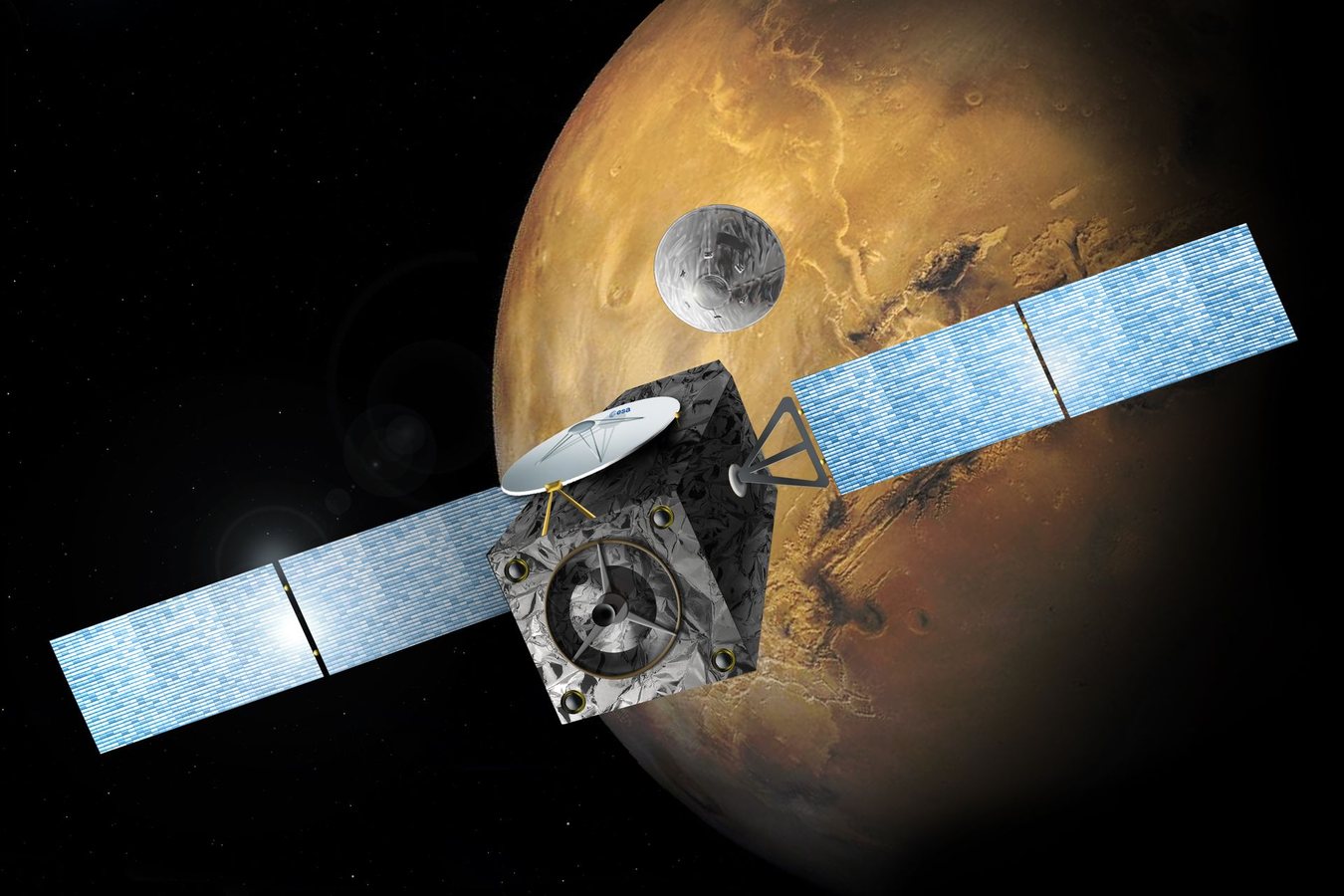
Europe's ExoMars mission reached Mars on Oct. 19, 2016, when the Trace Gas Orbiter and the Schiaparelli demonstration lander arrived at the planet after a journey of roughly seven months. The pair had been launched together earlier that year on a Russian Proton rocket, and their arrival marked a significant step in the European Space Agency's long-running effort to understand the Martian atmosphere and to develop the technologies needed for landing on the surface.
The Trace Gas Orbiter was designed to carry out a detailed inventory of gases in the Martian atmosphere, with particular attention to methane and other trace constituents that could be linked to geological or biological activity. Its instruments were built to detect these gases at very low concentrations and to map how they vary across the planet and over time. The orbiter also carried a camera system capable of imaging the surface at high resolution, and it was intended to serve as a communications relay for landers and rovers operated by ESA and its partners.
The Schiaparelli lander was a technology demonstration vehicle, not a full science mission. Its purpose was to test the entry, descent, and landing systems that Europe would need for later missions to the Martian surface. The lander carried a small suite of instruments, including sensors to measure the Martian atmosphere during descent and a meteorological station designed to operate on the surface. The data it collected were meant to inform the design of future European landing attempts.
The arrival itself was a two-part operation. The orbiter fired its engines to enter orbit around Mars, while Schiaparelli separated and headed for the surface. The lander was expected to descend through the atmosphere, deploy a parachute, and touch down in the Meridiani Planum region. The mission team monitored the descent from the orbiter and from ground stations, and the orbiter was positioned to relay signals from the lander during its final approach.
The ExoMars program was a collaboration between the European Space Agency and Russia's space agency, Roscosmos, with contributions from a broad set of European industrial partners and scientific institutions. The 2016 mission was the first of two planned ExoMars launches; the second was intended to place a European rover on the Martian surface. The orbiter's science operations and its role as a communications relay were expected to support that later mission as well as other international efforts to explore Mars.
The arrival of the Trace Gas Orbiter and Schiaparelli on Oct. 19, 2016, thus represented both a scientific milestone and a technical test for Europe's ambitions at Mars. The orbiter went on to conduct its atmospheric survey from orbit, while the lander's descent provided engineering data that would shape subsequent European plans for landing on the planet. The date remains a notable one in the history of Mars exploration, marking the moment when Europe's largest mission to the Red Planet arrived at its destination.
13