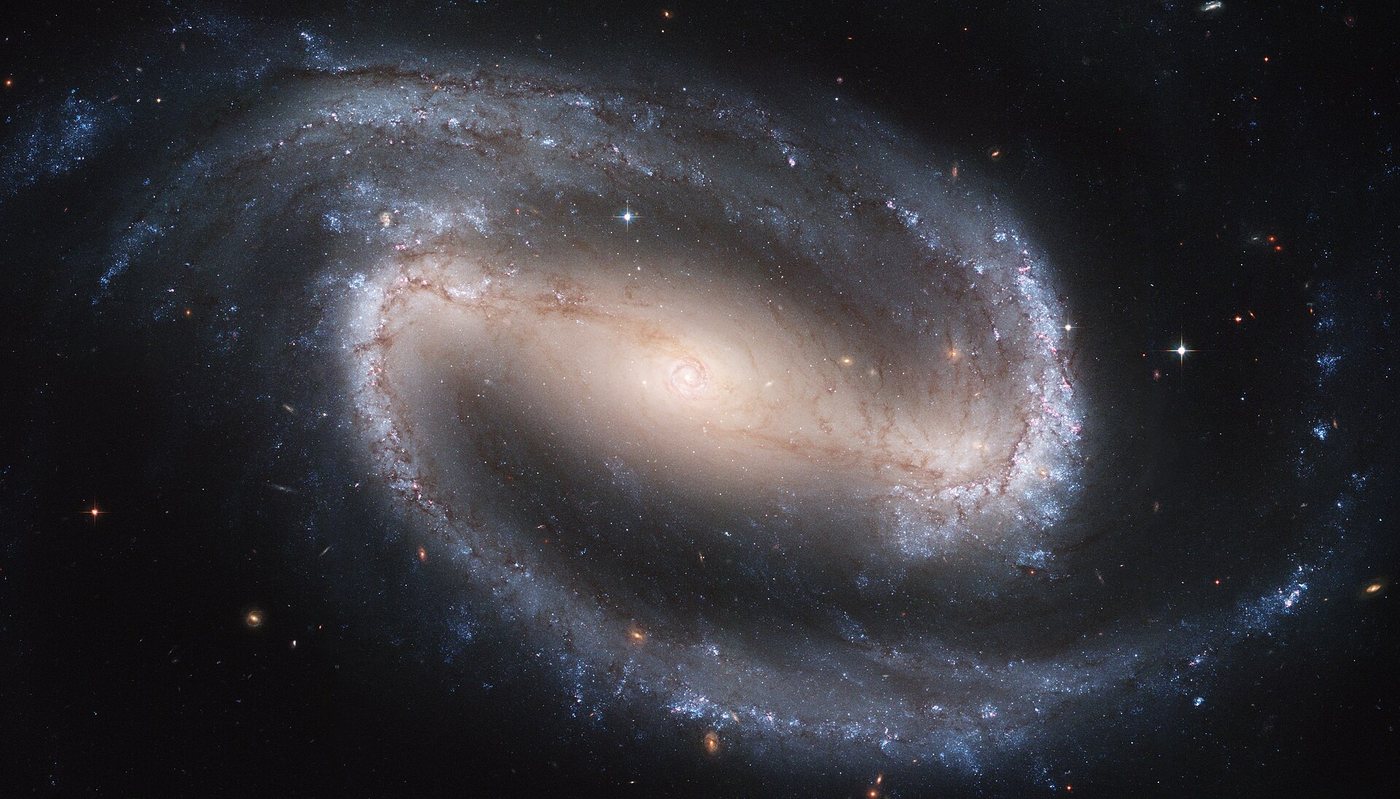
The NASA/ESA Hubble Space Telescope has captured a new view of NGC 1827, an intermediate spiral galaxy located in the constellation Columba. The galaxy is seen nearly edge-on, a viewing angle that exposes the dense bands of dust threading through its disk and gives astronomers a side-on cross-section of its structure.
NGC 1827 is classified as an intermediate spiral galaxy, a designation that places it between two major morphological types: galaxies with a well-defined central bar and those with an unbarred, more open spiral structure. Its edge-on orientation means the galaxy's flat disk appears as a thin band, with the dust lanes silhouetted against the brighter light of stars and glowing gas behind them.
The new Hubble image highlights the dusty character of the galaxy. Dust lanes are common in spiral galaxies, where they trace the denser regions of the interstellar medium, but they become especially conspicuous when a galaxy is viewed edge-on. In such orientations, the dust absorbs and scatters starlight, creating dark ribbons that can obscure the galaxy's inner regions and complicate measurements of its central structure.
Columba, the constellation in which NGC 1827 appears, is a southern constellation. The galaxy's position in the southern sky makes it a target for observatories with access to that hemisphere, though Hubble's position above Earth's atmosphere allows it to observe such objects without the blurring effects of atmospheric turbulence.
Hubble, a joint project of NASA and the European Space Agency, has operated for more than three decades. Its instruments have produced detailed images of galaxies across the morphological spectrum, from tightly wound spirals to irregular systems, and its archive is widely used by researchers studying how dust, gas and stars are distributed within galaxies.
Images of edge-on galaxies like NGC 1827 are valuable because they allow astronomers to study the vertical structure of galactic disks, including how far dust and stars extend above and below the midplane. Such observations help refine models of how galaxies form and evolve, and how their interstellar material is cycled between stars and the surrounding medium.
The new view of NGC 1827 adds to Hubble's long record of spiral galaxy imaging. While the image is primarily a striking portrait of a dusty disk seen from the side, it also serves as a reminder of how viewing angle shapes what astronomers can learn from a galaxy, revealing structure that would remain hidden in a face-on orientation.
13