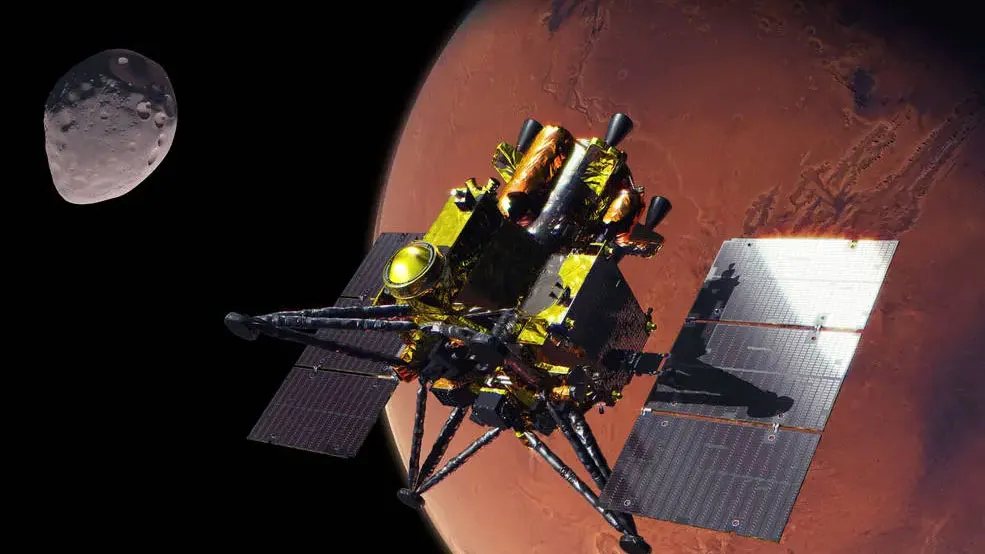
Japan is preparing to launch a spacecraft on a mission to bring back the first samples ever collected from a Martian moon, an effort that could give scientists a direct window into the early history of the Mars system. The MMX mission, led by the Japan Aerospace Exploration Agency, aims to retrieve roughly 10 grams of dust and rock from one of the two small moons orbiting Mars and return the material to Earth for laboratory analysis.
The target is a world barely a few kilometers across, and the mission is designed to touch down briefly, collect surface material, and lift off again before beginning the long journey home. If successful, the returned samples would be the first pristine material delivered from the Martian system, distinct from meteorites found on Earth that are believed to have originated on Mars.
Scientists are particularly interested in whether the Martian moons are captured asteroids or debris thrown up from Mars itself by a giant impact. The answer would reshape understanding of how the inner solar system formed and evolved. Material from a Martian moon could also carry traces of Mars's ancient atmosphere or surface, giving researchers a new way to study the planet's history without launching a complex sample-return mission to the Martian surface.
The mission has been in development for years and involves a suite of scientific instruments, including cameras, spectrometers, and a small rover that would explore the moon's surface. The spacecraft is also designed to carry a sample container that will be recovered on Earth after reentry, allowing scientists to study the material with the most advanced laboratory techniques available.
Japan has a strong track record in sample-return missions. Its Hayabusa2 spacecraft returned samples from the asteroid Ryugu in 2020, and the earlier Hayabusa mission brought back material from the asteroid Itokawa despite significant technical difficulties. Those missions demonstrated that JAXA can navigate to small bodies, collect samples, and bring them home, experience that directly informs the MMX design.
The mission is not without risk. Landing on a tiny, low-gravity body requires precise navigation, and the sampling mechanism must work reliably in an environment where a slight error could send the spacecraft tumbling. The return journey will also test the team's ability to guide the sample capsule back to a safe landing on Earth.
If MMX succeeds, the samples would be shared with researchers around the world, and the mission could help pave the way for future exploration of Mars and its moons. The data and material would also support planning for human missions to the Martian system, which would need to understand the environment around Mars and its small satellites.
The launch window is a key constraint, as the mission must depart when Earth and Mars are favorably aligned. Once launched, the spacecraft will take several years to reach Mars, spend time studying the moons from orbit, and then attempt its sampling maneuver before returning to Earth. The entire round trip is expected to take roughly five years, with the sample capsule arriving back on Earth in the early 2030s.
For planetary scientists, the prospect of holding material from a Martian moon is a major step. It would allow detailed chemical and isotopic analysis that cannot be done remotely, and it would provide a benchmark for interpreting data from orbiters and rovers. The mission also reflects a broader trend in space science, where sample return is increasingly seen as the most powerful way to answer fundamental questions about the solar system's origins.
16