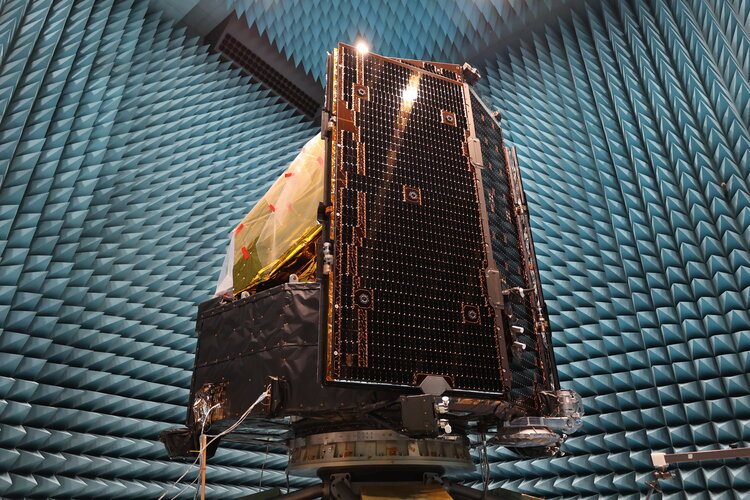
The European Space Agency's Plato spacecraft, a mission built to search for Earth-sized planets orbiting other stars, has cleared a series of electronics tests at the agency's ESTEC facility in the Netherlands. The checks were designed to confirm that the spacecraft's onboard systems will keep working once they leave the ground behind, and they mark what engineers describe as the last major pre-launch examination for the mission.
The central test took place in the Maxwell Test Chamber, a shielded, Faraday-cage enclosure lined with foam to mimic the conditions of space. Inside it, engineers examined electromagnetic compatibility, looking for any unwanted interference between the spacecraft's systems. None was found, which means the instruments and electronics can operate side by side without disrupting one another.
The tests matter because electronics do not always behave the same way in a vacuum as they do in a laboratory on Earth. Temperature swings, radiation and the absence of air can all change how circuits perform, so ground checks alone are not enough. Plato had already been put through vibration and acoustic trials in January, and it then went through the Large Space Simulator, which recreates the environment it will face in orbit.
With the electronics work complete, Plato is set to be carried into space by an Ariane 6 rocket, operated by Arianespace, with liftoff planned for March 2027. Once in orbit, the spacecraft will watch for the faint dimming of starlight that occurs when a planet passes in front of its star, a method that could help astronomers identify rocky worlds that might have conditions suitable for liquid water.
We rewrote this story on 4 November 2026 after an editorial review.
Credit. Based on reporting for ESA Top News. Is this your work? Write to us.
111