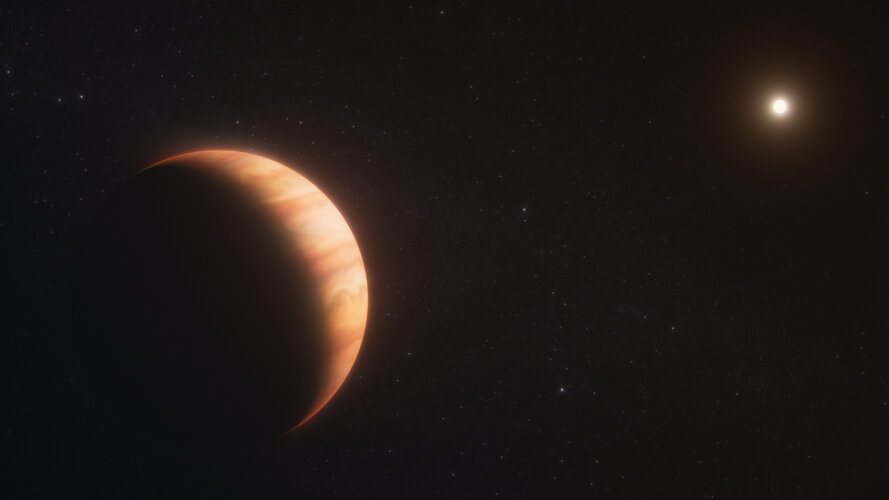
A Jupiter-sized planet orbiting the remnant of a Sun-like star has survived the star's death, and the James Webb Space Telescope has helped scientists begin to explain how. The planet, known as WD 1856 b, circles a white dwarf roughly 80 light-years from Earth, completing one orbit about every 34 hours.
The planet was first spotted in 2020 using NASA's TESS and Spitzer missions. Webb later watched it pass in front of its star, a transit that allowed researchers to estimate its mass at roughly four to eleven times that of Jupiter. The observations also showed the planet to be around 126 degrees Celsius, noticeably warmer than models predicted. Webb further detected an atmosphere containing clouds and, likely, methane.
The heat is the central puzzle. A planet this close to its star should have been destroyed when the star swelled into a red giant, yet WD 1856 b appears to have made it through. Researchers suggest it either migrated inward gravitationally or was swallowed by the expanding star and survived. The star belongs to a triple system, and its outer companions may have played a role. The planet's heating is estimated to have occurred between 3 and 5.5 billion years after the white dwarf formed.
The findings matter beyond this single system. Our own Sun will become a red giant in roughly five billion years, and WD 1856 b offers a preview of what could happen to planets in the outer Solar System. What it means for gas giants like Jupiter remains unclear. Webb has observed four more transits of the planet, and results from those atmospheric measurements are still pending.
We rewrote this story on 4 November 2026 after an editorial review.
Credit. Based on reporting for ESA Top News. Is this your work? Write to us.
178