The U.S. Air Force is considering an artificial-intelligence layer for Minuteman III, but the technically significant part of the proposal is data architecture rather than autonomous weapons control. The system would federate information from roughly 60 disconnected sources used to sustain the intercontinental ballistic missile fleet and make those records searchable through one interface.
The Air Force Nuclear Weapons Center’s performance work statement describes a heterogeneous data environment that includes conventional databases, local hard drives and shared networks. The underlying records span fleet-health metrics, engineering drawings, specifications, interface-control documents, supply systems, maintenance data and repositories of weapon-system risks.
That fragmentation creates a classic information-retrieval problem with unusually high stakes. Personnel must manually assemble data before they can assess risks associated with parts attrition and functional age-out. A component can become a problem because it fails, because the supply chain cannot replace it, or because its design and performance no longer satisfy the needs of a system that has been operating for decades.
The proposed tool would provide centralized query and assessment capabilities. It would also render complex technical material, including 2D and 3D drawings and functional-flow diagrams. The Air Force says the capability should make complex system architectures easier to navigate and improve training for new personnel.
This is not a plan to let a generative model rewrite engineering truth. The work statement explicitly says the new system will not serve as the Authoritative Source of Truth. Instead, it should pull data from the existing authoritative systems in near real time. That choice makes retrieval fidelity and provenance central to the design.
The proposed performance thresholds show how the Air Force intends to evaluate that fidelity. The system should successfully connect to and query at least 95 percent of the initial specified sources. Search results should be 99 percent accurate when compared with source data. The contractor must also demonstrate a measurable reduction in the time and manual effort needed to compile information.
Those numbers do not eliminate the possibility of error. A 99 percent search target still requires humans to understand what kinds of mistakes matter, how validation will detect them and when a user must return to the underlying record. The performance work statement therefore requires safeguards and continuous validation checks to protect accuracy and integrity.
Security adds another engineering constraint. The initial project would support Controlled Unclassified Information at Impact Level 5. The Air Force says later work could potentially involve Secret information at Impact Level 6. That would affect model hosting, data movement, software-development practices, access controls and personnel clearances.
The scope does not assign the AI system launch, targeting or command-and-control responsibilities. Its functions are defined around engineering, maintenance, supply and technical risk data. Separately, official Air Force material describes Minuteman III launch operations as a two-officer crew function in underground launch control centers, supported by a redundant command communications network.
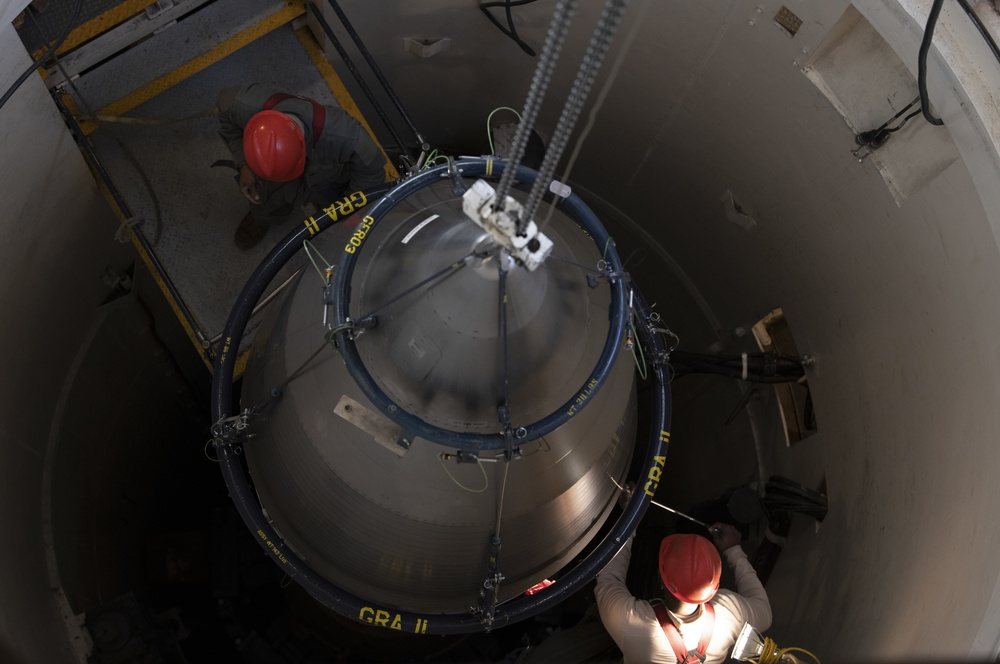
The system being sustained is itself an unusually long-running engineering platform. Minuteman III was first deployed in 1970. The present force consists of 400 missiles at F.E. Warren, Malmstrom and Minot Air Force bases. Much of the fundamental infrastructure has supported operations for more than 50 years, and life-extension work will continue while the LGM-35A Sentinel is gradually introduced.
That age helps explain why an AI retrieval layer could be useful. Modern engineering programmes are often built around integrated digital environments. Minuteman III accumulated its knowledge across successive generations of databases, paper-derived records and purpose-built systems. Replacing all of them at once would be a major undertaking; querying them coherently may be a more achievable intermediate step.
The Air Force has not yet committed to building the tool. The current notice is market research, not a request for proposals. If a procurement follows, it will offer a useful test of applied AI in a safety- and security-sensitive domain: not whether a model can generate an impressive answer, but whether it can retrieve the right engineering evidence, show where it came from and reliably reduce human search time without becoming the authority itself.
99