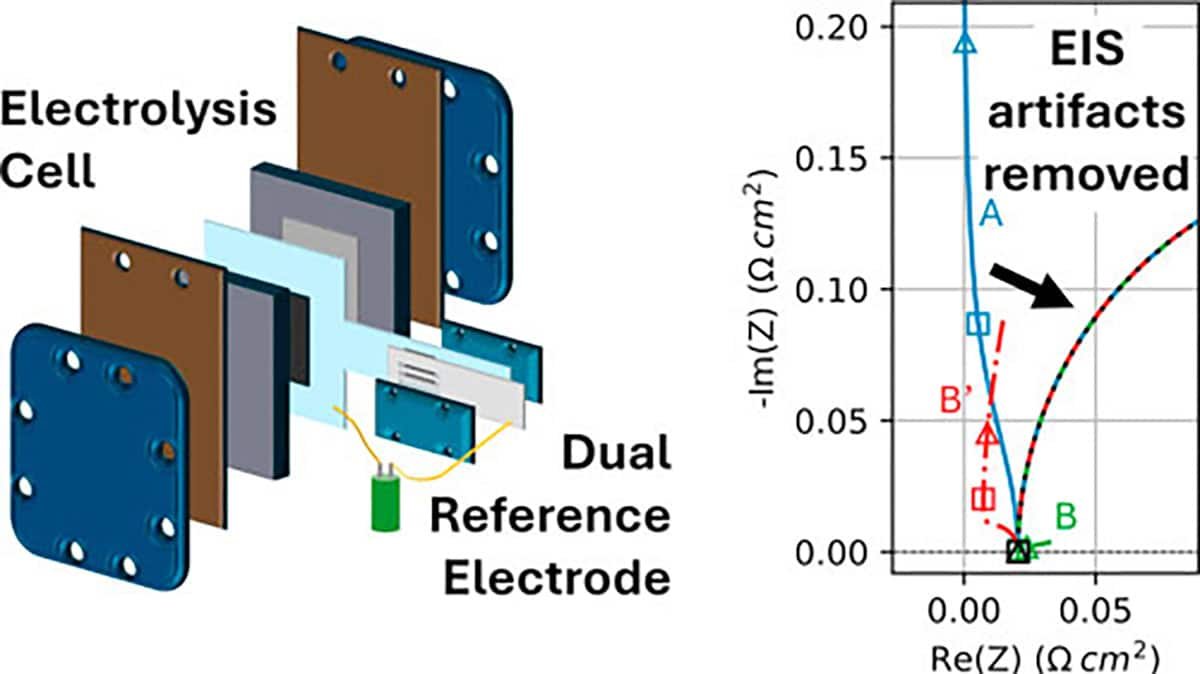
Combining reference electrodes with electrochemical impedance spectroscopy (EIS) can give researchers a clearer picture of what is happening at each electrode inside an electrolysis cell, allowing overpotentials and degradation processes to be assigned to specific components rather than treated as a single system-wide effect. The approach and its practical limits are the focus of a webinar presentation by Ken Hansen and Lena Beuhre, who developed the work during postdoctoral research at NLR, formerly known as NREL.
Reference electrodes are described as a valuable tool for understanding processes at individual electrodes. When paired with EIS, the technique can separate the contributions of different cell components and help identify where performance losses originate. That capability matters for electrolysis applications, where distinguishing anode from cathode behavior is central to improving durability and efficiency.
The method is not straightforward to deploy. Placing reference electrodes inside a cell with a solid electrolyte is difficult, and researchers must also contend with constraints including operation under pressurized gases and limited geometric clearance. These practical barriers complicate the design of reference electrode setups and can limit where measurements can be taken.
EIS measurements bring their own vulnerabilities. The technique is easily affected by perturbations and noise, which can produce results that cannot be interpreted. The problem is especially acute when reference electrode setups are used, according to the presentation, because the additional complexity of the measurement configuration can introduce artefacts into the data.
The webinar is structured to move from general principles to a concrete case. It opens with an introduction to the usefulness of reference electrodes across different electrolysis applications, followed by possible setups and exemplary use cases. The presenters then select an exemplary setup for a proton exchange membrane water electrolyzer (PEMWE) and present EIS results that show the perturbations and noise in practice. Finally, they propose a way to filter the signal and remove artefacts from the EIS results.
Both presenters brought relevant experience to the work. Beuhre came with a background in reference electrodes for PEMWE, while Hansen's experience was in reference electrodes for CO2 reduction reaction (CO2RR) and in EIS measurements. They published a short communication on the topic during their postdoctoral research at NLR.
The collaboration extended beyond the reference electrode work. Hansen and Beuhre also worked together in the H2NEW consortium, where their efforts covered anode catalyst development, degradation, and electrochemical characterization in segmented cells for PEMWE.
Their careers have since moved in different directions. Hansen now works on advanced diagnostic tools for CO and CO2 reduction reaction devices. Beuhre moved to Hannover, where she is a junior research group leader for «Electrochemical Energy and Material Conversion» and a habilitation candidate.
The presentation's focus on filtering artefacts reflects a broader challenge in electrochemical measurement: separating genuine cell behavior from noise introduced by the measurement itself. For electrolysis research, where small changes at an electrode can signal the onset of degradation, that distinction can determine whether EIS data yields actionable insight or remains uninterpretable.
12