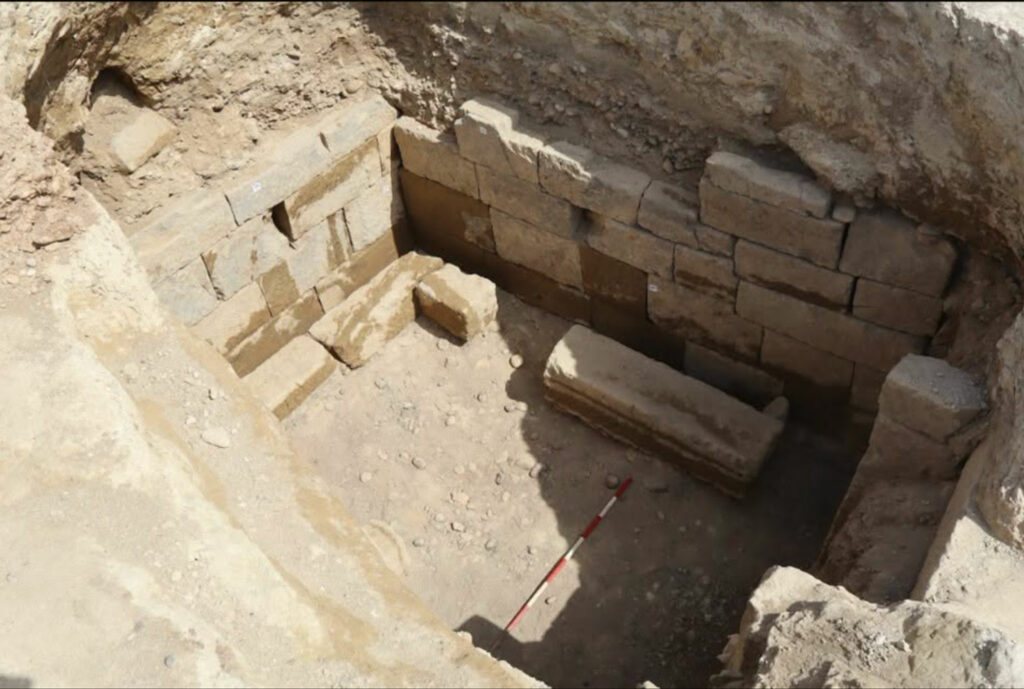
An international team of archaeologists has excavated a tomb dating to the late seventh century B.C. near Vulci, the Etruscan city in central Italy, and the finds offer a glimpse of the trade links that tied local elites to the wider Mediterranean world. The burial, cut into the necropolis associated with Vulci, consists of three rooms built from large blocks of volcanic stone.
The tomb had been badly disturbed. Looters in the twentieth century brought down much of the roof and walls, and the team had expected little to survive. Instead, the layers of collapsed rubble sealed off many of the objects inside, shielding them from further damage and allowing the excavators to recover a substantial assemblage.
Among the material are ceremonial dining vessels, weapons and fittings from a chariot, along with a bronze tripod, carved bone and ivory objects, jewelry, and a pair of women's footwear. The researchers also recovered local pottery alongside imported wares from Athens and Corinth, which point to active exchange with Greek workshops during the period.
One of the most intriguing pieces is a lamp carved from gypsum alabaster. Researchers have suggested it may have been brought from Naucratis, the Greek trading settlement in Egypt, though the Greek island of Rhodes has also been proposed as a possible origin. For now, the lamp's source remains unconfirmed, and the team has not settled the question.
The project was carried out jointly by Sapienza University of Rome, the French School at Rome, and the British Museum. Taken together, the grave goods show how a family at Vulci could assemble an array of luxury and ceremonial items drawn from across the Mediterranean, a picture that archaeologists say helps clarify the economic networks of the Etruscan world.
We rewrote this story on 4 November 2026 after an editorial review.
Credit. Based on reporting by Jessica Esther Saraceni for Archaeology Magazine. Is this your work? Write to us.
114