A silica nanoparticle suspended in a focused laser beam can detect collisions with individual atoms and molecules, according to a proof-of-principle study by researchers at Yale University and Lawrence Berkeley National Laboratory. The demonstration, reported in Physical Review Letters, shows that a macroscopic object held in an optical trap can resolve single-particle impacts, an ability that could lead to a new type of background pressure sensor and support future searches for dark matter and neutrinos.
The work grew out of the team's efforts to develop novel detectors for neutrinos and dark matter. Physicists have proposed that hypothetical particles such as dark matter could be detected when they occasionally scatter from nanometre-sized objects held in optical traps. Similarly, if a nano-object contains a radioactive substance, the kinetics of its decay products could be studied by observing the object's recoil. To make such measurements, researchers must first understand the background collisions between nanoparticles and residual gases inside a vacuum chamber.
«Usually when an atom collides with an atom it just disappears because the impact is so large that you won't be able to keep it in the trap,» said Yu-Han Tseng of Yale, a member of the research team. He added that this is the dominant mechanism limiting the lifetime of experiments that use atom tweezers, because gas inevitably collides with the trapped atoms.
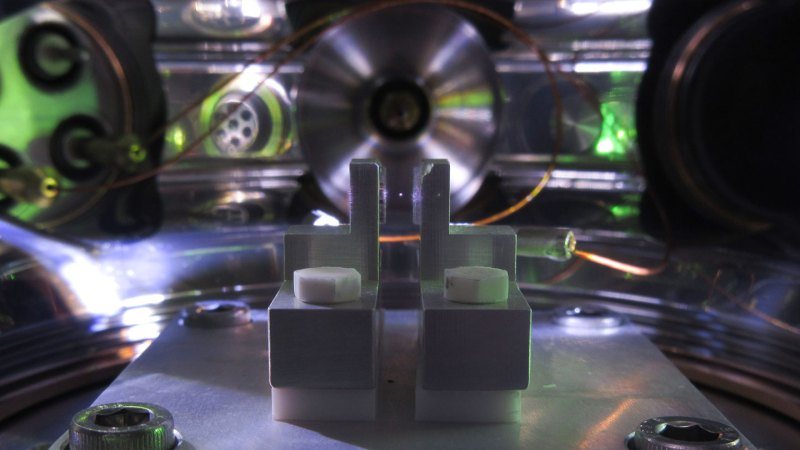
In the new experiment, Tseng and colleagues in David Moore's group at Yale, together with a physicist at Lawrence Berkeley National Laboratory, trapped a silica nanosphere with a radius of 50 nanometres using a focused laser beam inside a vacuum chamber. At the focus of the trap, the particle naturally underwent simple harmonic motion. The researchers then injected small amounts of different gases into the chamber. The atoms or molecules collided randomly with the sphere, producing relatively small disturbances to the much larger object.
Without the trap, those collisions would have set the sphere moving randomly around the chamber in the familiar phenomenon of Brownian motion, making it impossible to track. Because the particle was trapped, however, the collisions perturbed its harmonic motion without dislodging it. By measuring those perturbations, the team could detect the collision impulses and infer the gas pressure. «I think what's quite unique is that, even with a macroscopic object, we can do a very precise measurement,» Tseng said.
The researchers tested three gases — krypton, xenon and sulphur hexafluoride. In each case they began at the highest vacuum they could achieve and gradually injected gas, raising the pressure to about 1.5 nanobar, far below atmospheric pressure of roughly 1 bar. They monitored the nanosphere's motion along the direction of the trapping laser using the phase of backscattered laser light. For each gas they collected data at seven different pressures, detecting the rate and size of individual impulses. The rate increased with pressure and was broadly consistent with the kinetic theory of gases.
The result shows that individual collisions can be resolved by monitoring a macroscopic system, and the researchers believe the approach could be applied in a variety of experiments and potentially serve as a future pressure standard. «We'd be delighted if someone were to take this further and turn it into a workable pressure sensor that you could integrate into another system,» said Clarke Hardy, Tseng's colleague at Yale.
The team's own interests lie elsewhere, however. «The main goal of our research is to dope the nanospheres with radioactive isotopes that will undergo decays and allow us to reconstruct the momentum of emitted neutrinos,» Hardy said.
Independent work has also detected single-atom impulses on a trapped nanosphere. Maxime Perdriat of ETH Zurich, lead author of a paper published earlier this year in Physical Review A, said the Yale result is «an amazing» achievement. «Contrary to what we have done he's able to measure the distinction between when you can resolve single atoms and when you have too many atoms to resolve, and this has very important implications for dark matter, for sterile neutrinos,» Perdriat said. He believes both efforts point toward the same long-term applications in fundamental and particle physics.
20