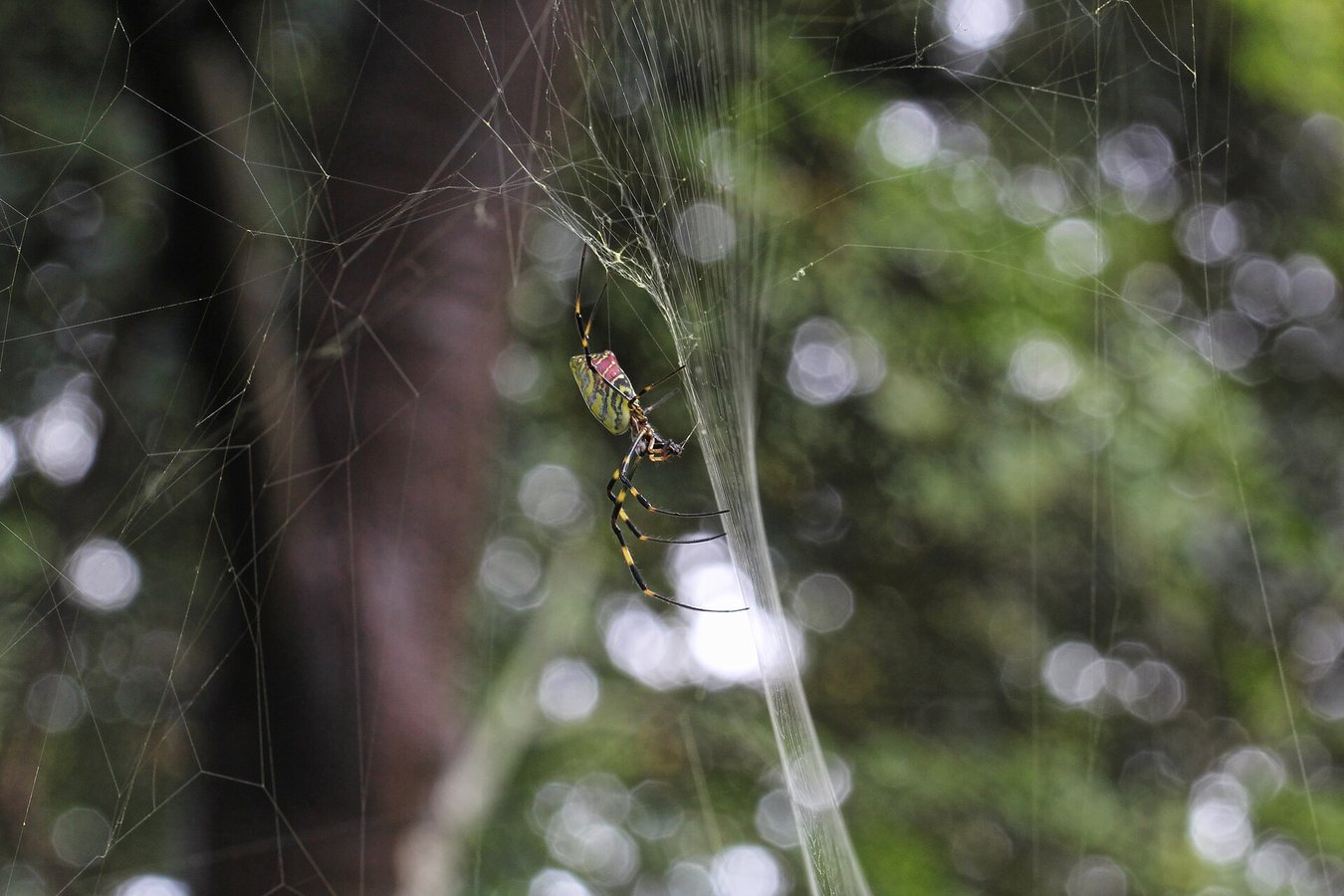
Two spiders are redefining what biologists understand about the outer limits of animal engineering. The Darwin's bark spider can construct orb webs spanning up to 25 metres, using silk that ranks among the toughest natural fibres in the world, while Portia, a genus of jumping spiders, is capable of leaping up to 50 times its own body length.
The figures place both animals in rare territory. The Darwin's bark spider's web is not merely large by spider standards; it is one of the most extensive structures built by any single organism relative to its own body size. The silk that holds it together has drawn attention from materials researchers because its toughness — a combination of strength and extensibility — exceeds that of most natural fibres, including some produced by silkworms.
Portia's leaping ability is equally striking. A jump of 50 body lengths is comparable to a human clearing a football field in a single bound. The genus is known among arachnologists for its unusually flexible hunting behaviour, and the leap is powered by a hydraulic system rather than by muscle alone, allowing the spider to generate rapid force without the bulky limbs that would otherwise be required.
Both examples illustrate how extreme adaptations can emerge from relatively simple body plans. The Darwin's bark spider does not need large jaws or potent venom to secure prey; its web intercepts insects across a wide area, and the silk's toughness allows the structure to absorb the impact of flying insects without breaking. Portia, by contrast, relies on mobility and precision. Its leap lets it cross gaps between branches and ambush prey that would otherwise be out of reach.
The two species also occupy different ecological roles. The Darwin's bark spider is associated with riverine habitats, where it spins webs across waterways — a behaviour that requires silk capable of withstanding wind, moisture, and the occasional impact of debris. Portia is a jumping spider found in tropical and subtropical regions, where it hunts other spiders, including species that build webs. Its ability to leap is part of a broader toolkit that includes vibration-based mimicry and strategic route planning.
For researchers, the spiders are more than curiosities. The Darwin's bark spider's silk is studied as a model for high-performance fibres that could be produced synthetically, while Portia's jump mechanics inform work in robotics and biomechanics. Both animals show that nature's solutions to movement, capture, and survival can exceed what human engineers have achieved in comparable materials and mechanisms.
The details come from natural history documentation that highlights the scale and precision of these adaptations. The Darwin's bark spider's 25-metre web and Portia's 50-body-length leap are not isolated records but part of a wider pattern in which spiders have evolved some of the most specialised structures and behaviours in the animal kingdom.
That pattern continues to attract scientific interest because it sits at the intersection of ecology, materials science, and evolutionary biology. Each new measurement adds to a growing catalogue of extremes that help explain how small organisms can exert an outsized influence on their environments — and why spiders remain a focus for researchers studying natural design.
10