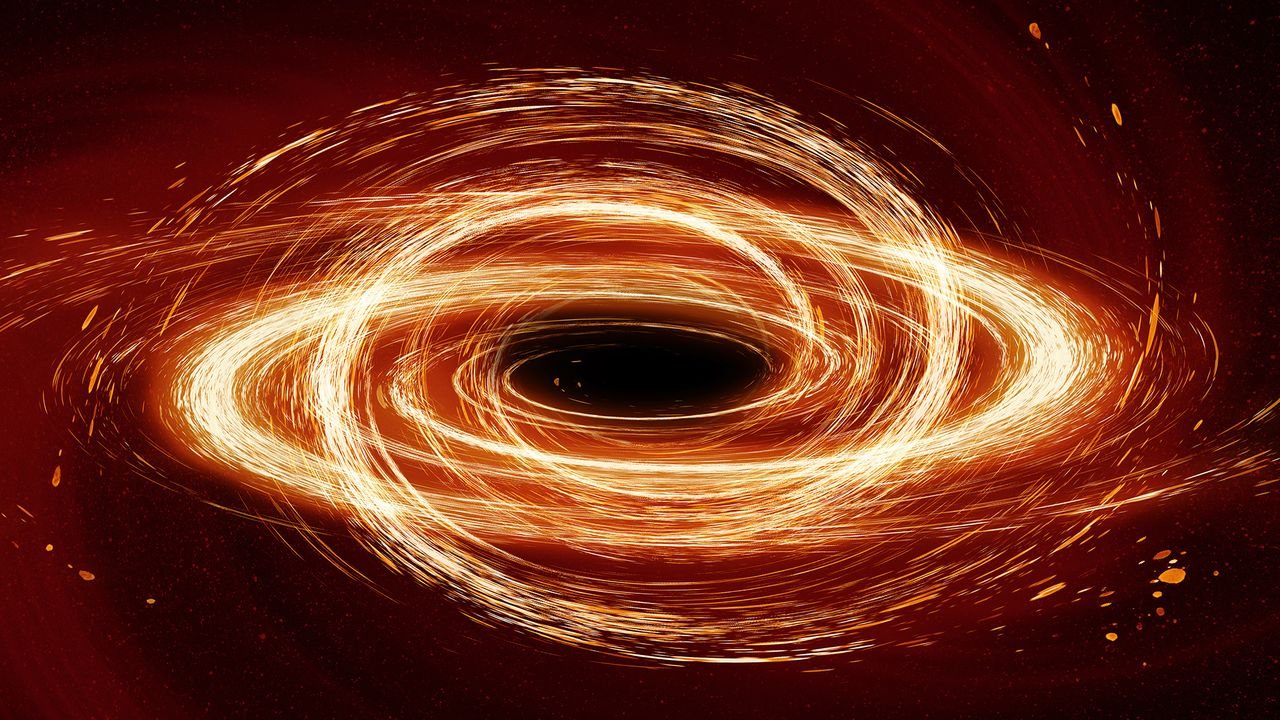
In a groundbreaking experiment, physicists have created a black hole out of light, using it to test one of Stephen Hawking's most famous and elusive theories: Hawking radiation. The achievement, reported by researchers, marks a significant step in understanding how black holes might emit radiation and eventually evaporate, a concept that has remained largely theoretical since Hawking first proposed it in 1974.
The experiment involved constructing a laboratory analog of a black hole using a specially designed optical system. By manipulating light in a way that mimics the intense gravitational field of a black hole, the team was able to observe phenomena analogous to Hawking radiation. This radiation, predicted by Hawking, suggests that black holes are not entirely black but instead emit particles due to quantum effects near their event horizons, leading to gradual mass loss and eventual evaporation.
Hawking's theory has been difficult to test directly because real black holes are too far away and their radiation is extremely faint. The analog created by the physicists, described as «smaller than the tiniest scale in nature,» allowed them to simulate the conditions near a black hole's event horizon in a controlled laboratory setting. This approach provides a unique window into quantum gravity, a field that seeks to unify general relativity and quantum mechanics.
The experiment builds on previous work with black hole analogs, but this new method using light offers greater precision and control. The researchers used a system of lasers and optical fibers to create a «white hole» analog, which is the time-reversed version of a black hole. In this setup, light waves were manipulated to create a horizon that traps photons, similar to how a black hole's gravity traps matter and light. By studying the behavior of light at this horizon, the team detected signatures consistent with Hawking radiation.
This finding has implications beyond black hole physics. It could help scientists understand the fundamental nature of spacetime and the behavior of matter under extreme conditions. The results also provide a testbed for theories of quantum gravity, such as string theory and loop quantum gravity, which predict modifications to Hawking's original calculations.
The research team emphasized that while their analog does not replicate all aspects of a real black hole, it captures the essential quantum effects that drive Hawking radiation. The experiment confirms that Hawking's predictions hold even in systems that are not gravitational in origin, supporting the universality of his theory.
Stephen Hawking's work on black hole radiation revolutionized our understanding of these cosmic objects. Before his theory, black holes were thought to be eternal and unchanging. Hawking showed that they could emit radiation and eventually disappear, raising profound questions about information loss and the nature of quantum mechanics. The new experiment brings scientists closer to resolving these puzzles by providing empirical data where none existed before.
The study also highlights the growing field of analog gravity, where laboratory systems are used to simulate gravitational phenomena. This approach has been used to test other aspects of general relativity, such as the behavior of light near a black hole and the formation of horizons. The success of this experiment suggests that analog systems will continue to play a crucial role in exploring the frontiers of physics.
Looking ahead, the researchers plan to refine their setup to study more complex aspects of Hawking radiation, such as its spectrum and the role of quantum entanglement. They also hope to investigate whether the radiation carries information about the black hole's interior, a key question in the information paradox.
This experiment represents a convergence of theoretical physics and experimental ingenuity. By creating a black hole from light, scientists have taken a significant step toward testing one of the most profound predictions in modern physics. The results not only validate Hawking's insights but also open new avenues for exploring the quantum nature of gravity.
138