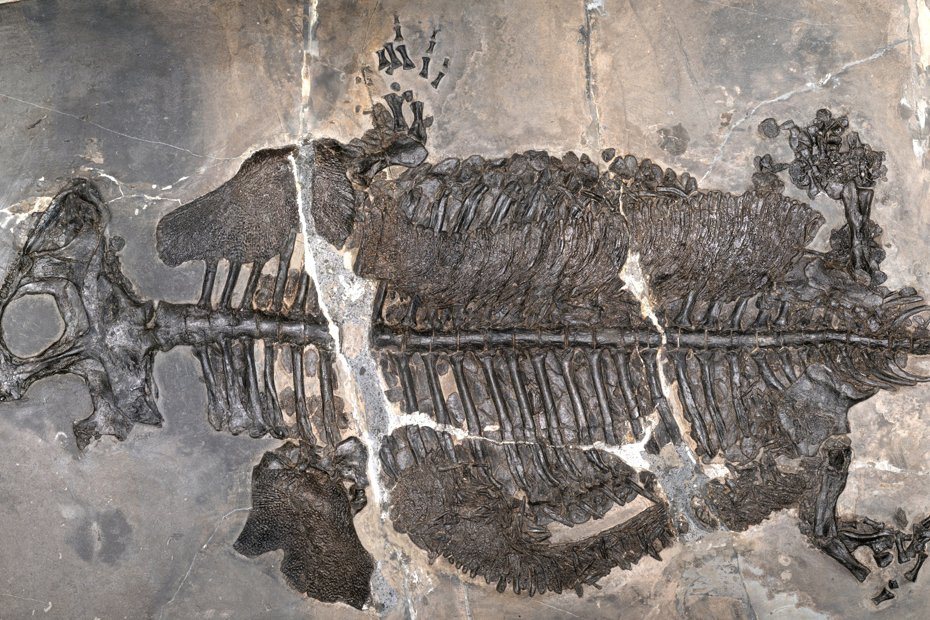
A bottom-dwelling amphibian that lived in the Late Triassic seas has been identified from a fossil found in southwestern China, the first evidence that amphibians ever adapted to life in the ocean. The animal, named Gerrothorax maritimus, lived about 237 million years ago, when the region was covered by water and a multitude of marine reptiles swam nearby.
The fossil is near-perfect and exceptionally well preserved. It measures 74 centimetres in length and was discovered by farmers in what is now a national geopark in Guanling county. Researchers believe the animal's strong body armour may have been the key to surviving in salt water, which is normally fatal to amphibians because their skin is permeable.
"It was a flat animal that lived on the sea floor," said Ryosuke Motani of the University of California, Davis, who was part of the team that analysed the fossil. Its wide mouth and strong hyoid bone in the neck suggest it used suction feeding, a strategy seen in some modern bottom-dwelling predators of similar size, such as wobbegong sharks. The creature was probably an ambush feeder.
From the start, the researchers knew the animal was neither a fish nor a reptile. Its anatomy, including four legs and gills, marked it as an early amphibian. There is no evidence that it underwent metamorphosis, as many modern amphibians do when tadpoles become frogs, Motani said.
To confirm that the animal was truly marine and had not simply been washed into the sea after death, the team analysed strontium isotope ratios in the fossil bones. The remains carried a clear seawater signature, indicating that G. maritimus grew to adulthood in the ocean. Palaeogeographic reconstructions also suggest the site was at least 30 kilometres from land at the time. The fossil was found alongside a large marine reptile, an ichthyosaur called Guizhouichthyosaurus, which reached lengths of about 7 metres.
The closest known relative of G. maritimus lived in fresh water. Gerrothorax pulcherrimus, a freshwater species, was first described nearly a century ago. This led the researchers to suggest that the marine lifestyle was an accident of evolution. "There was a freshwater amphibian that happened to have the equipment needed to colonise the sea, the body armour," Motani said. The armour protected the genus from predators in fresh water, and because it formed an impermeable barrier, it may also have helped the animals cope with seawater.
John Long of Flinders University in Australia, who was not involved in the study, said the find is a first, since none of the roughly 8,000 living amphibian species is fully adapted to life in the sea. "If not for the marine invasion by many groups of reptiles at the same time, they might have even had a chance at diversifying in this niche, but that clearly didn't occur," he said. "It shows us that amphibians closely related to modern forms were able to adapt to different environments, like seawater, in ways we never thought possible."
The findings were published in the journal Nature Ecology & Evolution. Coverage in Nature described the armoured creature as an evolutionary game-changer that probably tolerated the salty seas of the Late Triassic thanks to its armour cladding.
12