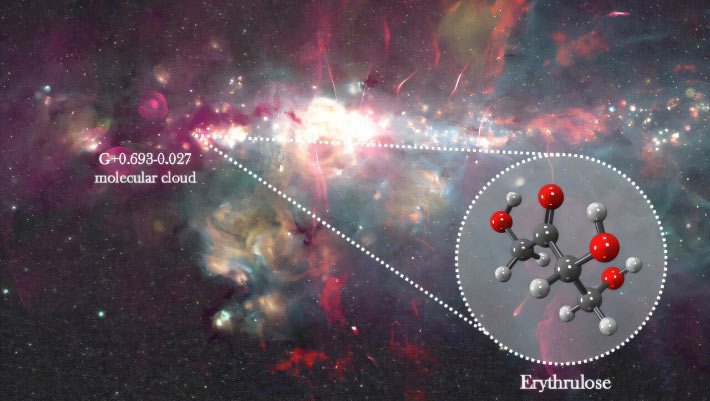
Astronomers have detected a natural sugar commonly found in raspberries and sunless tanning lotions within a vast cloud of dust and gas near the center of the Milky Way, marking the first time such a molecule has been identified in interstellar space. The discovery, made using the Yebes 40-meter and IRAM 30-meter radio telescopes, provides new evidence that complex organic compounds essential for life can form in the frigid, low-density environment between stars.
The molecule, known as erythrulose, is a four-carbon sugar that belongs to the class of monosaccharides. On Earth, it occurs naturally in raspberries and is also used as an ingredient in cosmetic products designed to simulate a tan without exposure to ultraviolet radiation. The detection was made in the molecular cloud G+0.693-0.027, a region located near the galactic center that is rich in a variety of complex molecules.
Researchers identified the sugar by analyzing the radio waves emitted by the cloud. Each molecule produces a unique spectral fingerprint, and the team matched the observed signals to those of erythrulose. The presence of such a relatively large and complex organic molecule in interstellar space suggests that the chemical building blocks of life may be more widespread than previously thought.
The discovery does not imply the existence of extraterrestrial life, but it does indicate that the raw materials necessary for life can arise in the harsh conditions of space. Erythrulose is a sugar alcohol that can participate in chemical reactions leading to the formation of more complex biomolecules, including those that make up the backbone of RNA and DNA. Its detection adds to a growing list of organic molecules found in interstellar clouds, including simple sugars like glycolaldehyde, which was first detected in 2000.
G+0.693-0.027 is a particularly interesting target for astrochemists because it contains a high density of gas and dust, as well as a wide variety of molecules. The cloud is located about 26,000 light-years from Earth, near the supermassive black hole at the center of our galaxy. Its relatively warm temperature, compared to other interstellar clouds, may facilitate the formation of complex molecules that would otherwise be destroyed by ultraviolet radiation or cosmic rays.
The detection of erythrulose was made possible by the sensitivity of the Yebes and IRAM telescopes, which operate at millimeter and centimeter wavelengths. These instruments are capable of detecting faint signals from molecules that are present in very low concentrations. In the case of erythrulose, the molecule was found at a level of a few parts per trillion relative to molecular hydrogen, the most abundant molecule in the cloud.
Astronomers have long sought to understand how organic molecules form in space and whether they can be delivered to planetary surfaces via comets, meteorites, or interstellar dust. The discovery of erythrulose in a molecular cloud suggests that sugars can form in the interstellar medium itself, rather than requiring the more protected environment of a protoplanetary disk. This has implications for the origin of life on Earth and the potential for life elsewhere in the universe.
The finding also highlights the chemical complexity of the interstellar medium. Over the past few decades, astronomers have identified more than 200 different molecules in space, ranging from simple diatomic species like carbon monoxide to complex organic compounds like amino acids and sugars. Each new detection helps refine models of interstellar chemistry and the conditions under which life's precursors can emerge.
Erythrulose is not the only sugar detected in space. In 2000, astronomers found glycolaldehyde, the simplest sugar, in a star-forming region. More recently, other sugars and sugar-like molecules have been identified in various interstellar environments. However, erythrulose is the first four-carbon sugar to be detected, and its presence indicates that the chemical pathways leading to sugars of increasing complexity are active in space.
The research team, which includes scientists from Spain, Germany, and the United States, plans to continue searching for other complex organic molecules in G+0.693-0.027 and similar clouds. The goal is to build a comprehensive inventory of the molecular content of the interstellar medium and to understand how these molecules are distributed across the galaxy. Such studies may eventually shed light on the chemical evolution that preceded the emergence of life on Earth.
The discovery was published in a recent issue of the journal Astronomy & Astrophysics. The work was supported by the Spanish Ministry of Science and Innovation, the German Research Foundation, and other funding agencies. The Yebes 40-meter telescope is operated by the National Geographic Institute of Spain, while the IRAM 30-meter telescope is operated by the Institute for Radio Astronomy in the Millimeter Range, a collaboration between France, Germany, and Spain.
106