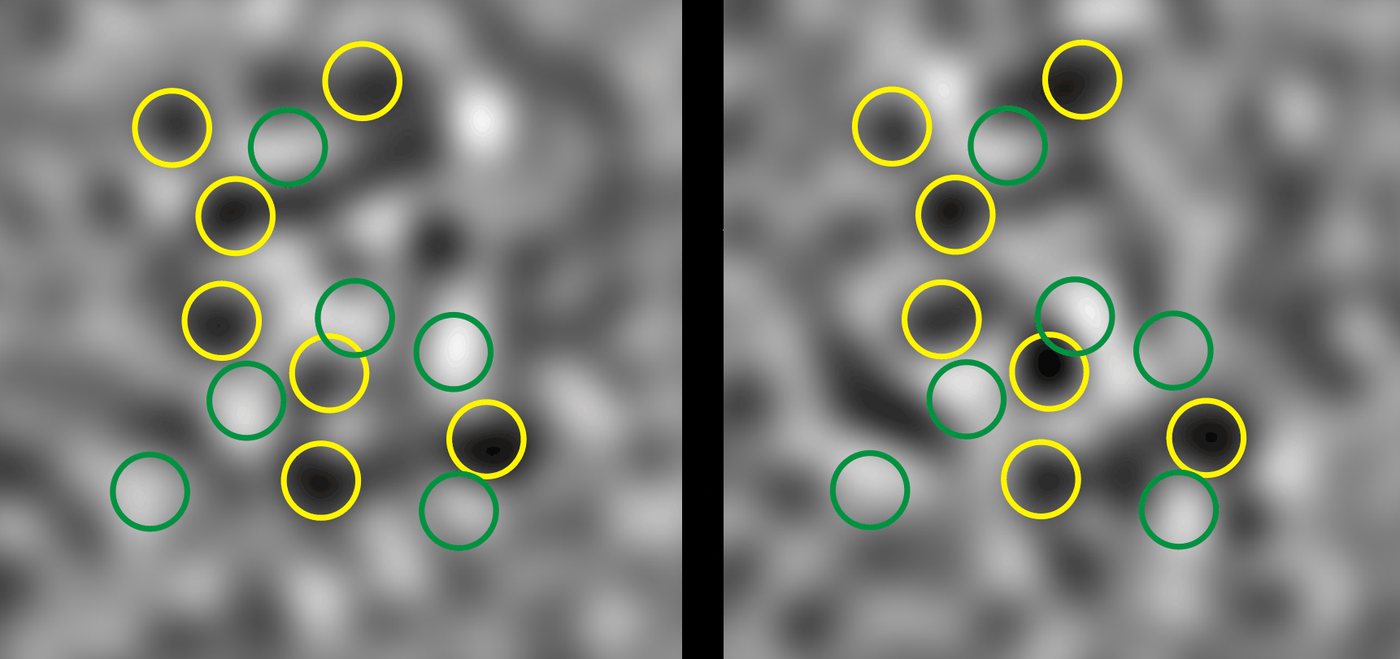
Physicists at the California Institute of Technology have experimentally observed energy patterns that theorists first predicted roughly 40 years ago, marking the end of a long search for a phenomenon that had remained purely mathematical until now.
The team arranged laser-trapped atoms into a quantum simulator, a controllable artificial system that mimics the behavior of more complex quantum materials. By tuning the interactions between the atoms, the researchers recreated two distinct quantum tipping points — critical thresholds where a system abruptly shifts from one collective state to another — and watched the atoms settle into the exact energy ratios that theory had long anticipated.
The result confirms a set of predictions that had resisted direct measurement for four decades. Quantum systems are notoriously fragile, and the energy ladders involved are difficult to isolate from environmental noise. Trapped-atom simulators offer a way around that problem: instead of measuring a natural material directly, researchers build a clean, adjustable quantum system and drive it through the same transitions.
According to the research team, the technique is notable not only for what it confirmed but for what it can now be used to explore. Because the simulator can be tuned to regimes where scientists do not already know the answer, it offers a rare experimental window into mysterious quantum systems that have so far defied both analytical solution and conventional measurement.
The work sits at the intersection of quantum simulation and condensed-matter physics, a field that has increasingly turned to cold-atom platforms to study collective quantum behavior. In these experiments, lasers hold individual atoms in place, and the strength of their interactions can be adjusted in real time. That flexibility allows researchers to test theoretical predictions under conditions that would be impossible to achieve in a solid-state material.
The two quantum tipping points observed in the experiment are of particular interest because they represent different classes of collective behavior. In each case, the atoms fell into the energy ratios predicted by theory, providing a direct experimental check on models that had previously been supported only by calculation.
Beyond confirming old predictions, the approach could help physicists attack problems where no reliable theoretical answer exists. Quantum systems with strong interactions often become computationally intractable, and the simulator offers an alternative route: rather than solving the equations, researchers can build the system and observe what it does.
The findings add to a growing body of work in which quantum simulators are used as instruments of discovery rather than demonstration. As the platforms become more precise and larger in scale, researchers expect them to address questions in quantum magnetism, superconductivity, and other areas where collective behavior emerges from simple underlying rules.
For now, the Caltech result stands as a long-delayed confirmation of a theoretical prediction and as a proof of principle for a method that may soon be applied to systems whose behavior remains unknown.
9