Earth's geographic poles — the points where the planet's imaginary rotation axis meets the surface — have wandered more dramatically in the geological past than scientists previously believed, according to a new study published in Science. The research, led by Mathew Domeier at the University of Oslo in Norway, used ancient sea-level records to identify four distinct periods when the poles shifted at rates exceeding 0.6 degrees per million years, faster than most tectonic plates move.
Earth has two main pairs of poles: magnetic poles, generated by the planet's magnetic field, and geographic poles, defined by its rotation. While magnetic poles are constantly in motion and can even flip entirely, geographic poles are generally far more stable. However, they can still shift through a phenomenon known as true polar wander, driven by the slow redistribution of mass in Earth's mantle through plate tectonics and mantle convection.
When the planet's spin is thrown out of balance, the solid outer layers of the globe — the crust and mantle — slip over the core to help Earth find a new stable spin equilibrium. «The crust and the mantle effectively slip over the core during a true polar-wander event,» Domeier explained.
Until now, most evidence for these events came from ancient magnetic data locked inside rocks formed millions of years ago, which produced confusing and conflicting results about their frequency and scale. Domeier's team took a different approach by analyzing the geological record of sea-level change for distinctive signals expected during true polar wander.
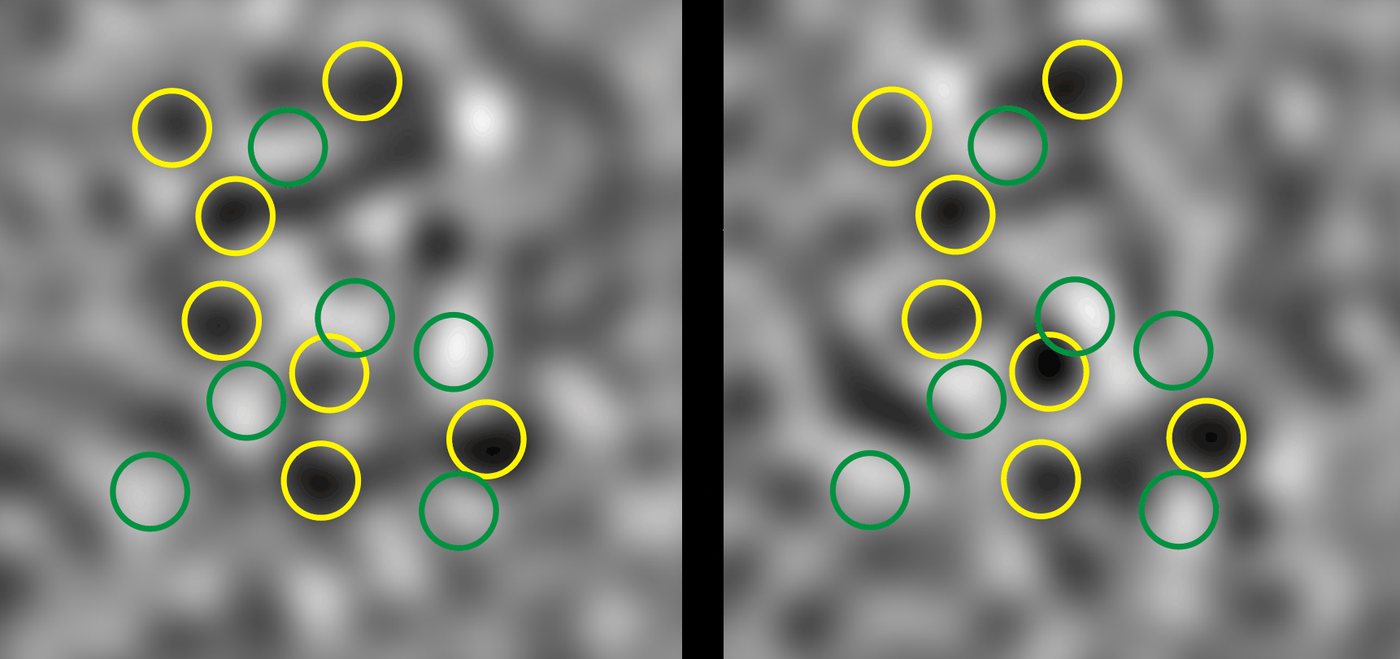
Because ocean water adjusts more quickly to changes in centrifugal potential than the rocky sea floor, true polar-wander events leave a telltale pattern. Sea level rises in one half of the northern hemisphere and falls in the other, with a reversed pattern in the southern hemisphere. This creates a beach ball-like global pattern that, according to Domeier, «is a very strange pattern that is not caused by other Earth processes.»
From their analysis, the researchers discovered that the geographic poles moved dramatically over periods of around 10 million years, four times in the geological past: at 20, 90, 140 and 190 million years ago. «By the timescales of human experience, the movement may not seem fast,» Domeier said. «We cannot estimate the exact speed, but we can recognise events where the rate of polar motion exceeded about 0.6 degrees per million years.»
This rate is faster than most tectonic plates move and fast enough to potentially affect climate systems. On human timescales, the events would be unnoticeable, but over longer geological periods, a wandering pole changes the distribution of land and sea.
True polar wander continues today, though likely not at the rate seen during the four fast bursts in the geological past. «[It] is measurable by satellites at a rate of about 10 cm per year, but most people are unaware of this. So these events are totally unrecognisable according to our everyday experience,» Domeier noted.
Sabin Zahirovic at the University of Sydney, who was not involved in the study, said very few people are aware that Earth's 2800-km-thick outer shell of crust and mantle moves with respect to the planet's spin axis. The study demonstrates that clues in coastline change provide an independent fingerprint of true polar wander. «This is a very exciting development that helps us link very deep Earth processes to changes in long-term climate and sea level on the planet,» Zahirovic said.
The findings offer a new way to understand the frequency and scale of true polar-wander events, which have been difficult to pin down using magnetic data alone. By providing an independent line of evidence from sea-level records, the research helps clarify how Earth's deep interior processes connect to surface changes over millions of years.
11