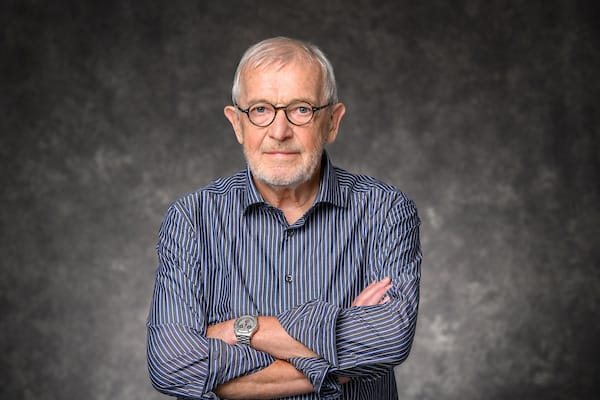
Francis Halzen, the principal investigator of the IceCube Neutrino Observatory, has been awarded the 2026 Nobel Prize in Physics. The Royal Swedish Academy of Sciences announced the prize in Stockholm, citing his decisive contributions to IceCube and to the discovery of high-energy neutrinos of astrophysical origin.
Halzen proposed and demonstrated that ice could serve as a detection medium for high-energy astrophysical neutrinos. He was a driving force behind forming the international collaboration and establishing the observatory. Halzen is a Vilas Research Professor and Gregory Breit Professor at the University of Wisconsin–Madison.
Halzen said the recognition was a surprise and a relief. "It's a great relief for me to finally deliver the recognition that this great collaboration deserves," he said. "This was a great surprise and is a celebration of a very unusual project. The success of this project involved the diligence and hard work of the many wonderful collaborators I've had the pleasure to work with."
The IceCube Neutrino Observatory, funded primarily by the U.S. National Science Foundation through an award to the University of Wisconsin–Madison, instruments a cubic kilometer of pristine glacial ice at the South Pole. The detector discovered the high-energy neutrino flux from astrophysical sources, which is the basis for the new field of neutrino astronomy. The international collaboration includes about 450 scientists from 58 institutions in 14 countries. Its work covers the characteristics and origin of high-energy astrophysical neutrinos, cosmic rays, neutrino properties and searches for physics beyond the Standard Model.
When IceCube first detected astrophysical neutrinos in 2013, their sources were unknown. Since then, the collaboration has reported evidence of neutrino emission from two galaxies, TXS 0506+056 and NGC 1068 (Messier 77). In 2023, IceCube also announced the observation of neutrinos from the Milky Way.
The IceCube Upgrade was installed in 2025 and 2026 to lower the energy threshold and improve calibration of the ice, which should improve reconstruction of neutrino directions. The first science data from the upgrade are expected later this year. Erin O'Sullivan, spokesperson of the IceCube collaboration, said: "We are very proud of our research with IceCube and congratulate Francis on his well-deserved Nobel Prize. Francis continues to inspire us with the potential of the future of the field, where we can move from the first discoveries to robust detections."
Looking ahead, the proposed IceCube-Gen2 would include an optical array with eight times the volume of the current detector and the ability to measure even higher-energy astrophysical neutrinos using radio detection techniques.
14