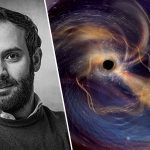
Scientists are using the gravitational «ringdown» of black holes immediately after they collide to test Albert Einstein's theory of general relativity under the most extreme conditions in the universe. By analyzing the characteristic vibrations emitted by a newly formed black hole, researchers can determine its mass and spin, and verify whether the spacetime around it behaves exactly as predicted. This technique, known as black hole spectroscopy, is the subject of a comprehensive international review published recently in the journal Classical and Quantum Gravity.
The review, which spans over 200 pages, was led by the University of Birmingham, Johns Hopkins University, and the Niels Bohr Institute. It involves dozens of authors, including Gregorio Carullo, an assistant professor at the University of Birmingham's Institute for Gravitational Wave Astronomy. Carullo, originally from Vibo Valentia, Italy, earned his Ph.D. in physics from the University of Pisa and held research positions in the United States, the Netherlands, and Germany before joining Birmingham in 2024.
«During the ringdown phase, the remnant black hole vibrates like a bell that has been struck,» Carullo said in an interview. These vibrations generate gravitational waves at discrete, damped frequencies called quasi-normal modes. The damping occurs because part of the signal is lost inside the black hole's event horizon and part radiates outward into space. The process is analogous to a struck bell whose sound fades as energy is dissipated.
To understand the ringdown, one must first consider the preceding merger. As two black holes spiral toward each other — the inspiral phase — they emit gravitational waves that rise in frequency, creating a «chirp» signal. When the black holes merge, they form a single, more massive black hole known as the remnant. Initially, this remnant is highly deformed and far from equilibrium. «To return to equilibrium, which in this case is the stationary rotating Kerr solution, it begins to resonate at the intrinsic frequencies of spacetime,» Carullo explained. Since general relativity describes black holes as pure vacuum — devoid of matter but possessing mass — this resonance arises from the geometry of spacetime itself.
For stellar-mass black holes observed by the LIGO and Virgo detectors, the ringdown lasts only about 10 milliseconds. For the supermassive black holes that the future space-based detector LISA will observe, the ringdown can persist for tens of minutes. The specific frequencies depend on the black hole's mass and rotation rate, allowing astronomers to measure these properties with increasing precision.
Unlike the inspiral phase, which reveals details about the binary orbit, the ringdown gives direct access to the intrinsic properties of spacetime with little contamination from orbital dynamics. «Ergo we can answer more fundamental questions,» Carullo said. «Are the objects we are observing really black holes? Are they described by the Kerr solution? Does general relativity accurately describe these signals, or do we need a better theory?» The review also considers speculative ideas, such as whether black holes are purely classical objects or whether quantum corrections might produce observable effects.
Beyond fundamental physics, black hole spectroscopy holds promise for astrophysics. By precisely measuring the masses and spins of remnant black holes, researchers can constrain models of stellar evolution and binary star formation. The ringdown signal thus serves as a «treasure trove» for answering both core questions about gravity and practical questions about how stars live and die.
Future gravitational wave observatories, such as the Einstein Telescope on Earth and the LISA mission in space, will dramatically increase the number of ringdown detections and the sensitivity of measurements. The review outlines a roadmap for turning black hole spectroscopy from a theoretical concept into a robust experimental science. Carullo described the Birmingham institute as a «young and dynamic group» that has created an optimal environment for his research. He also noted that the UK's research funding system is well organized and transparent, benefiting both his career and that of his partner, a baroque violinist.