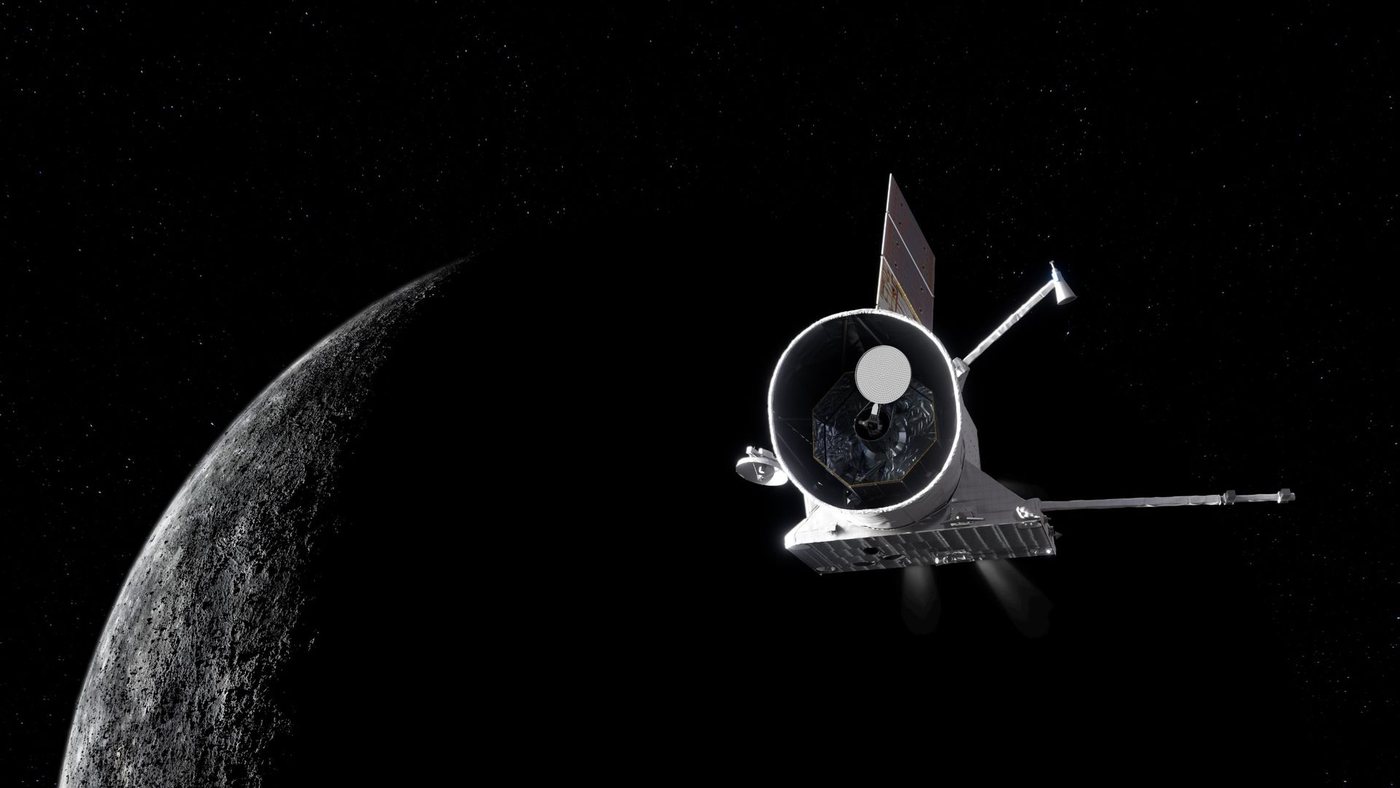
A joint European-Japanese mission has reached orbit around Mercury, the smallest planet in the solar system and the one closest to the Sun. The arrival of BepiColombo on November 21 makes it only the second spacecraft ever to circle the planet, following NASA's MESSENGER, which operated there between 2011 and 2015.
Entering orbit required a 37-minute engine burn, and confirmation of the maneuver took several hours to arrive. The burn was cut short by a software issue. Mission controllers say the spacecraft reported that it was in a safe condition, but the team is still investigating the problem and assessing what the shortened burn means for the mission. A further update is promised for Monday.
BepiColombo is a joint effort of the European Space Agency and the Japan Aerospace Exploration Agency. It launched in October 2018 on an Ariane 5 rocket from French Guiana. The spacecraft travels as two orbiters, ESA's Mercury Planetary Orbiter and JAXA's Mio, carried together by a Mercury Transfer Module that supplies power and propulsion for the cruise. Its route to Mercury was long and roundabout, using one Earth flyby, two at Venus and six at Mercury itself, which slowed its approach. A problem with a solar panel later reduced thruster power, adding roughly a year to the journey. Mercury's closeness to the Sun also makes it difficult for a spacecraft to be captured into orbit.
The next steps are already scheduled. The two orbiters are expected to separate around December 9, after which Mio is due to settle into a polar orbit. The Mercury Planetary Orbiter is set to reach its own polar orbit around March 10, 2027, and science operations are planned to begin around April 6, 2027.
Credit. Based on reporting by Mike Wall for Space. Is this your work? Write to us.
23