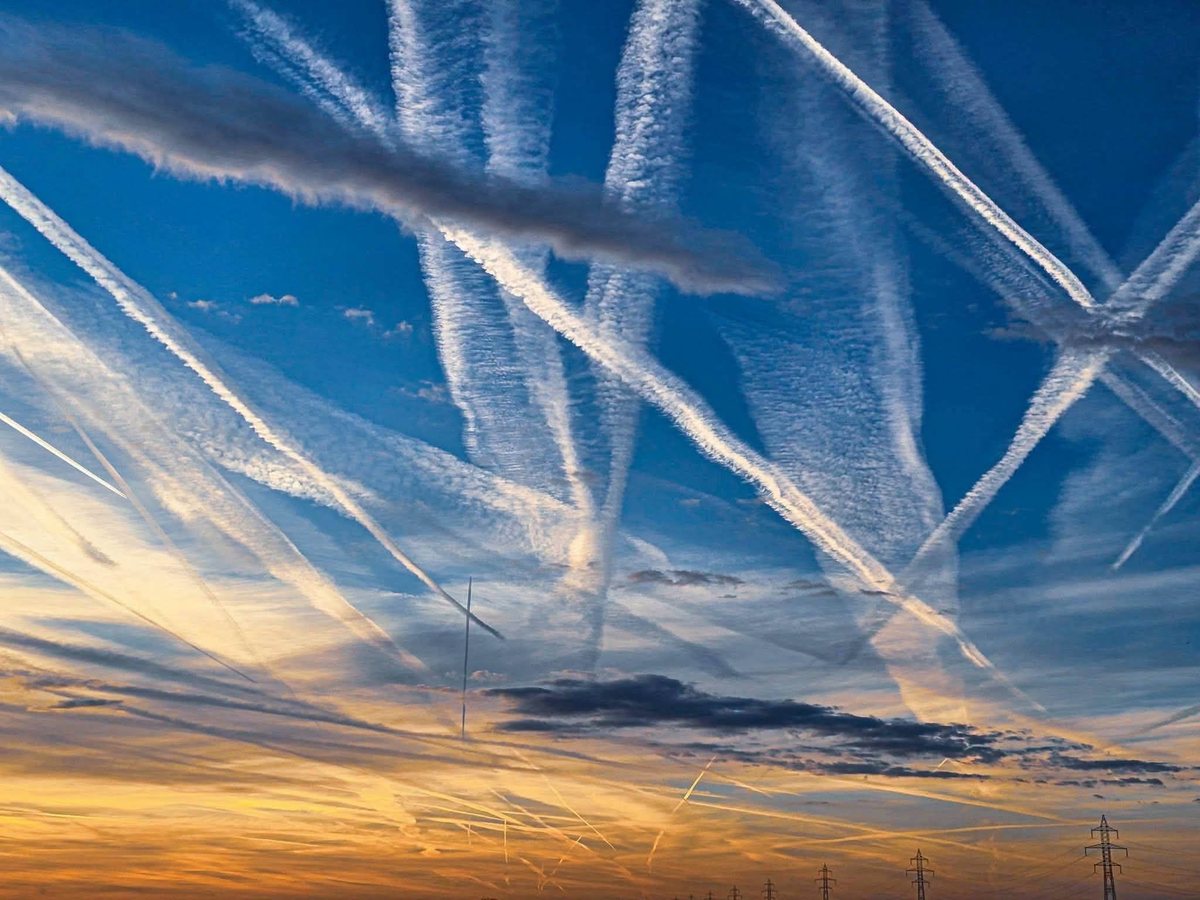
Social media feeds have again filled with photographs of aircraft condensation trails, accompanied by renewed claims that the white streaks are chemical agents deliberately released into the atmosphere. The conspiracy theory, commonly known as «chemtrails», has resurfaced in recent days, with supporters sharing images and alleging that the trails are toxic or disease-causing. Meteorologists and atmospheric scientists are once more explaining that the phenomenon is a purely physical process: the trails are composed of water vapor that condenses and freezes at high altitudes.
Alexandru Szatmari, a meteorologist, addressed the claims on Saturday, reiterating that condensation trails — or contrails — form when hot, humid exhaust gases from aircraft engines meet cold air at cruising altitudes. The sudden temperature drop causes the water vapor to condense into ice crystals, creating the visible white lines. «The trails do not intoxicate us and do not produce diseases. They are water», Szatmari said, according to reports. His statement echoes the consensus of atmospheric research: contrails are essentially artificial clouds, no different in composition from natural cirrus formations.
Despite repeated scientific explanations, the chemtrail narrative persists and appears to gain momentum during periods when contrails are particularly visible, such as in cold, humid weather. Proponents of the theory often interpret the persistence or spreading of contrails as evidence of chemical spraying, but meteorologists note that the duration and spread of contrails depend on atmospheric humidity and temperature. When the air is very cold and moist, contrails can linger for hours and spread into thin cirrus layers; when the air is dry, they evaporate quickly. These variations are well understood and have been documented in aviation and atmospheric science for decades.
The resurgence of the theory highlights a broader challenge for science communication: correcting misinformation that is emotionally compelling and visually reinforced. Social media algorithms can amplify sensational claims, and images of striking contrails — especially when multiple trails crisscross the sky — can appear ominous to untrained observers. Scientists have repeatedly pointed out that no credible evidence supports the idea of a secret large-scale spraying program, and that the logistics of such an operation would be impossible to conceal. Atmospheric monitoring networks, which track pollutants and particulate matter, have not detected the chemical signatures that the theory implies.
For the public, the practical takeaway is straightforward. Contrails are a normal byproduct of aviation and are made of water ice. They do not contain hidden toxins, and there is no evidence linking them to illness. Meteorologists like Szatmari continue to engage with the public on social media, hoping that clear, repeated explanations will eventually counter the pseudoscientific claims. However, as the latest wave of posts demonstrates, the chemtrail myth remains resilient, resurfacing whenever conditions make the trails especially noticeable.
10