Astronomers have discovered a new exoplanet in the Beta Pictoris system, a gas giant named Beta Pictoris d that has been hiding in plain sight for more than a decade. The planet, which is about 2.4 times the mass of Jupiter, was identified after researchers noticed an unexpected signal while studying the system's previously known planet, Beta Pictoris b.
The discovery, published today in The Astrophysical Journal Letters, was led by Ben Sutlieff of the University of Edinburgh and Markus Bonse of the European Southern Observatory (ESO). The team was initially analyzing images of Beta Pictoris b to track its evolution when they spotted a faint, separate signal. «There's something else there, have you seen it?» Bonse recalled saying as he examined the data.
To confirm the finding, the researchers turned to the ESO archive, which contains observations from the Very Large Telescope (VLT) and other instruments. There, they found Beta Pictoris d in multiple images dating back 11 years, including one where it was barely distinguishable from the light of its brighter neighbor, Beta Pictoris b. «Planet d, it seems, has been playing hide-and-seek with us for over a decade, and only now can we shout 'found it!'» said co-author Jayne Birkby of the University of Oxford.
Beta Pictoris d is a gas giant, similar to Jupiter or Saturn, but it is significantly smaller and cooler than the other two known planets in the system. Beta Pictoris b and c each have masses about ten times that of Jupiter, while the new planet is only 2.4 times Jupiter's mass, making it one of the lightest exoplanets ever directly imaged from Earth. Its relatively low temperature means its signal is extremely faint compared to the star Beta Pictoris, which is about 63 light-years away.
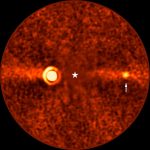
Direct imaging of exoplanets is challenging because planets are much fainter than their host stars. Beta Pictoris d is about 100 times fainter than Beta Pictoris b, making it the faintest exoplanet ever directly photographed from Earth, according to Bonse. The first clear observation was made using the Eris instrument on the VLT, which employs advanced adaptive optics developed in Italy by the National Institute for Astrophysics (INAF).
«The Eris instrument on the VLT was absolutely crucial, providing its initial high-contrast detection,» said co-author Armando Riccardi of INAF, technical manager of the Eris adaptive optics module. «Thanks to this system, we obtained exceptionally deep non-coronagraphic images in the mid-infrared. This allowed us to detect one of the lowest-mass exoplanets ever directly observed from the ground. It really demonstrates that ground-based adaptive optics remain essential for discovering new worlds.»
An independent team led by Aidan Gibbs of the University of California also discovered the same planet using the James Webb Space Telescope (JWST). Their results were also published today in The Astrophysical Journal Letters. The confirmation of Beta Pictoris d from multiple instruments strengthens the finding and provides new insights into the system's architecture.
The Beta Pictoris system is known for its prominent debris disk, a ring of dust and gas left over from planet formation. The new planet's wide orbit may help explain how the inner edge of this disk is shaped. «This discovery of Beta Pictoris d is a huge milestone: it reveals a third giant planet that, finally, could explain how the inner edge of the system's debris disk is shaped,» Riccardi said.
The discovery highlights the value of archival data in astronomy. The team found that Beta Pictoris d had been captured in earlier observations with the VLT's Sphere instrument and even in JWST data, but it had gone unnoticed because it was often hidden by the glare of Beta Pictoris b. In 2014 images, the two planets appeared almost perfectly aligned from Earth's perspective, and only after subtracting the light of planet b could the fainter planet d be seen.
With three known planets, the Beta Pictoris system offers a rich laboratory for studying planetary formation and dynamics. The new findings underscore the power of combining ground-based and space-based telescopes to reveal worlds that have long remained hidden.
112