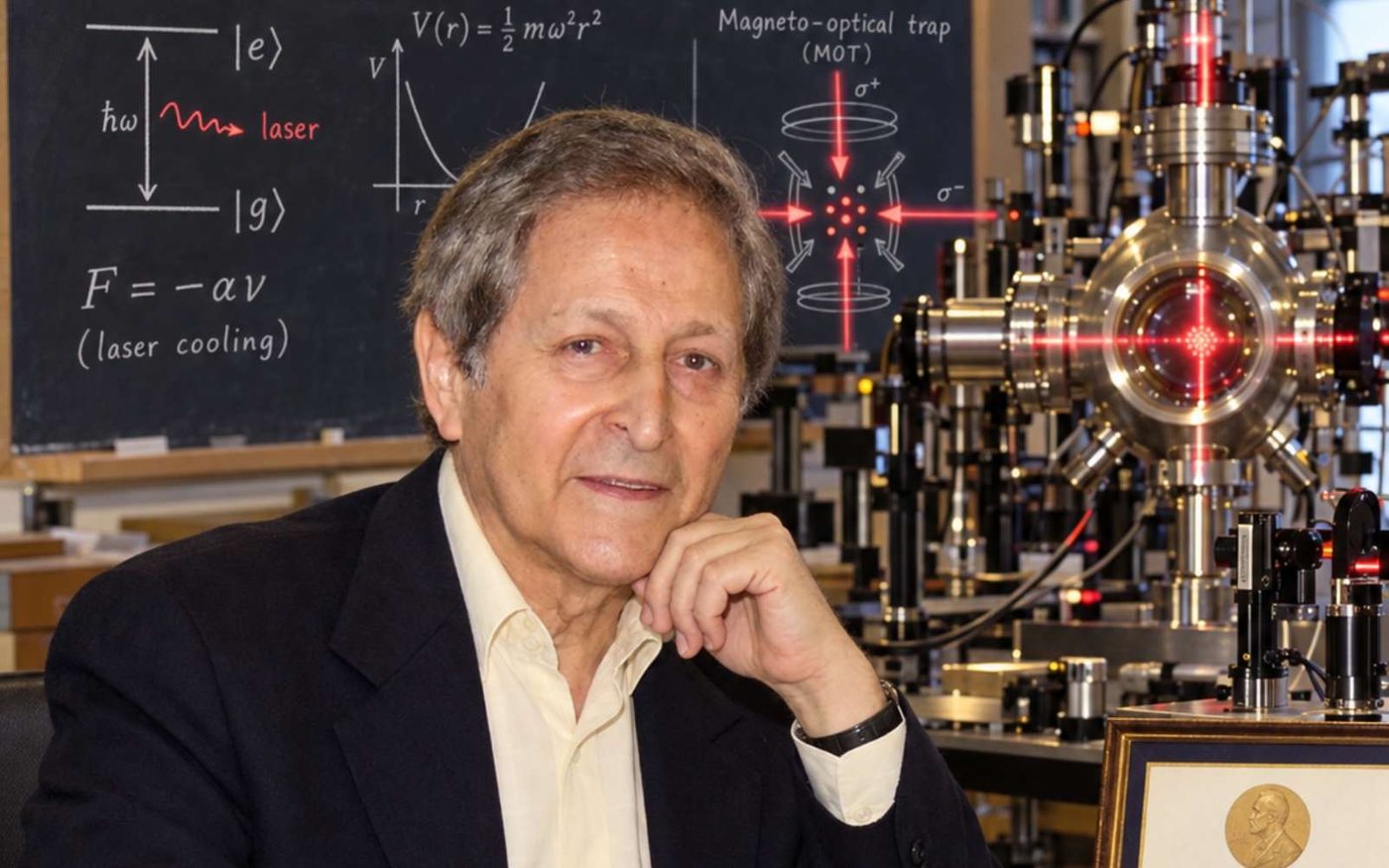
French physicist Claude Cohen-Tannoudji, who shared the 1997 Nobel Prize in Physics for methods to cool and trap atoms with laser light, died in Paris on 22 October at the age of 93. His theoretical work helped turn a promising laboratory technique into a tool that reshaped atomic physics and laid groundwork for later quantum research.
He shared the prize with Steven Chu and William Phillips. Their pioneering experimental work in the 1980s showed that collisions with photons could cool atomic gases to temperatures well below 1 millikelvin. Early results were understood through a process known as Doppler cooling. Researchers soon found, however, that atoms could be cooled to temperatures far lower than Doppler cooling predicted, and that unexplained gap became a central puzzle for the field.
That puzzle was resolved by Cohen-Tannoudji's theoretical work, which offered an insight into how atoms could be cooled to much colder temperatures. Working with future Nobel laureate Alain Aspect and others, he cooled a helium gas to ever lower temperatures, reaching 180 nanokelvin in 1995. The experiments demonstrated how far laser-based techniques could push matter toward the lowest temperatures reachable in the laboratory.
Cohen-Tannoudji was born on 1 April 1933 in Constantine, Algeria. He left Algeria for France in 1953, the year before the Algerian War of Independence began, and enrolled at the Ecole Normale Supérieure in Paris. He graduated in 1957, then performed extended military service because of the war in Algeria before returning to the school in 1960 to pursue a PhD. His supervisors were Alfred Kastler, himself a future Nobel laureate, and Jean Brossel. His dissertation examined theoretical and experimental aspects of optical pumping, a technique for manipulating the energy states of atoms with light.
He went on to teach physics at the University of Paris and to supervise doctoral students. Among them was Serge Haroche, who shared the 2012 Nobel Prize in Physics for his work on measuring and manipulating quantum systems. The link between the two generations of French laureates illustrates the research lineage that grew from Cohen-Tannoudji's laboratory and classroom.
Beyond his research, he is known for the three-volume textbook Mécanique quantique, written with Bernard Diu and Franck Laloë. The work is available in English translation as Quantum Mechanics and has been praised for its unique approach to teaching quantum physics, a reputation that has kept it in use with students for decades.
French science outlets also marked his death, highlighting his role in understanding how to cool and trap atoms near absolute zero with lasers, and his reputation as an outstanding teacher of quantum physics to generations of students. Those tributes underline how his influence extended from the experimental bench to the lecture hall and the printed page.
11