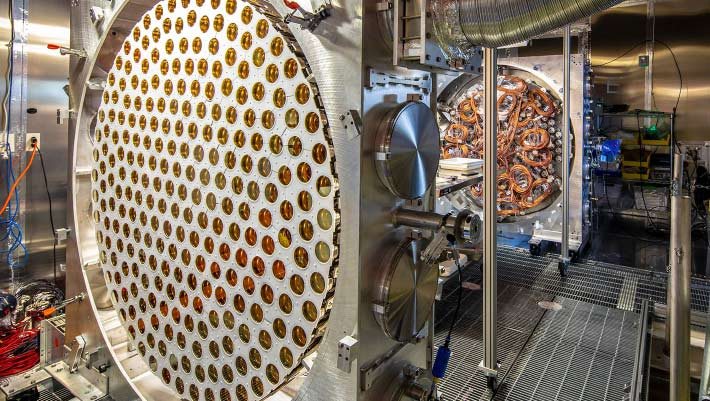
Physicists working with the LUX-ZEPLIN (LZ) dark matter detector, buried deep in a former South Dakota gold mine, have recorded a single particle interaction that defies easy explanation. The event, detected at an energy of 248 keV, appeared in a region of the detector where background noise is expected to be extremely low. While the team is not yet claiming a discovery, the signal has drawn attention because it resembles what some theoretical models predict for dark matter particles.
The LZ experiment is one of the most sensitive searches for weakly interacting massive particles, or WIMPs, a leading candidate for dark matter. Dark matter is thought to make up about 85 percent of all matter in the universe, yet it has never been directly observed. The detector uses a titanium cylinder filled with seven tons of liquid xenon, kept at very low temperatures. When a particle strikes a xenon nucleus, it produces two flashes of light: a weak, rapid S1 signal and a stronger S2 signal. The ratio between these flashes helps scientists distinguish between dark matter interactions and background events, such as gamma rays.
In this latest run, the researchers expanded their search to higher energies, up to 270 keV, to test more complex theoretical models, including effective field theories and inelastic dark matter scenarios. These models suggest that dark matter particles could occasionally collide with greater violence or change state during impact, leaving a more pronounced energy signature. The anomalous event was found in this extended energy window, at 248 keV, in a part of the detector with very low expected background.
The LZ team, comprising about 250 scientists and engineers from 30 institutions, released a preprint of their findings on September 1 to invite scrutiny from the broader physics community. The paper has not yet undergone peer review. The researchers emphasize that a single event, while intriguing, is far from conclusive. Additional data will be needed to determine whether this is the first hint of a dark matter particle or a rare background fluctuation.
The signal’s location and energy make it difficult to attribute to known sources of noise, but the team remains cautious. In the hunt for dark matter, false positives have occurred before, and the scientific community will require more than one event to confirm a discovery. The LZ detector continues to operate, and future runs may provide the statistical power needed to clarify the nature of this curious signal.
181