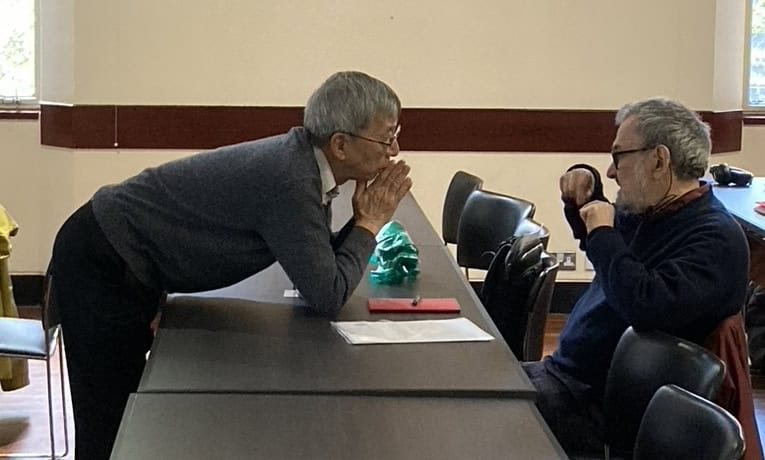
Masao Doi and Luca Peliti met in person for the first time at a University of Cambridge conference held from 22 to 25 September, an event marking five decades of the theoretical framework that now bears both their names. The meeting, funded by the Wildcard programme of the German Carl Zeiss Foundation, gathered physicists to trace the history of Doi-Peliti field theory and to assess its present and future applications.
Doi, then at Tokyo Metropolitan University, published two foundational papers in September 1976 in Journal of Physics A. The work recast classical stochastic many-body problems in a mathematical language close to that of quantum field theory. At a time when field-theoretic methods in statistical mechanics were expanding rapidly, the insight remained largely unnoticed for years and was independently rediscovered several times. The most prominent rediscovery came in 1980 from Peter Grassberger and Martin Scheunert at the University of Wuppertal, who also drew attention to the theory's wide range of applications.
The framework acquired its second name after a meeting organised by the Centre Européen de Calcul Atomique et Moléculaire in September 1985, where Grassberger discussed the work with Luca Peliti of the University of Rome. Peliti subsequently reformulated Doi's theory in a path integral formalism, making it suitable for renormalisation. That same year he published a letter on the renormalisation group treatment of a reaction-diffusion process, using the approach that became known as Doi-Peliti field theory.
The two strands of work soon became regarded as fundamental tools for calculating not only asymptotic behaviour but also systematic approximations of observables in reaction-diffusion processes. John Cardy of the University of Oxford used Doi-Peliti theory as a workhorse for such problems. Through the 2000s, Cardy and colleagues produced a series of renormalisation group treatments of reaction-diffusion processes, along with reviews and tutorials at different levels of technicality, helping to make the theory accessible to a broader community of researchers.
At the Cambridge meeting, speakers described how key insights emerged, covering both historic developments and the achievements and challenges that remain. The atmosphere was relaxed, and participants included several of the researchers who shaped the field. Doi, who became chief scientist at the Wenzhou Institute of the University of Chinese Academy of Sciences in 2018 and is well known for his work in polymer and soft-matter physics, remarked that it was the first time he had attended a conference bearing his name.
The occasion also underlined how long the two men had worked in parallel without meeting. When Ziluo Zhang, a former PhD student of the conference organiser, joined the Wenzhou Institute as a postdoc in 2023, he found that Doi was unaware the field theory carried his name and had not followed the many developments built on it since its inception. The Cambridge event closed that gap, placing Doi and Peliti side by side for the first time.
An upcoming special issue of Journal of Physics A will be dedicated to Doi-Peliti field theory, extending the anniversary beyond the conference itself. For the physicists involved, the meeting served as both a retrospective on a theory that took years to be fully recognised and a starting point for the questions it may still help answer.
11