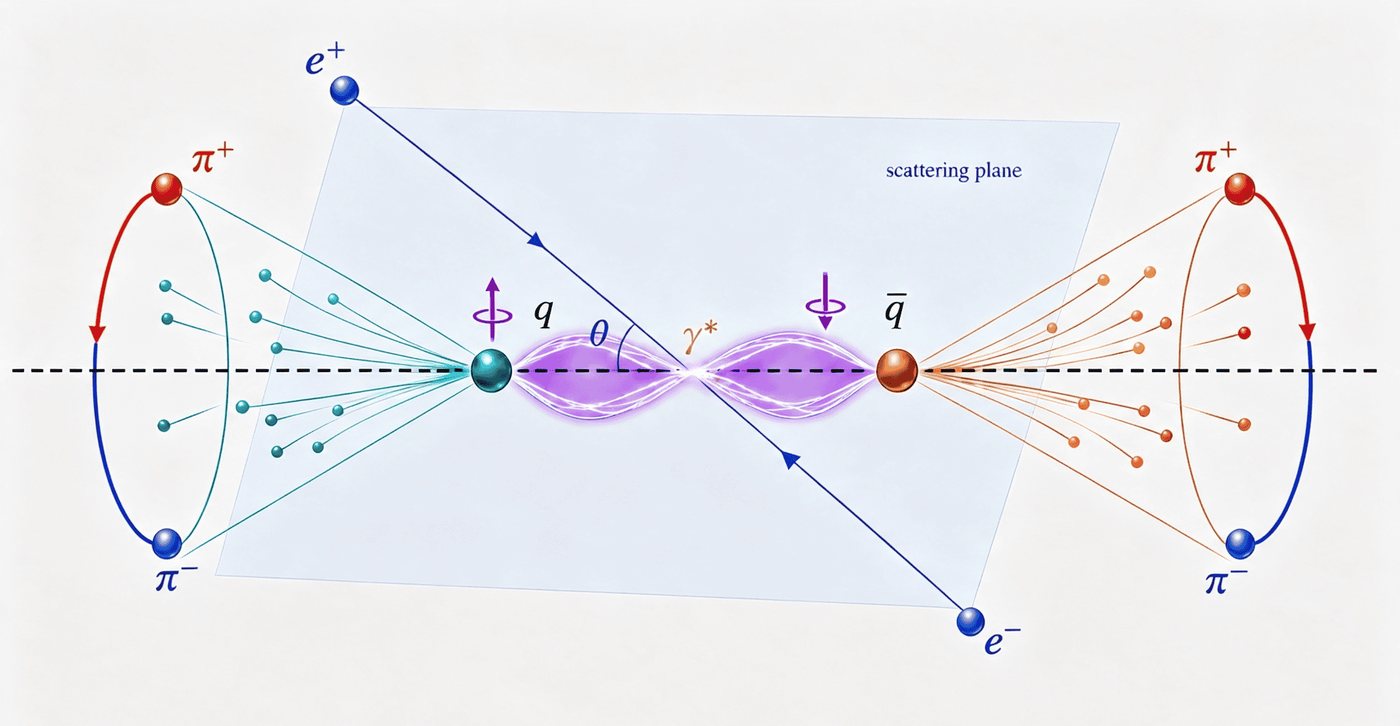
Physicists have proposed a new way to probe the hidden electromagnetic properties of quarks by exploiting quantum entanglement, potentially opening a fresh avenue in the search for physics beyond the Standard Model. The method, developed by Qing-Hong Cao and colleagues at the Chinese Academy of Sciences, analyzes the spin correlations of quark-antiquark pairs produced in electron-positron collisions. Their work appears in Reports on Progress in Physics.
Quarks are fundamental building blocks of matter and come in six flavours: up, down, strange, charm, bottom, and top. They are never observed in isolation because they are confined inside composite particles called hadrons. Protons, for example, contain two up quarks and one down quark, while neutrons contain one up quark and two down quarks. This confinement makes direct measurement of quark properties extremely difficult, leaving many of their electromagnetic characteristics, such as anomalous magnetic or electric dipole moments, largely unexplored.
Anomalous dipole moments would signal the presence of new particles or interactions not described by the Standard Model, the prevailing theory of particle physics. Yet because quarks cannot be isolated, any such effect must be inferred indirectly from the particles they produce. The new approach does exactly that by focusing on electron-positron collisions, which can create a quark and an antiquark pair. These quarks then fragment into sprays of hadrons, and by analyzing the directions in which those hadrons emerge, researchers can reconstruct information about the spins of the original quarks.
The team showed that anomalous magnetic or electric dipole interactions would modify the quantum-entangled spin state of the quark-antiquark pair in a characteristic way. A magnetic dipole interaction would drive the pair into a spin-triplet state, while an electric dipole interaction would produce a spin-singlet state. These changes would leave distinct signatures in the angular distributions of the resulting hadrons.
Rather than searching for an excess of events, as many collider searches do, the proposed method probes changes in the spin-correlation structure of the quark-antiquark system. This makes it a complementary technique for testing the Standard Model using existing collider data. The authors note that the work introduces a new entanglement-based approach for probing the electromagnetic properties of light quarks, connecting quantum spin correlations in hadron production with possible quark dipole interactions.
The research builds on decades of experimental and theoretical effort to understand quark behavior inside nucleons. While previous studies have explored the sea of quarks and antiquarks within protons and neutrons, the new method offers a different handle by leveraging quantum entanglement as a precision tool. If anomalous dipole moments exist, they could reveal themselves through subtle distortions in the hadron angular patterns predicted by the model.
Such a discovery would be revolutionary, indicating that quarks have internal structure or interact with unknown forces. Even if no signal is found, the technique provides a new way to constrain the properties of quarks and test the limits of the Standard Model. The authors suggest that the approach could be applied to data from current and future lepton colliders, where electron-positron collisions are produced in large numbers.
By turning entanglement from a curiosity of quantum mechanics into a practical probe of fundamental physics, the work highlights how quantum information concepts are increasingly finding use in high-energy particle research. The next step will be to apply the method to real collision data and see whether the spin correlations of hadrons match the Standard Model predictions or hint at something new.
13