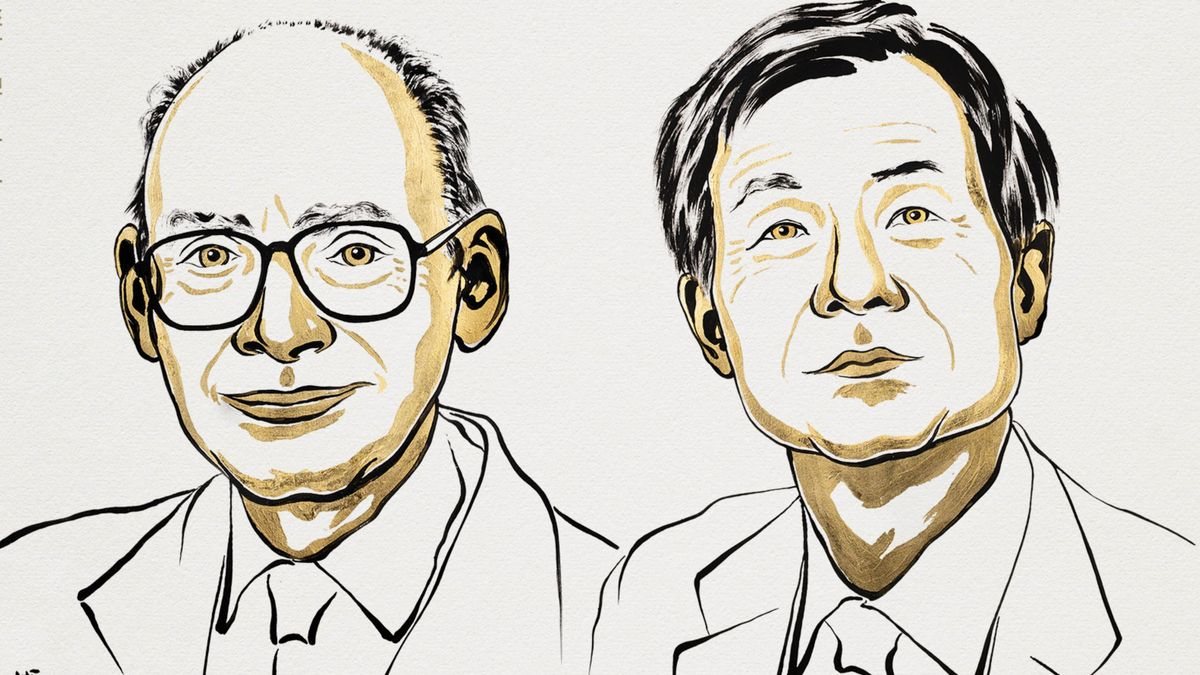
The Royal Swedish Academy of Sciences has awarded the 2026 Nobel Prize in Chemistry to Henri B. Kagan and Kenso Soai for their work on symmetry in the chemistry of life and for finding a method for a chemical reaction to spontaneously choose a single mirror image. The announcement, made this Wednesday, recognizes research that addresses a chemical enigma more than a century old: how homochirality, the property that makes the molecules of life exist in a single chiral version, can arise spontaneously.
«Henri Kagan and Kenso Soai have provided a solution to a chemical mystery more than a century old: how homochirality can arise spontaneously», said Heiner Linke, chair of the Nobel Committee for Chemistry. To explain their work, Linke recalled that in nature many molecules exist in two different versions. «Like my hands, they are mirror images of each other», he explained. «They look the same, but they are not identical. I cannot superimpose my hands one on top of the other. Such molecules are called chiral, from the Greek word for hand».
All the proteins in the human body, for example, are composed only of left-handed amino acids, and right-handed versions almost never appear in nature. This asymmetry has direct consequences for drug development. «Many molecules active in pharmaceutical applications are also chiral, and one hand may have the desired therapeutic effect while the other hand may have no effect or, in the worst case, even be harmful», Linke noted. The central question was how to design a reaction capable of spontaneously creating only one of the two mirror images without the intervention of any other chiral molecule. «It is this puzzle that this year's laureates have solved», he summarized.
Kenso Soai explained during the press conference that the reaction obtained may offer an explanation of how life is organized with essentially pure organic compounds. «I think that is our important point», he said. The chirality problem is not only relevant to DNA and amino acids, but is fundamental and a prerequisite for the origin of life. «We are very pleased to have found an organic reaction to explain homochirality. Of course, this is not the definitive answer, but this field must increasingly develop in order to understand life», he added.
The chemist Bernardo Herradón, of the Institute of General Organic Chemistry at the CSIC, highlighted that the merit of both researchers was overcoming the belief that it could never be possible to obtain a compound enantiomerically purer than the starting material. «They found a result that was surprising, what is known as chirality amplification», he explained. «From a practical standpoint it had great value because it allowed obtaining a compound with high purity using as starting materials a compound with somewhat less purity. And their work was basic research and a great example of what should be done in science: once you have explained the result, that explanation should help you predict».
Raquel Pérez Herrera, tenured researcher at the Institute of Chemical Synthesis and Homogeneous Catalysis (ISQCH, Unizar-CSIC), where she leads the Asymmetric Organocatalysis group, considered that this recognition highlights the enormous importance of asymmetric catalysis. «The prize reinforces the need and relevance of deepening the understanding of the mechanisms that govern molecular chirality, an area with direct implications for the development of new compounds, materials and pharmaceutical applications», she stated. «Furthermore, it shows how fundamental research in chemistry can help explain such fascinating and intriguing questions as the origin of homochirality in nature. Those of us who work in this field feel this recognition as something very close to us».
The Chemistry prize is the third of the science Nobel Prizes announced this year, in which no female scientist has been recognized. The seven scientists honored this year are all men, a pattern that has been widely criticized over the past decade and that the Swedish Academy does not seem to have any intention of correcting.
Credit. Based on reporting by Antonio Martínez Ron for El Diario. Is this your work? Write to us.
155