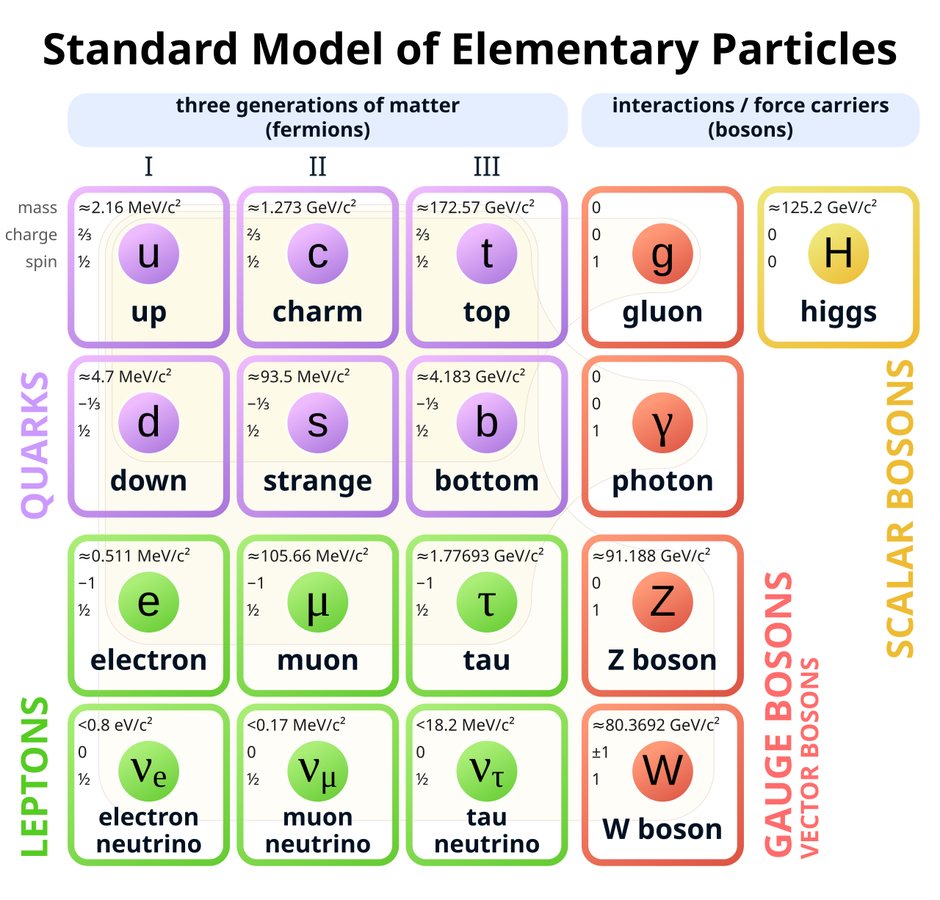
Physicists at Northwestern University have trapped a single positron and fully resolved its lowest-energy quantum states for the first time, creating a device the team calls a one-positron quantum cyclotron. The achievement, led by Gerald Gabrielse, is intended to enable future measurements of the positron's magnetic moment at unprecedented precision, opening the way to an extremely stringent test of a fundamental symmetry of the Standard Model of particle physics.
The Standard Model has been extraordinarily successful at describing fundamental particles and their interactions, yet it cannot explain one of the most obvious features of the observable universe: that it contains far more matter than antimatter. «The great mystery of the Standard Model is its ability to make extremely precise predictions of what can be measured, while being inconsistent with basic features of the universe,» Gabrielse said. Physicists therefore keep testing the theory, looking for situations where its predictions fall short in the hope of discovering new physics.
The conventional approach is to collide particles at ever higher energies and search for deviations from predictions. More recently, researchers have also pursued low-energy experiments that trap particles using magnetic and electric fields and make exquisitely precise measurements of properties such as the magnetic moment. The Northwestern work belongs to this second tradition.
One important tenet of the Standard Model is CPT invariance, which considers three hypothetical transformations of the universe: charge conjugation, in which every particle is swapped for its antiparticle; parity, in which everything is flipped into its mirror image; and time reversal, in which time runs backwards. According to the theory, a universe subjected to all three transformations at once would obey exactly the same laws of physics as our own. If that holds, every particle must be the perfect twin of its antiparticle, with identical masses and magnetic moments equal in size but opposite in sign.
To develop a test of CPT invariance for the electron and its antiparticle, the positron, Gabrielse's team traps a single positron in a Penning trap. Inside, a strong magnetic field puts the positron into a circular path, and the trap is cooled to 300 millikelvin to place the particle in its lowest-energy quantum states. «High speed positrons from the decay of a sodium nucleus are slowed and captured in an environment that is so cold that they can be observed making one-quantum jumps between their lowest quantum states,» Gabrielse explained.
The team showed that the positron can be held in its cyclotron ground state and excited to higher-energy states using a driving electromagnetic force, including transitions between the particle's spin states. These low-energy states are defined by the size of the positron's cyclotron orbit and by the relative orientation of its magnetic moment to the cyclotron's magnetic field. Measuring the energy difference between spin states reveals the size of the positron's magnetic moment.
The researchers believe future single-positron cyclotron measurements will provide a value for the magnetic moment to one part in 1013. «The one-positron quantum cyclotron should enable the first quantum measurements of the positron magnetic moment,» Gabrielse said. If CPT invariance holds, the result should exactly match the size of the electron's magnetic moment, which has already been measured to one part in 1013 using a one-electron quantum cyclotron.
By bringing the positron up to the electron's level of precision, Gabrielse and colleagues hope to deliver the most stringent test yet of CPT invariance for leptons, and perhaps a new route toward observations that could finally break the Standard Model's predictions. The research is described in a paper accepted for publication in Physical Review Letters.
9