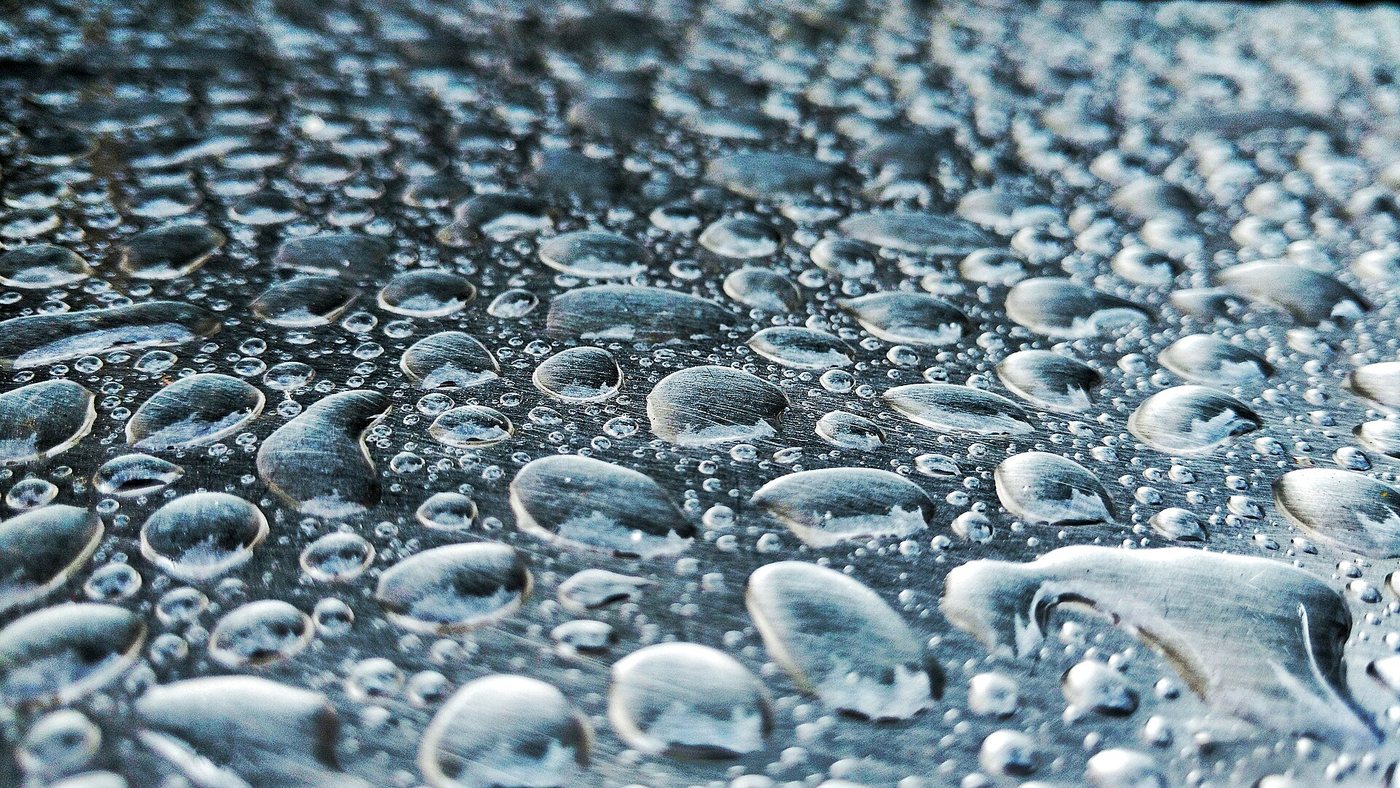
Water droplets sliding across solid surfaces can build up electric potentials of thousands of volts and, when they discharge, corrode non-conductive coatings on metals, according to researchers in Germany. The team, led by physical chemist Hans-Jürgen Butt at the Max Planck Institute for Polymer Research in Mainz, says the poorly understood phenomenon warrants further investigation to help protect vulnerable outdoor equipment and cultural heritage sites from corrosion.
Metal corrosion by water droplets is a serious economic and safety issue, and prevention depends on understanding the underlying processes. Conventional wisdom holds that most corrosion results from physical abrasion by droplet motion combined with chemical degradation from natural acids and anthropogenic pollutants in the water. The idea that electrochemistry might play a significant role had not been seriously considered, Butt said, partly because the triboelectric effect — the charging of objects by rubbing them together — was long thought not to work in liquids.
For solids, rubbing two insulating materials together transfers electrons, a phenomenon known for more than 2,500 years. But that process relies on atomic-scale surface roughness to concentrate charge at specific points where bonds can break, and fluids cannot, by definition, be rough. “If you take a water droplet and let it slide there is some mechanical force from surface tension, but that’s much too low,” Butt said. “There is no way you could generate enough energy locally to pick up an electron or to put an electron or an ion from the water onto the surface.”
Over the past decade, however, it has become increasingly clear that sliding droplets do become highly charged. In their present work, Butt and colleagues deposited water droplets onto copper surfaces covered with a 60-nanometer layer of Teflon. When droplets were dropped straight onto the surface, no corrosion was observed. But when droplets were first deposited onto sloped insulating surfaces — including plant leaves, PVC construction boards, and the perfluorooctadecyltrichlorosilane (PFOTS) hydrophobic coating often used on window glass — they ran down and then fell onto the Teflon-coated copper.
After roughly 3,000 droplet impacts, atomic force microscopy and confocal microscopy revealed evidence that the droplets had corroded both the coating and the underlying copper. The researchers believe the droplets become positively charged as they slide down the sloping surface. As they fall onto the coating, the potential difference between the droplet and the copper can exceed 1 kV, greater than the dielectric breakdown strength of the coating, causing the droplet to discharge. This damages the coating and leaves the underlying metal vulnerable to further oxidation.
To test their hypothesis, the researchers measured charge movement within the copper surface, showing that negative charge flowed toward droplets dripping off insulating surfaces. High-speed cameras also showed that a drop deposited directly retained its spherical shape before impact, whereas a dripping drop was drawn into a cone shape, producing a tip of positive charge that would increase its corrosive capacity.
The practical implications remain unclear. “Technical coatings on cars, ships etc. are typically 100 microns and thicker, so the process we describe is probably not of direct relevance,” Butt said. However, the phenomenon could be involved in the degradation of monuments and other outdoor historical objects. “We have evidence that surfaces change their properties when you slide charges over them, but the real consequences are not yet known,” he added.
Butt said his group is most focused on understanding the fundamental physics involved. “We still don’t know why the heck there is such a charge separation: it’s energetically unfavourable, it should not happen, but it happens,” he said. “The one effect we describe here is, in a way, pretty trivial — everyone knows that if you have a high potential and it’s somehow grounded there is a breakthrough — but what happens at the surface with this deposited charge is not clear.”
Materials scientist Zhong Lin Wang of the Georgia Institute of Technology, who helped develop the triboelectric nanogenerator used to quantify the effect in liquids, said the transferred electrons can be kicked back into the water solution, resulting in chemical reactions at the nearby surface. That process, called contact-electro-catalysis, was first proposed in 2022 and is now an active field of research in chemistry, materials, and environmental science. Wang called the new work “an interesting discovery” showing that electrons transferred from water droplets can break the surface coating layer and lead to local oxidation. The research is described in Nature.
115