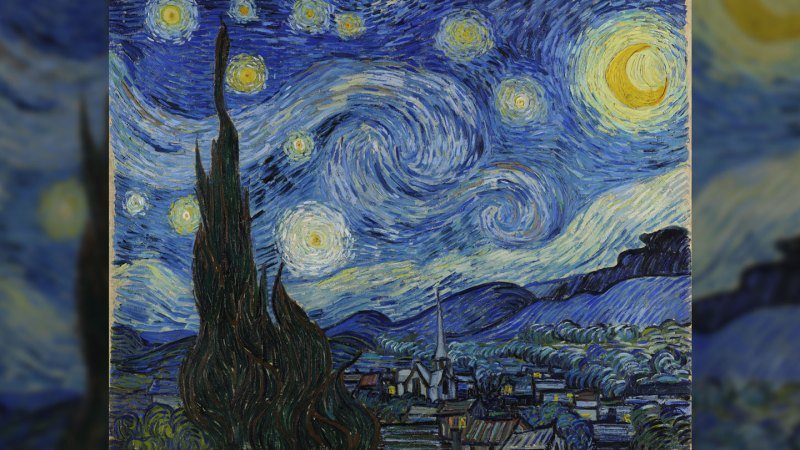
South Korean researchers have proposed that the night sky in Vincent van Gogh’s « The Starry Night » corresponds to a specific evening: July 22, 1889. The finding challenges the date most often associated with the painting, which is June 1889, and offers a new way of linking the artwork to the real sky above the asylum in Saint-Rémy-de-Provence, France.
The study rests on two lines of evidence. The first is the arrangement of stars in the painting, which the researchers say aligns with the sky as it appeared on the evening of July 22. The second is van Gogh’s own correspondence. In his letters, the artist described weather conditions and his surroundings in detail, and the researchers used those descriptions to narrow the window of time in which the scene could have been observed.
The work is among the most recognizable paintings in Western art. Van Gogh painted it in the summer of 1889 while he was a patient at the Saint-Paul-de-Mausole asylum, where he had admitted himself after a period of mental crisis. The painting shows a swirling sky above a quiet village, with a bright crescent moon and a prominent star cluster. Art historians have long debated whether the swirling forms were drawn from direct observation or imagination, and the new study adds a fresh dimension to that discussion by treating the sky as a potentially accurate record.
Science News, which has also reported on the research, framed the question as whether the painting was a « flight of fancy » or a depiction of a real sky. The researchers’ answer, in this account, is that van Gogh’s attention to his surroundings was closer to observation than invention. The letters, which show him paying close attention to the weather and light, support that reading, though the researchers present their date as a probable match rather than a certainty.
The proposed date matters beyond art history. Dating a painting’s subject through astronomy requires reconstructing the sky as it looked at a particular place and time, and the study shows how astronomical calculation can be used alongside archival records to test long-standing assumptions. Whether the July 22 date will be broadly accepted by art historians and astronomers remains to be seen, since any revision of a widely cited date typically invites further scrutiny of the same evidence.
18