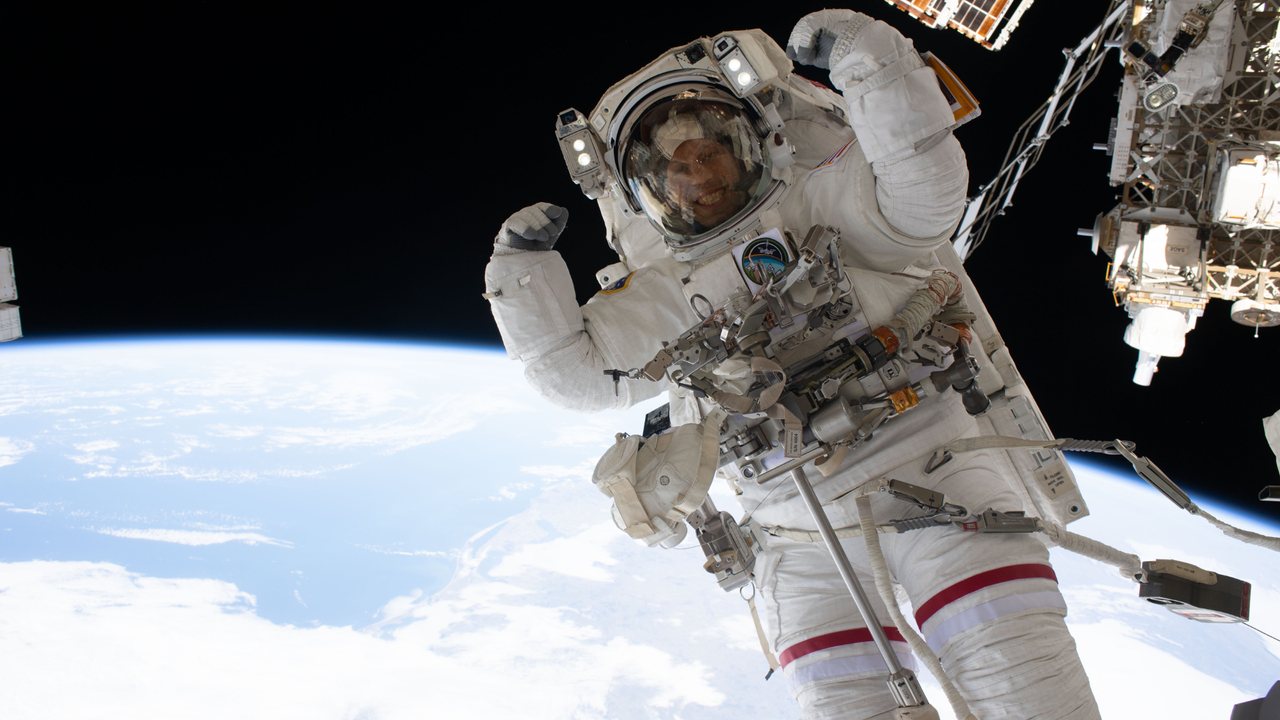
A striking new image released by NASA shows an astronaut flexing his biceps while conducting a spacewalk outside the International Space Station (ISS), offering a rare glimpse into the physical exertion required for extravehicular activity (EVA). The photograph, taken during a routine maintenance mission, captures the astronaut in the midst of a task that demands both strength and precision in the vacuum of space.
The image, featured as 's photo of the day for July 7, 2026, shows the astronaut anchored to the station's robotic arm, his spacesuit illuminated against the blackness of space. The flexed bicep is visible through the suit's fabric, a testament to the intense physical effort involved in maneuvering in a pressurized suit that weighs hundreds of pounds on Earth but is nearly weightless in orbit.
Spacewalks are among the most challenging activities astronauts perform. They require hours of preparation, including pre-breathing pure oxygen to purge nitrogen from the blood, and can last up to eight hours. During an EVA, astronauts must perform tasks such as repairing scientific instruments, upgrading equipment, or inspecting the station's exterior, all while managing the limited mobility of their suits.
The photograph underscores the importance of physical fitness for astronauts, who undergo rigorous training on Earth to prepare for the demands of space. In microgravity, muscles can atrophy if not exercised regularly, making strength maintenance a key part of daily life on the ISS. Astronauts spend about two hours each day exercising using specialized equipment like the Advanced Resistive Exercise Device (ARED) to counteract bone density loss and muscle deterioration.
This particular spacewalk was part of a series of EVAs aimed at upgrading the station's power systems and installing new solar arrays. The crew members involved were selected for their technical expertise and physical endurance. The image has drawn attention on social media, with many users commenting on the visible muscle definition despite the bulky suit.
The ISS has been continuously inhabited since November 2000, and over that time, astronauts have conducted more than 250 spacewalks to build, maintain, and upgrade the orbiting laboratory. Each EVA is carefully choreographed and monitored by teams on the ground to ensure safety and efficiency. The suits themselves are complex machines, providing life support, communication, and protection from extreme temperatures and micrometeoroids.
The photo serves as a reminder of the human element in space exploration. Behind every scientific breakthrough and technological achievement are individuals pushing their physical and mental limits. As space agencies plan longer missions to the Moon and Mars, understanding the physical toll of space travel becomes increasingly critical.
NASA and other space agencies continue to study the effects of microgravity on the human body, including muscle loss, bone density reduction, and changes in vision. The data gathered from EVAs and daily exercise routines on the ISS inform the design of future missions, where astronauts may spend months or years away from Earth.
The image also highlights the aesthetic beauty of spacewalks, which have become iconic symbols of human exploration. The contrast between the astronaut's suit and the dark cosmos, combined with the visible effort of the human body, creates a powerful visual narrative. It is a moment frozen in time that captures both the challenge and the wonder of working in space.
As the ISS approaches its planned retirement in the early 2030s, the legacy of its spacewalks will endure. They have paved the way for commercial space stations and deep-space exploration. The photograph of the astronaut flexing his muscles is more than just a striking image; it is a snapshot of the resilience and determination that define human spaceflight.
104