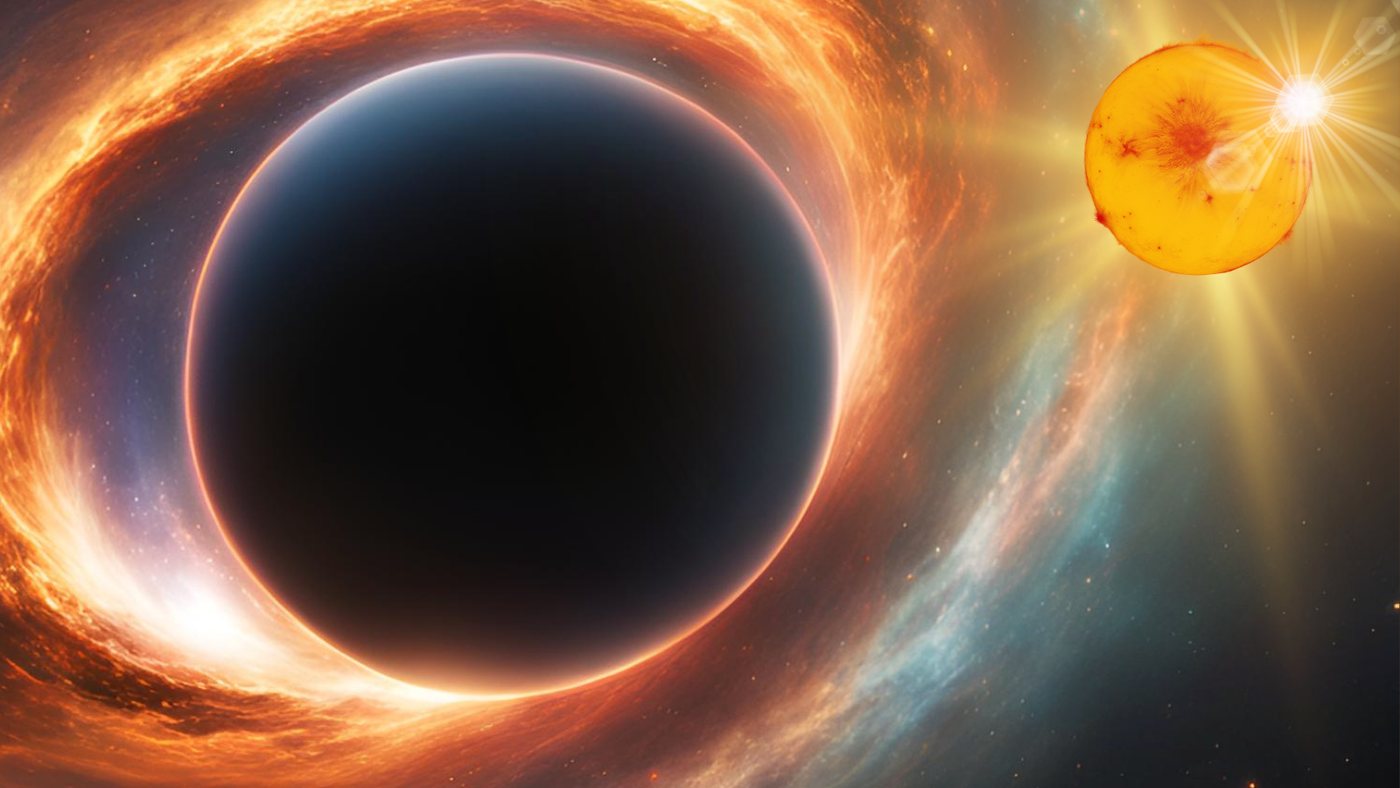
Astronomers are turning to the public in a new effort to track down the Milky Way's «missing» black holes. The project asks volunteers to help identify stellar-mass black holes, objects that are abundant in theory but nearly invisible in practice because they emit no light of their own.
Stellar-mass black holes form when massive stars collapse at the end of their lives. The Milky Way is expected to host millions of them, yet only a few dozen have been confirmed. Most are detected only indirectly, when they pull gas from a companion star and produce bright X-rays, or when their gravity distorts the light of stars behind them. The vast majority are thought to drift through space in isolation, silent and undetectable by conventional means.
The new initiative aims to close that gap by enlisting volunteers to sift through astronomical data. Citizen science projects have become an increasingly important tool in astronomy, allowing researchers to process datasets too large for any single team to handle. Volunteers have previously helped classify galaxies, spot planets and identify unusual stars, and astronomers hope similar crowdsourcing can surface the subtle signatures of hidden black holes.
The search matters beyond the tally itself. Knowing how many stellar-mass black holes exist and where they sit would sharpen models of how stars evolve, how galaxies form and how matter behaves under extreme gravity. The objects also serve as natural laboratories for testing physics in conditions that cannot be reproduced on Earth.
Finding them is difficult because a lone black hole gives off no radiation. Astronomers must look for indirect clues, such as the gravitational microlensing effect, in which a black hole's gravity briefly magnifies the light of a background star, or the wobble of a companion star orbiting an unseen massive object. Both signals are faint and easy to miss, which is where large numbers of human eyes can help.
The project reflects a broader shift in astronomy toward public participation as surveys generate ever-greater volumes of data. Volunteers are not merely assisting professionals but contributing to discoveries in their own right. For the Milky Way's hidden black holes, that collective effort may be the key to finding what has so far remained out of sight.
11