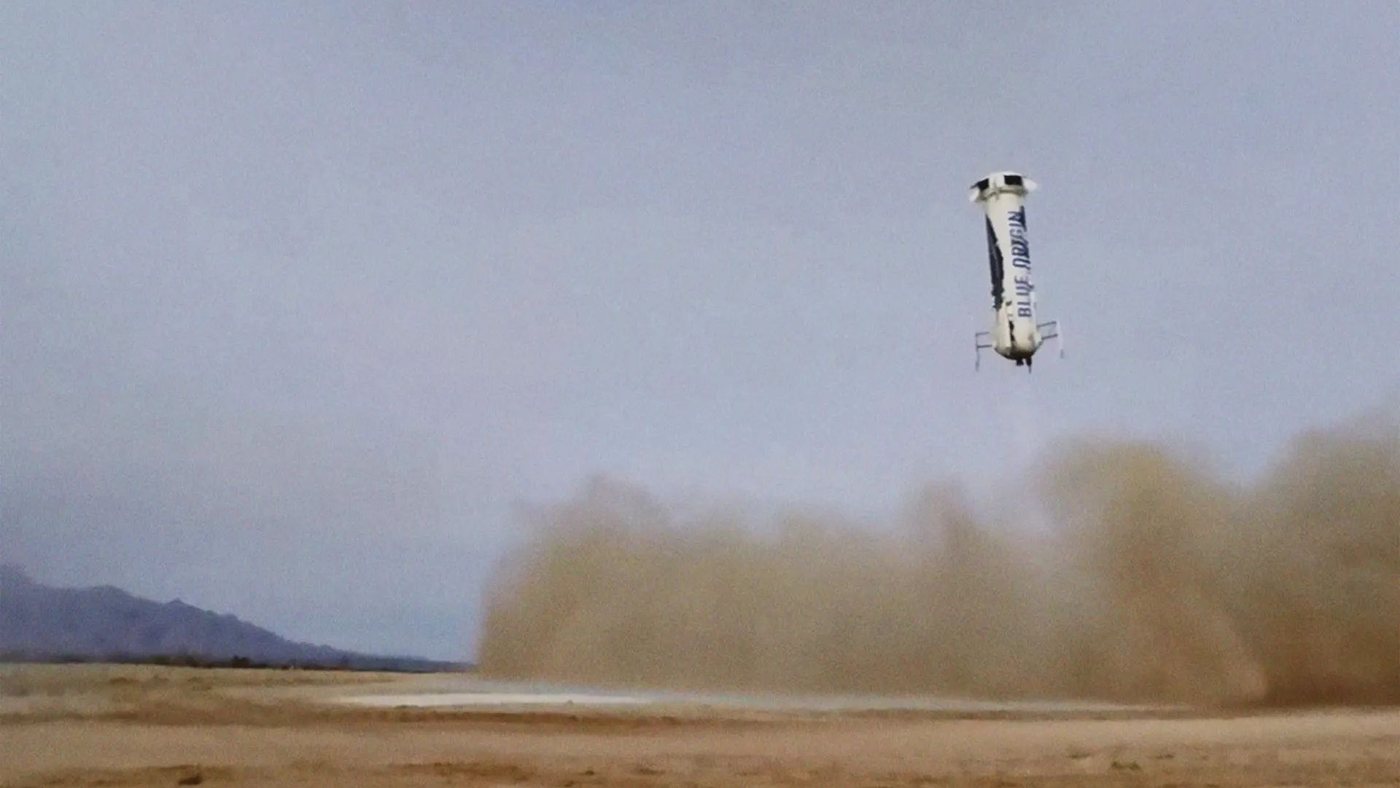
Blue Origin, the rocket company founded by Jeff Bezos, achieved a milestone on November 23, 2015, when its suborbital New Shepard rocket returned from space and landed upright. It was the first time a rocket had completed such a landing after reaching the edge of space.
The achievement mattered because it addressed one of the central challenges of reusable spaceflight. Rockets have traditionally been discarded after a single use, and recovering a booster intact would allow the same hardware to fly again, lowering the cost of reaching space. A vehicle that can return under its own power and stand on its base offers a practical path toward that goal.
New Shepard is designed for suborbital flights, which carry payloads up past the boundary of space before descending, rather than placing objects into orbit around Earth. Its successful landing demonstrated that the vehicle could survive the return trip from the upper atmosphere and set down under control.
The feature in which this milestone was recorded is part of Space.com's "On this day in space" series, which revisits notable moments in the history of spaceflight. The date of the original achievement is 2015, and readers should note that the series is a retrospective look at an event from that year rather than a new development.
Credit. Based on reporting by Hanneke Weitering and Elizabeth Howell for Space.com. Is this your work? Write to us.
9