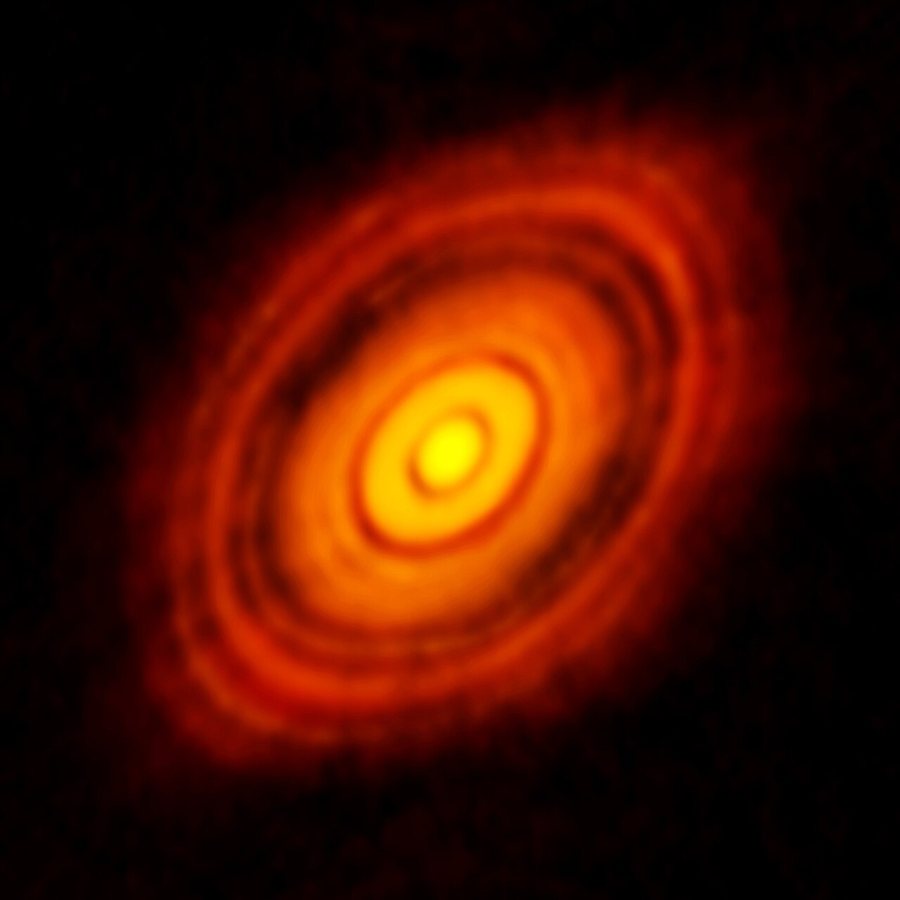
Astronomers have identified 21 extreme debris disks around young stars whose unusual dust signatures appear to be the aftermath of violent collisions between bodies the size of the Moon and Mars. The finding, based on new observations, suggests these disks are not simply the quiet leftovers of planet formation but the wreckage of recent, catastrophic impacts that could signal star systems in the midst of a planetary shake-up.
Extreme debris disks are a rare class of circumstellar disk that emit far more dust than typical debris disks found around stars of similar age. The dust is thought to be generated by ongoing collisions between planetesimals — the building blocks of planets — and the new study indicates that the impacting bodies must have been large, on the scale of moons and small planets, to produce the observed dust levels.
The research team examined 21 such disks, looking for the telltale signs of violent impacts. In these systems, the dust is not distributed uniformly but appears in clumps and rings that vary over time, consistent with the debris expanding after a major collision. The observations suggest that the dust is freshly created, meaning the impacts occurred relatively recently in astronomical terms.
Such collisions are a natural part of the planet-formation process. In young star systems, rocky bodies grow by accreting smaller objects, and the final stages of this process are marked by giant impacts. The Moon is believed to have formed from debris ejected when a Mars-sized body struck the early Earth, and similar events are thought to be common in other planetary systems. The extreme debris disks may therefore be snapshots of this chaotic period.
Beyond simply confirming that giant impacts happen, the findings could help astronomers identify star systems that are undergoing a planetary reorganization. If a system is experiencing a shake-up — for example, if planets are migrating or being scattered — the resulting collisions would produce dust that can be observed. This makes extreme debris disks potential markers of dynamical instability in young planetary systems.
The study adds to a growing body of evidence that the early histories of planetary systems are far more violent than once assumed. While the solar system today is relatively calm, its youth was likely punctuated by similar collisions, leaving behind scars such as the Moon and the asteroid belt. By studying extreme debris disks around other stars, astronomers hope to piece together how common such violent episodes are and what they mean for the eventual architecture of planetary systems.
The new observations of these 21 disks provide a sample that can be used to test models of collision cascades and dust production. Future work will focus on monitoring these systems over time to see how the dust fades, which can reveal the size and frequency of the impacting bodies. For now, the results suggest that the dusty disks around some young stars are not just passive remnants but active crime scenes of planetary construction — and destruction.
15