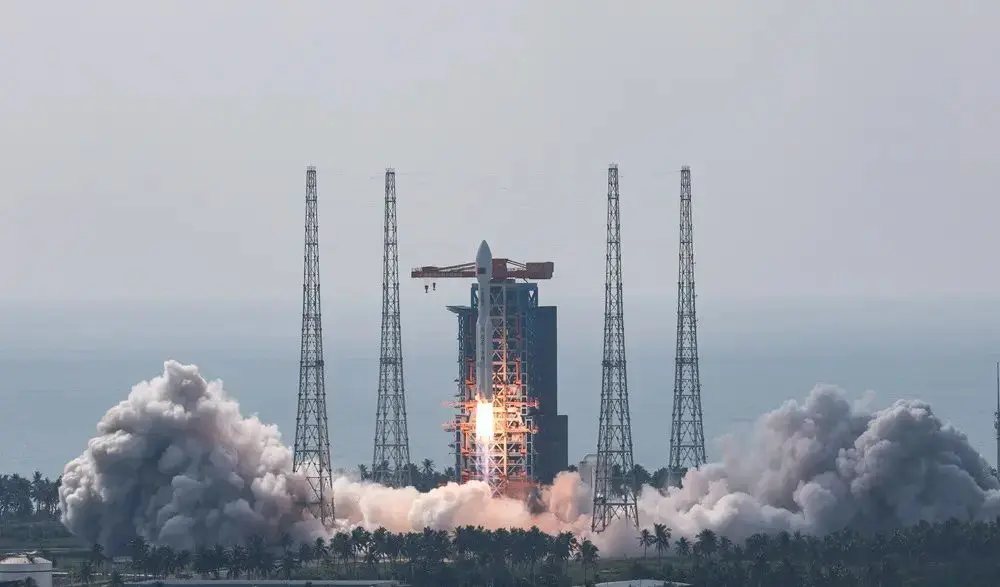
Two spacecraft will leave Earth together aboard the same launcher from Europe's spaceport in Kourou on 15 September, and at ESA's European Space Operations Centre (ESOC), two independent mission teams are preparing to fly them in parallel. FLEX, the European Space Agency's photosynthesis mission, and Sentinel-3C, the newest satellite in the Copernicus programme monitoring Earth's oceans, land, ice and atmosphere, will share a single rocket ride to orbit, then go their separate ways under the control of separate teams working in close coordination.
The arrangement is unusual for ESA mission control. Typically, a launch involves one spacecraft and one flight control team. This time, two mission teams are rehearsing side by side, not only for their own spacecraft but also for the moments when the two operations intersect. Those intersections include the shared launch phase, the separation sequence and the early orbit period, when both teams must track their own satellite while remaining aware of the other's status.
FLEX, short for Fluorescence Explorer, is designed to measure the faint glow of chlorophyll fluorescence emitted by vegetation from space. That signal offers a direct view of how efficiently plants convert sunlight into chemical energy through photosynthesis, a process that underpins the global carbon cycle and agricultural productivity. The mission is expected to sharpen understanding of plant health and stress, with implications for food security and climate research.
Sentinel-3C joins the Copernicus constellation of Earth observation satellites. Its instruments are built to monitor sea surface temperature, ocean colour, sea level, land cover, ice extent and atmospheric composition. The data feed into services used by governments, scientists and industry for weather forecasting, marine navigation, environmental monitoring and climate assessment. Sentinel-3C replaces and extends the capabilities of earlier satellites in the series, helping maintain continuity of long-term environmental records.
At ESOC, the rehearsal is about more than technical checklists. Flight controllers, spacecraft engineers, ground station operators and mission planners must synchronise their timelines so that commands to one spacecraft do not interfere with the other. The teams also practise contingency scenarios, including what happens if one satellite experiences an anomaly while the other is still in a critical early phase. Coordination procedures define who takes the lead, how information is shared and how decisions are escalated.
The dual launch reflects a broader trend in space operations: sharing rides to orbit reduces cost and increases launch opportunities, but it places new demands on mission control. Each spacecraft has its own orbit, its own commissioning schedule and its own set of scientific or operational objectives. Once separated from the launcher, FLEX and Sentinel-3C will follow different paths, and the two teams will transition from joint rehearsal to independent routine operations.
For ESA, the parallel preparation at ESOC is also a test of how the agency manages increasingly complex missions with limited ground resources. The experience gained from coordinating two teams during a single launch could inform future multi-satellite launches and constellation deployments, where dozens of spacecraft may need to be commissioned in quick succession.
As 15 September approaches, the two teams will continue their joint exercises, refining the handovers and communication links that will carry them through launch and the first critical hours in orbit. The goal is a smooth transition from a shared rocket ride to two separate missions, each delivering its own stream of data about the planet's vegetation, oceans, land and atmosphere.
132