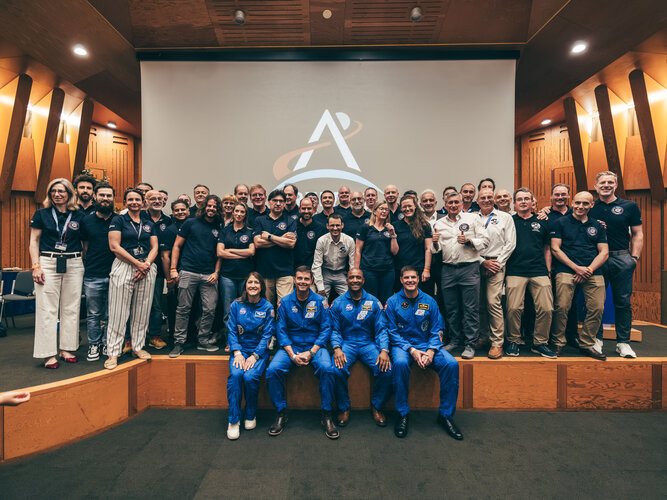
The team behind the European Service Module (ESM) for NASA's Orion spacecraft recently met with the four astronauts of the Artemis II mission at the European Space Research and Technology Centre (ESTEC) in the Netherlands. The meeting brought together NASA astronauts Christina Koch, Reid Wiseman, and Victor Glover, alongside Canadian Space Agency astronaut Jeremy Hansen, with the engineers and technicians who built the critical propulsion and power system for their spacecraft.
Artemis II, scheduled for launch no earlier than September 2025, will be the first crewed mission of NASA's Artemis program and the first human voyage to the vicinity of the Moon since Apollo 17 in 1972. The mission will carry the four astronauts inside the Orion crew module, which is powered and propelled by the European-built service module. The ESM provides propulsion, thermal control, electrical power, and life-support consumables such as water and oxygen for the crew.
The European Service Module is a key contribution from ESA to the Artemis program, built by Airbus Defence and Space in Bremen, Germany. It is derived from ESA's Automated Transfer Vehicle (ATV), which previously delivered cargo to the International Space Station. The module's main engine is an Orbital Maneuvering System engine originally built for the Space Shuttle, while its eight auxiliary thrusters and 24 smaller reaction control thrusters are all European-designed. The module also carries four solar arrays that generate enough electricity to power the spacecraft's systems.
During the meeting at ESTEC, the crew had the opportunity to inspect the service module hardware and discuss the mission's technical details with the engineering team. The astronauts also participated in training exercises that familiarized them with the module's systems and emergency procedures. This direct interaction between the crew and the builders is considered essential for building trust and ensuring that the astronauts understand the hardware they will rely on during the 10-day mission.
Artemis II will follow a trajectory that takes the crew around the far side of the Moon and back to Earth, testing all of Orion's systems with humans aboard for the first time. The mission will not land on the lunar surface but will pave the way for Artemis III, which aims to land the first woman and the next man on the Moon near the south pole. The European Service Module will play a critical role in both missions, providing the propulsion needed to enter and exit lunar orbit.
The meeting at ESTEC also highlighted the growing transatlantic partnership in human space exploration. ESA has committed to providing service modules for the first six Artemis missions, with the second module already delivered to NASA and the third in production. This collaboration ensures that European industry remains at the forefront of deep-space exploration technology while sharing the costs and benefits of returning humans to the Moon.
For the crew, the visit was an opportunity to express their gratitude and confidence in the European team. Commander Reid Wiseman noted that seeing the hardware up close and meeting the people who built it reinforced his trust in the mission's success. The astronauts also toured ESTEC's test facilities, including the Large Space Simulator and the acoustic chamber, where Orion components have been tested for the harsh conditions of space.
As Artemis II moves closer to launch, the European Service Module team continues to support preflight preparations, including final checks on the module's integration with the crew module at NASA's Kennedy Space Center in Florida. The successful completion of these tests will clear the way for stacking the Space Launch System rocket and ultimately sending humans farther from Earth than ever before.
96