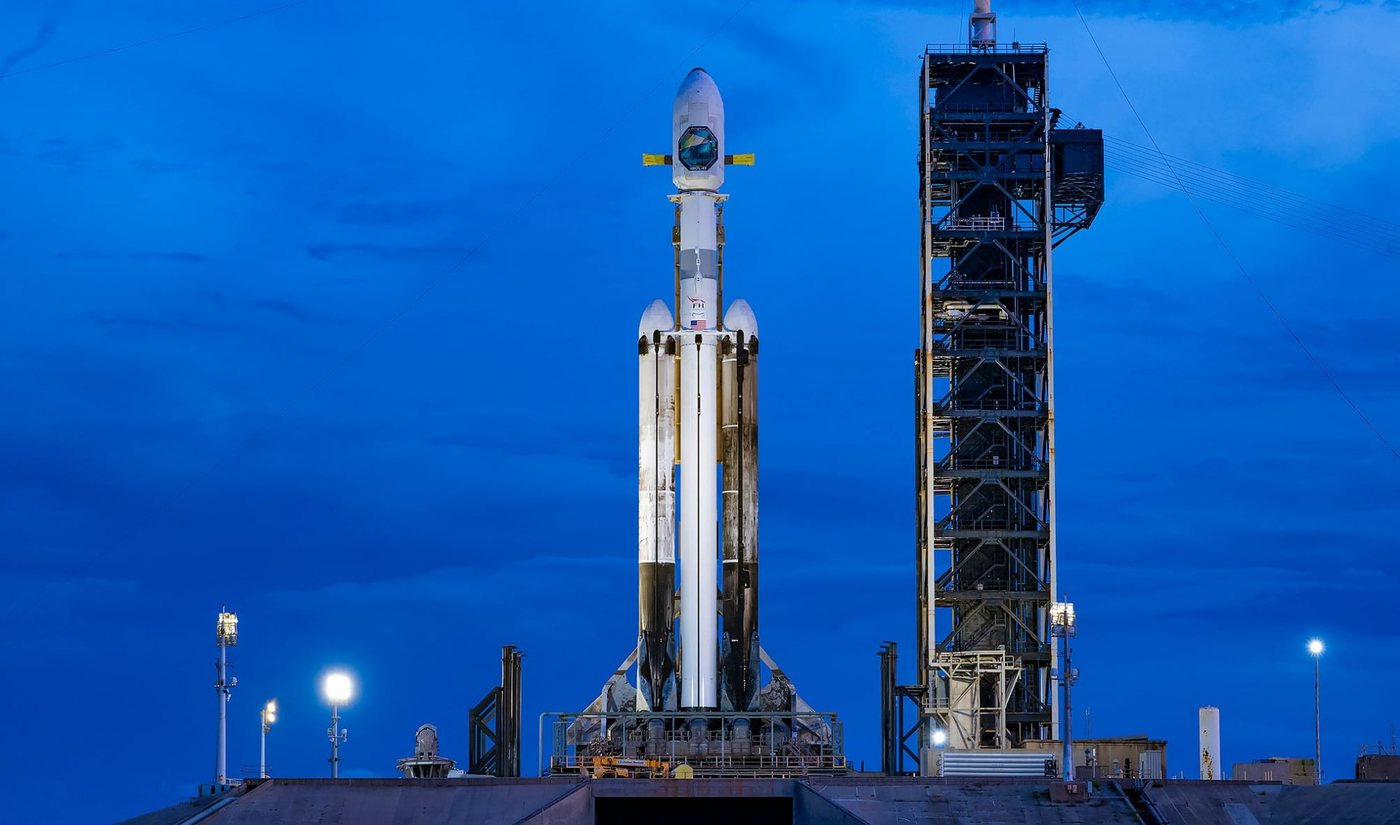
SpaceX's Falcon Heavy is scheduled to launch the classified NROL-97 payload for the National Reconnaissance Office from Launch Complex 39A at Kennedy Space Center in Florida, with liftoff set for 11:53 p.m. EDT on Oct. 1. The mission will send the secret payload into a high-energy orbit on a northeasterly trajectory, a profile that suggests a large, high-mass satellite destined for a distant orbital regime.
The launch window extends for 59 minutes, closing at 12:52 a.m. EDT on Oct. 2. A backup opportunity is available the following day at 11:48 p.m. EDT if weather or technical issues force a scrub. The mission marks the quickest turnaround between two Falcon Heavy flights, coming just over a month after the rocket launched NASA's Nancy Grace Roman Space Telescope on Aug. 30.
As with that earlier mission, the two side boosters will be recovered while the center core will be expended. Booster B1072, flying for the fourth time after supporting the GOES-U, ViaSat 3 F3, and Roman telescope missions, will land at Landing Zone 2. Booster B1104, on its second flight after also supporting the Roman mission, will touch down at Landing Zone 1. The center core, B1106, will be on its first and final flight, a common practice for Falcon Heavy center cores when maximum performance is required.
Falcon Heavy is SpaceX's super-heavy-lift, partially reusable launch vehicle, capable of delivering up to 63,800 kilograms to low-Earth orbit and 26,700 kilograms to geostationary transfer orbit. The 70-meter-tall rocket features three side-by-side Falcon boosters, each powered by nine Merlin 1D sea-level engines burning kerosene and liquid oxygen, for a total liftoff thrust of 22,819 kilonewtons. The second stage uses a single vacuum-optimized Merlin engine and is expended after each flight.
The NROL-97 payload's exact identity and technical details remain classified, as is standard for National Reconnaissance Office missions. However, the choice of Falcon Heavy with an expended center core points to a high-mass payload, and the targeted high-energy orbit suggests destinations such as geostationary-Earth orbit, medium-Earth orbit, or a highly elliptical orbit. Unlike low-Earth orbit reconnaissance satellites that offer brief imaging windows, payloads in high-energy orbits can provide continuous coverage of specific regions. Such orbits are frequently used for intelligence, missile-warning, or missile-defense satellites, as well as Earth observation and weather monitoring.
The NRO is unlikely to disclose any payload details in the near future. Following NROL-97, Falcon Heavy's next mission is Griffin Mission One, scheduled for no earlier than December 2026. That flight will launch an Astrobotic-developed lunar lander under NASA's Commercial Lunar Payload Services program, performing a trans-lunar injection burn to deliver the uncrewed 6,360-kilogram Griffin One lander to the lunar surface.
After that, Astrobotic Lunar Mission 3 is tentatively planned for 2027, carrying payloads to the Moon's South Pole aboard another Astrobotic lander. Those payloads may include the FLEX Lunar Innovation Platform rover developed by Venturi Astrolab. Falcon Heavy is also scheduled to launch a heavy payload manifest for the United States Space Force and the NRO in 2027.
Despite the Falcon family's pending retirement in the coming years, Falcon Heavy's manifest remains full, and the rocket will likely continue flying for several years until SpaceX's Starship becomes fully operational and can take over heavy-lift missions. For now, the vehicle stands ready at LC-39A for its latest national security mission, carrying a payload whose purpose and capabilities will remain hidden from public view.
11