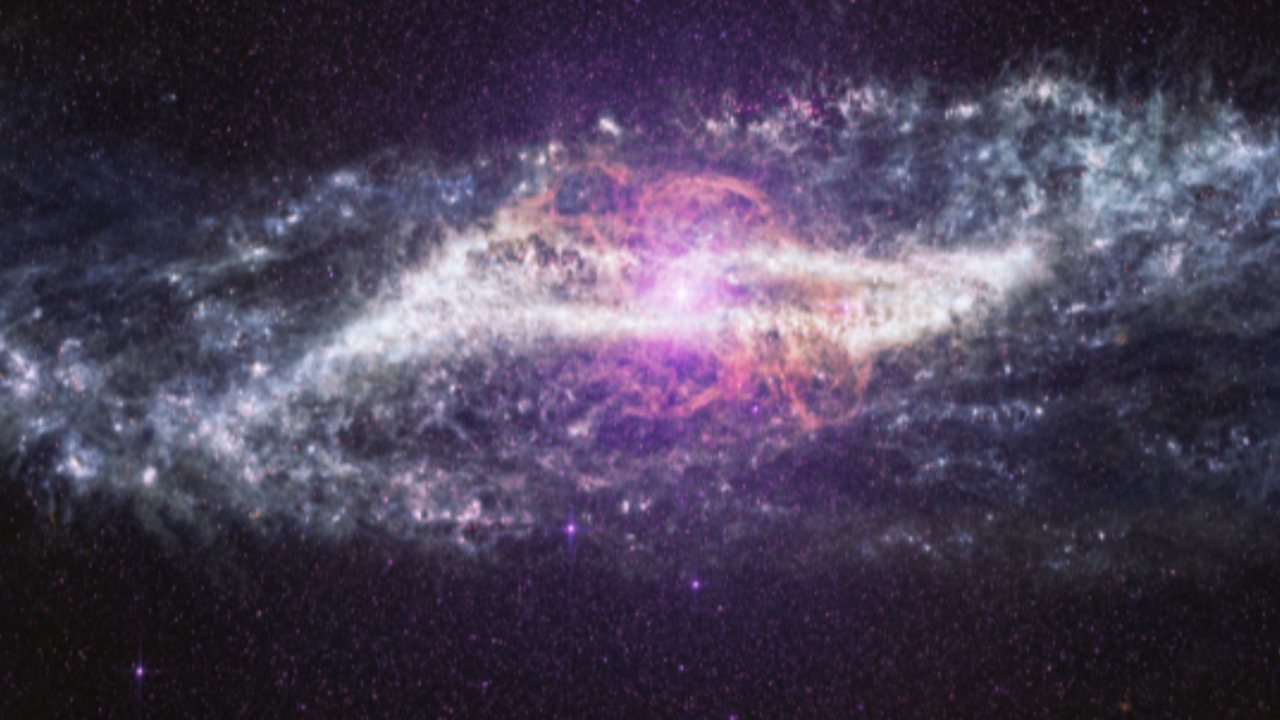
The James Webb Space Telescope (JWST) has marked its fourth anniversary in orbit by releasing a striking new image of a dramatic galaxy collision, offering astronomers a fresh look at the violent processes that shape the universe. The image, captured by the telescope's infrared instruments, reveals a chaotic scene where two galaxies are merging, sending shockwaves through clouds of gas and dust and triggering bursts of new star formation.
Launched on December 25, 2021, and fully operational since mid-2022, JWST has revolutionized astronomy with its ability to peer through cosmic dust and observe the universe in unprecedented detail. The anniversary image highlights a region where galaxies are crashing together, a phenomenon that scientists say provides critical clues about how galaxies evolve over billions of years. The collision site, located hundreds of millions of light-years away, shows streams of stars and gas being pulled apart by gravitational forces, with bright knots of intense star formation scattered throughout the wreckage.
«This image is a beautiful reminder of the dynamic and often violent nature of the cosmos,» said a NASA spokesperson in a statement accompanying the release. «Webb's infrared vision allows us to see through the obscuring dust and witness the birth of new stars in these extreme environments.» The telescope's instruments, including the Near-Infrared Camera (NIRCam) and the Mid-Infrared Instrument (MIRI), were used to capture the image, which combines multiple wavelengths to highlight different features of the collision.
The anniversary comes as JWST continues to deliver groundbreaking science, from detecting the earliest galaxies in the universe to analyzing the atmospheres of exoplanets. In its four years of operation, the telescope has provided data that has reshaped our understanding of cosmic history, including observations of galaxies that formed just a few hundred million years after the Big Bang. The new image of the galaxy crash site adds to this legacy, offering a detailed view of a process that was common in the early universe but is more difficult to observe today.
Galaxy mergers are a key driver of galactic evolution, funneling gas toward central supermassive black holes and triggering episodes of rapid star formation. The collision captured in the anniversary image is expected to eventually result in a single, larger galaxy, with its black holes merging into one. Astronomers are particularly interested in such events because they can help explain how galaxies like our own Milky Way formed and evolved over time.
The JWST mission, a collaboration between NASA, the European Space Agency (ESA), and the Canadian Space Agency (CSA), has already exceeded expectations in terms of scientific output. Since its first images were released in July 2022, the telescope has been used by thousands of researchers worldwide, leading to hundreds of peer-reviewed studies. Its ability to observe in the infrared spectrum allows it to see objects that are too faint, distant, or obscured by dust for other telescopes, such as the Hubble Space Telescope, to detect.
«Webb has opened a new window on the universe,» said an ESA astronomer involved in the mission. «Every new image brings surprises and deepens our understanding of the cosmos.» The telescope's longevity is also a positive sign: its fuel supply is expected to last for more than 20 years, far exceeding the original 10-year design life, ensuring many more anniversaries of discovery ahead.
The anniversary image of the galaxy crash site is available on the JWST website and has been widely shared on social media, drawing praise from both professional astronomers and space enthusiasts. As the telescope continues its mission, scientists are eagerly awaiting further observations that will shed light on the formation of stars, planets, and galaxies, as well as the nature of dark matter and dark energy.
For now, the fourth anniversary serves as a milestone in what has already become one of the most successful space observatories ever built, with the promise of even more remarkable discoveries in the years to come.
110