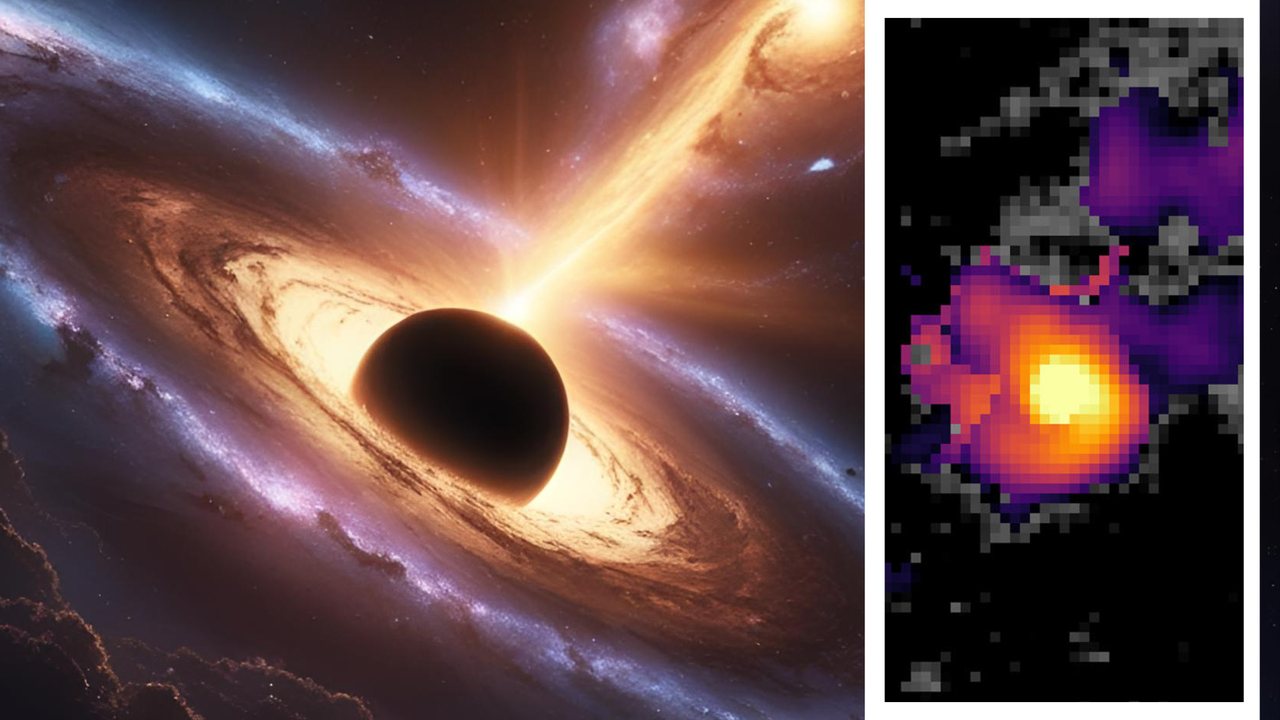
The James Webb Space Telescope has provided astronomers with a direct look at how supermassive black holes feed themselves, solving a long-standing puzzle about the growth of these cosmic giants. Observations of a black hole at the center of a galaxy more than 13 billion light-years away show that the black hole pulls in surrounding gas and dust, but also ejects some material that later falls back in, creating a self-sustaining cycle. This discovery, published by a team of researchers using Webb's infrared capabilities, marks a major step in understanding the evolution of galaxies and the role black holes play in shaping them.
The black hole in question lies in the galaxy GN-z11, one of the most distant and brightest galaxies known, which existed just 430 million years after the Big Bang. Using Webb's Near-Infrared Camera, the scientists detected a powerful outflow of gas from the black hole's accretion disk, the swirling ring of matter that feeds it. This outflow, traveling at speeds of several hundred kilometers per second, pushes material away from the black hole, but the team found that some of this ejected gas eventually cools and falls back toward the black hole, replenishing its fuel supply. This feedback loop, the researchers say, allows the black hole to continue growing even after it has expelled much of the surrounding gas.
«We were surprised to see that the black hole is not just consuming gas but also recycling it,» said Dr. Roberto Maiolino, an astrophysicist at the University of Cambridge and lead author of the study. «This process has been theorized for decades, but Webb has given us the first direct evidence that it actually happens.» The findings, published in the journal Nature Astronomy, challenge earlier models that assumed black holes would quickly exhaust their fuel and stop growing. Instead, the observations suggest that supermassive black holes can sustain themselves over long periods by regulating their own feeding through these outflows.
The discovery has significant implications for understanding the co-evolution of black holes and their host galaxies. Supermassive black holes, which can have masses millions or billions of times that of the sun, are thought to reside at the centers of most large galaxies, including the Milky Way. Their growth is closely tied to the formation of stars in their galaxies, as the outflows they produce can heat or remove gas that would otherwise form new stars. The Webb observations show that this interaction is more dynamic than previously thought, with the black hole's feeding and feedback processes operating in a delicate balance.
«This is a crucial piece of the puzzle,» said Dr. Hannah Übler, a co-author from the University of Cambridge. «We now see that black holes can regulate their own growth by recycling gas, which helps explain why they don't grow too fast or too slowly.» The team plans to use Webb to study other distant black holes to see if this recycling mechanism is common in the early universe. If confirmed, it could reshape theories of how the first supermassive black holes formed and grew so quickly after the Big Bang.
The James Webb Space Telescope, launched in December 2021, is the most powerful space observatory ever built. Its ability to see in infrared light allows it to peer through dust clouds and observe the most distant objects in the universe. This discovery is part of a growing body of Webb observations that are transforming our understanding of the early cosmos, from the first galaxies to the formation of stars and planets. The telescope's sensitivity has enabled astronomers to study black holes at a time when the universe was less than 5 percent of its current age, providing a window into processes that shaped the cosmos as we know it.
For the researchers, the next step is to determine how much of the recycled gas actually reaches the black hole and how this affects its growth rate. They also hope to investigate whether similar recycling occurs in black holes that are closer to Earth, which could help refine models of galactic evolution. The findings underscore the importance of Webb's mission to explore the universe's infancy and answer fundamental questions about the nature of black holes and their role in cosmic history.
99