The James Webb Space Telescope has captured unprecedented details of a distant exoplanet orbiting a dead star, providing astronomers with a striking preview of what may await Earth and the rest of the solar system billions of years from now. The observations, focused on a planetary system roughly 4,000 light-years away, reveal a world that survived the violent death of its parent star—a fate that could mirror our own Sun’s eventual transformation into a white dwarf.
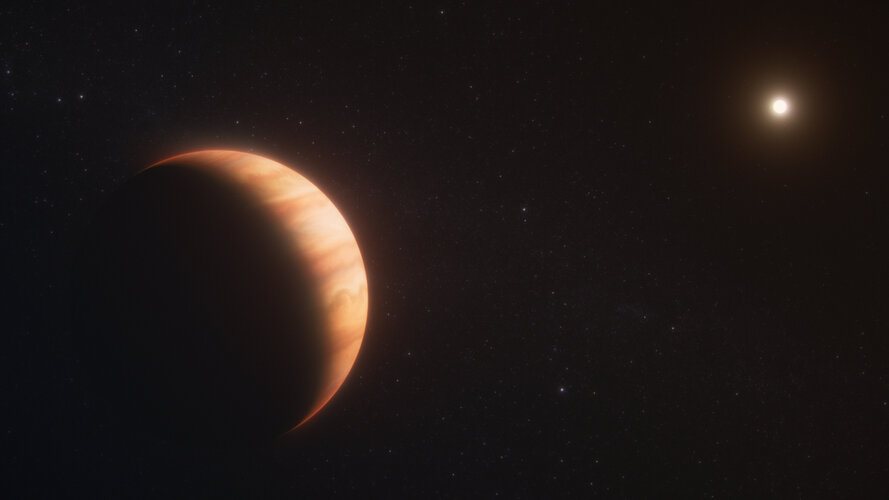
This exoplanet, located in the constellation Lyra, orbits a white dwarf—the dense, cooling remnant of a star that has exhausted its nuclear fuel. The system offers a rare opportunity to study planetary evolution after stellar death, a process that our Sun will undergo in about 5 billion years. When the Sun exhausts its hydrogen fuel, it will expand into a red giant, likely engulfing Mercury, Venus, and possibly Earth, before shedding its outer layers and leaving behind a white dwarf.
The James Webb Space Telescope’s infrared capabilities allowed scientists to analyze the exoplanet’s atmosphere and composition in detail. The data suggest that the planet, roughly the size of Jupiter, has a carbon-rich atmosphere with traces of water vapor and methane. These findings are significant because they demonstrate that planetary atmospheres can persist even after the host star has died, challenging previous assumptions about the survivability of such worlds.
«Stellar death is not the end,» said Dr. Sarah Kendrew, an astronomer at the Space Telescope Science Institute and lead author of the study. «Our observations show that planets can endure the cataclysmic events that mark the end of a star’s life, and they may even retain some of their original atmospheric characteristics.» The research team used Webb’s Near-Infrared Spectrograph to capture the spectrum of light passing through the exoplanet’s atmosphere as it transited its white dwarf host.
The white dwarf in this system is about half the mass of the Sun but compressed into a sphere roughly the size of Earth. Its intense gravitational pull and radiation environment make it an unlikely place for life as we know it, but the survival of a gas giant planet in such a harsh setting provides valuable insights into planetary system evolution. The exoplanet’s orbit is surprisingly close to the white dwarf—much closer than Mercury is to the Sun—suggesting that it may have migrated inward after the star’s death.
This discovery has broader implications for understanding the long-term fate of our own solar system. While Earth will likely be consumed when the Sun becomes a red giant, the outer planets—Jupiter, Saturn, Uranus, and Neptune—may survive the transition. The James Webb observations indicate that such survivors could continue to orbit the white dwarf for billions of years, their atmospheres slowly evolving under the influence of the remnant star’s radiation.
The study also raises questions about the potential for life on moons orbiting such surviving planets. Although the white dwarf’s habitable zone is extremely narrow and close to the star, any moons with sufficient internal heat or thick atmospheres might theoretically maintain liquid water. However, the current data do not provide evidence for such scenarios, and further observations are needed.
Astronomers plan to conduct follow-up studies using Webb to examine other white dwarf systems for similar planetary survivors. The telescope’s sensitivity and resolution make it uniquely suited to detect faint signals from these distant worlds, which are often obscured by the glare of the dead star. The findings were published in the Astrophysical Journal Letters and have sparked renewed interest in the long-term evolution of planetary systems.
For now, the James Webb Space Telescope’s glimpse into this distant system offers a sobering yet fascinating look at the solar system’s distant future. As Dr. Kendrew noted, «This is not just about understanding one exoplanet—it’s about understanding the ultimate fate of worlds like our own.» The research underscores the value of Webb’s mission in exploring cosmic phenomena that were previously beyond the reach of observational astronomy.
144