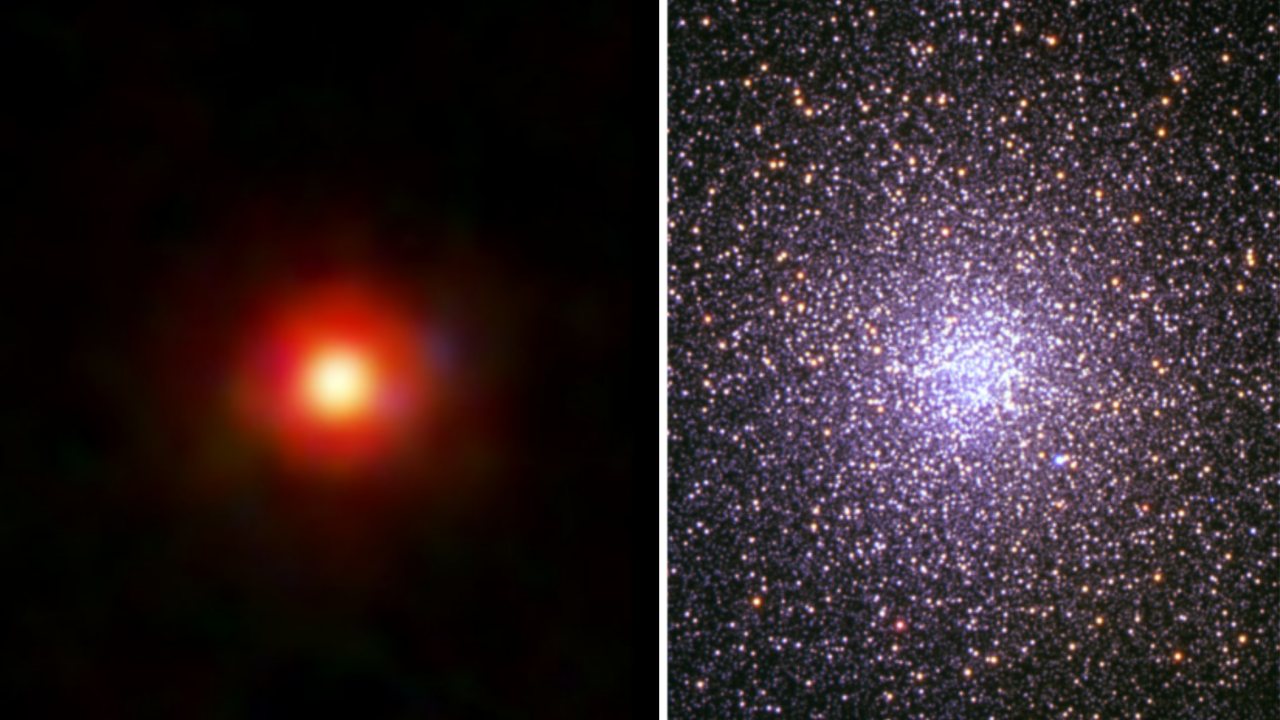
Mysterious objects known as 'Little Red Dots' (LRDs), first spotted by the James Webb Space Telescope in 2022, may not be what astronomers initially thought. A new study led by the University of Texas at Austin proposes that these compact, luminous sources could be the ancient ancestors of globular clusters — dense groups of old stars that have puzzled scientists for over a century.
The LRDs appear in the universe about 600 million years after the Big Bang and seem to vanish roughly 1.5 billion years later. They are small, bright, and emit a distinctive combination of red and ultraviolet light. Initially, researchers suspected they were supermassive black holes shrouded in thick gas clouds, dragging young stars toward dramatic ends. While that scenario explains many of their properties, the new study offers an alternative that could connect LRDs to one of astronomy's enduring mysteries: the origin of globular clusters.
Globular clusters are dense collections of hundreds of thousands, sometimes millions, of stars. The Milky Way alone hosts about 150 of them. Despite being studied for more than a century, how these clusters formed has remained unknown. 'We usually observe them after billions of years of evolution, when their massive stars have disappeared, gas has been dispersed, and dynamic processes have altered their masses and structures,' said Danielle Berg, an astronomer at UT Austin and co-author of the study. 'This makes it very difficult to reconstruct the original conditions in which they formed.'
The new study, published as a preprint on arXiv, suggests that LRDs could be globular clusters caught in the act of formation. At the heart of each such cluster, the researchers propose, a supermassive star — up to hundreds of thousands of times more massive than the Sun — could have formed through a series of stellar collisions. This massive star would have been a powerful chemical forge, producing unusual elements in its core. 'When they die, they expel that material again,' Berg explained, 'seeding the next generation of stars with the chemical fingerprints we still observe in globular clusters today.'
This idea connects to a long-standing puzzle within globular clusters themselves. Stars in a globular cluster are all roughly the same age, having formed in an intense burst of star formation in the early universe. One would expect them to share a relatively simple chemical composition. Yet some clusters show a phenomenon called multiple populations: groups of stars with anomalous abundances, rich in helium, nitrogen, sodium, and aluminum but poor in carbon, oxygen, and magnesium. This chemical pattern points to nuclear fusion at extremely high temperatures — much higher than those found in the cores of even normal massive stars. 'A supermassive star is exactly the kind of environment that can produce this combination,' said Mike Boylan-Kolchin, another co-author.
The supermassive star at the center of a forming globular cluster would have a short life. 'In our model, the supermassive star that helps make the object look like a Little Red Dot would live only for a short period,' said John Chisholm, lead author of the study. 'Once the star dies, the object might no longer look like a Little Red Dot, even though the cluster itself survives for billions of years.' This could explain why LRDs disappear from view after about 1.5 billion years — the central engine that made them shine so brightly has faded.
Several additional clues support the connection. The distribution of LRDs in the early universe matches that of present-day globular clusters. Models of LRD evolution show that their mass could transform smoothly into that of modern globular clusters. And LRDs appear in the universe at roughly the same time that the oldest globular clusters are thought to have formed. 'At the moment there is no overwhelming evidence that Little Red Dots are globular clusters, but this hypothesis would explain many different and surprising observations,' Boylan-Kolchin noted.
The study does not rule out other possibilities. 'Little Red Dots could be galaxies, they could involve black holes, or they could be something even more unexpected,' Chisholm said. 'Our work shows that the formation of globular clusters with supermassive stars should be part of this discussion.' The research team, which also includes scientists from the Max Planck Institute for Astronomy and other institutions, plans to continue studying LRDs with future observations from the James Webb Space Telescope and other facilities to test their hypothesis further.