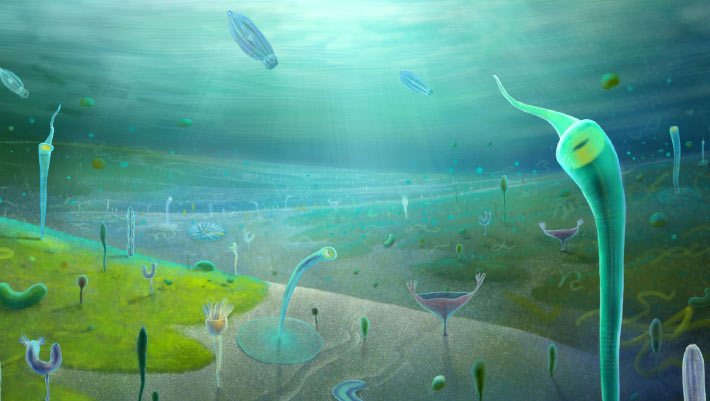
Some of the oldest complex animals on Earth may have survived as fossils because of the way ancient sea levels rose and fell, according to a new study led by researchers at Adelaide University. The team argues that dramatic shifts in the depth of the ocean helped create conditions that preserved soft-bodied creatures that would otherwise have decayed without leaving a trace.
The work focuses on rocks in Australia that date back to the Ediacaran period, a time when the first complex, multicellular life forms were beginning to appear. Fossils from this interval are rare and often poorly understood, partly because the organisms had no hard shells or skeletons that easily survive burial.
According to the researchers, a large fall in sea level followed by a rise may have produced underwater canyons and sediment conditions that quickly buried organisms and kept them intact. Rapid burial limits the activity of microbes and scavengers, which is why the researchers see sea-level swings as a plausible explanation for the unusually good preservation seen in these rocks.
The findings offer one possible reason why fossils from this early chapter of animal evolution are so unusual. The short summary of the research does not specify the exact fossil sites, their precise ages, or how many samples were examined. It also remains unclear whether the same mechanism explains preservation elsewhere in the world, a question that future fieldwork and comparative studies would need to address.
Credit. Based on reporting by Natali Anderson for Sci.News. Is this your work? Write to us.
31