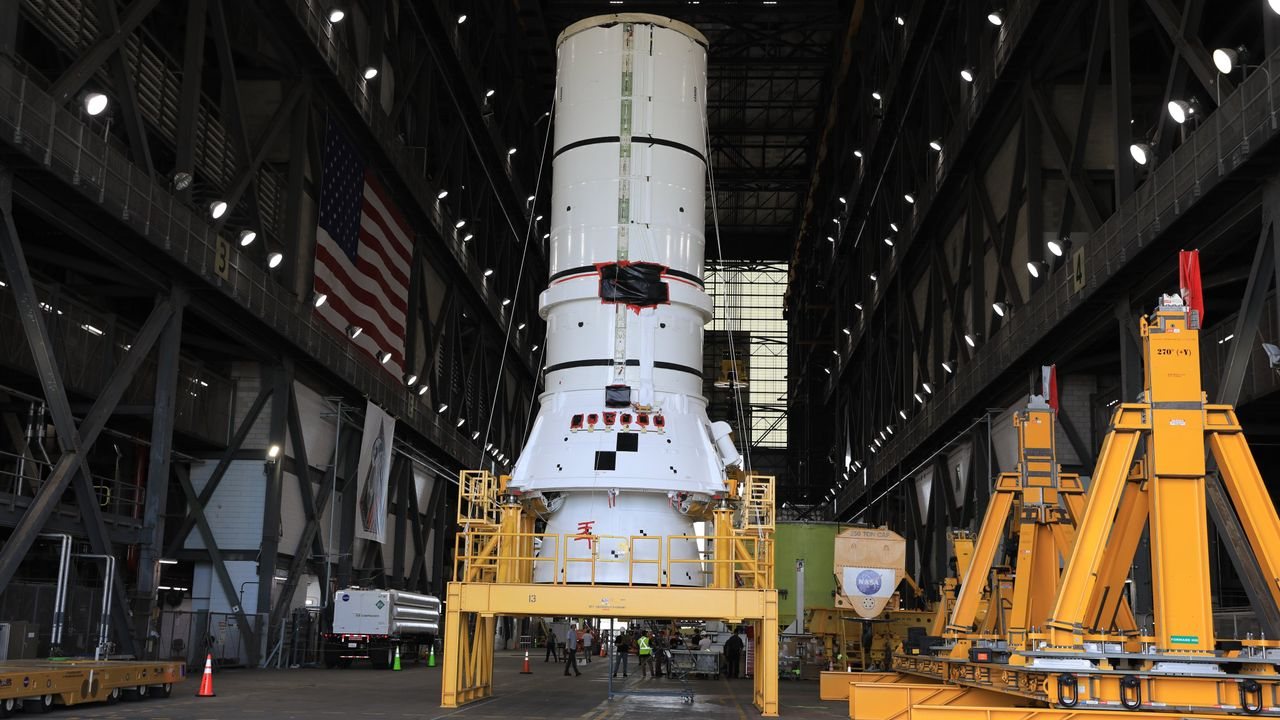
NASA has begun stacking the core stages of its Space Launch System (SLS) rocket at the Kennedy Space Center in Florida, moving a major step closer to the Artemis III mission that aims to land astronauts on the moon for the first time in over five decades. The agency released photographs on March 20 showing the first segments of the twin solid rocket boosters being lifted into place inside the Vehicle Assembly Building, signaling the start of the physical assembly of the most powerful rocket ever built.
Artemis III, currently targeted for launch no earlier than mid-2027, is designed to send a crew of four astronauts to the lunar south pole region. Two of those astronauts will descend to the surface in a SpaceX Starship variant, while the other two remain in orbit aboard the Orion spacecraft. The mission represents the culmination of NASA's Artemis program, which began with the uncrewed Artemis I flight in late 2022 and continued with the crewed Artemis II mission, now scheduled for 2025.
The stacking process involves carefully placing the five-segment solid rocket boosters, each taller than a 17-story building, onto the mobile launcher platform. These boosters provide more than 75 percent of the SLS rocket's total thrust at liftoff. Once the boosters are fully assembled, the core stage — a 212-foot-tall tank holding liquid hydrogen and liquid oxygen — will be moved from the nearby Michoud Assembly Facility in Louisiana and mounted between the boosters. The Orion spacecraft and its European-built service module will be added later, followed by the interim cryogenic propulsion stage that will help push Orion toward the moon.
NASA officials have emphasized that the stacking milestone is a critical step in validating the rocket's hardware and integration procedures. «Every piece of hardware that goes into the Vehicle Assembly Building has been tested and certified for flight,» said John Honeycutt, SLS program manager at NASA's Marshall Space Flight Center. «Seeing the boosters come together is a tangible sign that we are on track for Artemis III.»
The Artemis III mission has faced several delays since its original target of 2024. Technical challenges with the Starship lander, which must be refueled in orbit before heading to the moon, and issues with the Orion spacecraft's heat shield during Artemis I have pushed the timeline back. NASA Administrator Bill Nelson has stated that the agency is committed to a 2027 launch date but acknowledged that the schedule depends on the readiness of SpaceX's Starship and the completion of ground systems at Kennedy Space Center.
The lunar south pole is a prime target for exploration because it contains permanently shadowed craters that may hold water ice. This ice could be used for drinking water, oxygen, and rocket fuel, making it a key resource for future long-duration missions. Artemis III will focus on collecting samples, conducting scientific experiments, and testing technologies needed for a sustainable human presence on the moon.
International partners are also contributing to the mission. The European Space Agency provided the service module for Orion, which supplies propulsion, power, and thermal control. Canada, Japan, and other nations have signed the Artemis Accords, a framework for peaceful and cooperative lunar exploration. The mission will also carry scientific instruments from multiple countries, reflecting the global nature of the effort.
Once Artemis III is complete, NASA plans to follow with annual crewed missions, culminating in the construction of the Lunar Gateway — a small space station that will orbit the moon and serve as a staging point for surface expeditions. The agency has also contracted with Blue Origin to develop a second human landing system, ensuring redundancy and competition in the lunar transportation market.
The stacking of the SLS rocket is a visual reminder that the Artemis program is progressing despite its challenges. For the thousands of engineers, technicians, and support staff working at Kennedy Space Center and across the country, seeing the boosters rise inside the iconic Vehicle Assembly Building brings a sense of momentum. «This is what we train for,» said Lisa Watson-Morgan, manager of the Human Landing System program at NASA. «Every bolt tightened, every connection checked, brings us closer to the moment when humans once again walk on another world.»
As the stacking continues over the coming months, NASA will also conduct a series of integrated tests, including a full countdown rehearsal with the fully assembled rocket on the launch pad. If all goes according to plan, the Artemis III crew will be named approximately one year before launch, and the world will watch as the next generation of explorers sets off for the moon.
111