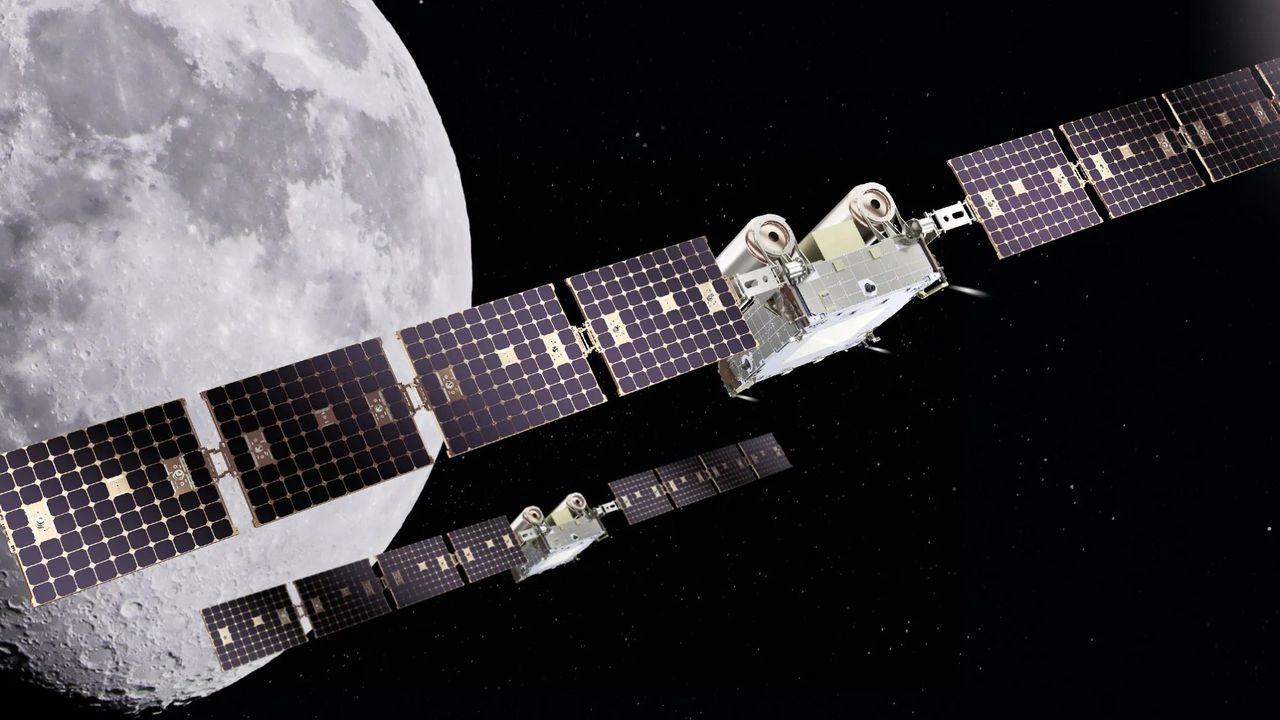
NASA is sending two probes to the moon to test complex three-body orbits, trajectories shaped by the gravitational pull of both Earth and the moon that could play a central role in future lunar exploration.
The two spacecraft are designed to demonstrate a path that exists only when three bodies interact in space. In such an orbit, a probe does not simply circle the moon as it would in a simple two-body system. Its trajectory is continuously shaped by Earth and the moon at the same time, producing looping, elongated paths that can offer significant advantages for missions that need to stay in contact with ground stations or observe specific regions of the lunar surface.
In orbital mechanics, this is known as the three-body problem, and it is famously difficult. While the orbit of a single satellite around Earth can be calculated with great precision using classical equations, adding a second massive body makes the motion unpredictable over long periods. Spacecraft flying three-body orbits must be tracked carefully and use periodic thruster corrections to remain on their intended paths.
The best-known examples are the halo orbits and Lissajous paths that loop around Lagrange points, the locations where the gravitational forces of Earth and the moon and the rotation of the system create balance points. The mathematical groundwork dates to the 18th century, when researchers showed that a small body could hold a stable position relative to two larger ones at five special points, later named after the mathematician Joseph-Louis Lagrange. A spacecraft positioned near one of these points can stay there for long stretches with relatively little fuel, which makes the points attractive for communication relays, telescopes and staging areas for deeper exploration.
For NASA, the tests are directly connected to the Artemis program and the planned Gateway space station. Gateway is designed to operate in a near-rectilinear halo orbit around the moon, a specific kind of three-body orbit that carries the station close over the lunar south pole before swinging it far into space. The agency already validated that trajectory with its CAPSTONE cubesat, which entered the near-rectilinear halo orbit in 2022 and returned data on its stability and the maneuvers needed to maintain it.
The two new probes are intended to build on that work by testing how a pair of spacecraft can operate together in the complex gravitational environment of the Earth-moon system. Flying two probes on related three-body orbits would allow NASA to test navigation techniques, communications relay concepts and formation-flying approaches that a single spacecraft cannot verify.
The mission also reflects a growing need to understand the region around the moon as traffic increases. In the coming years, many government and commercial missions are expected to operate in lunar orbit and on the lunar surface, from robotic landers to crewed vehicles and eventually Gateway. Reliable orbital models are essential for avoiding collisions, planning rendezvous and ensuring that spacecraft can keep stable paths without wasting fuel.
Three-body orbits have practical advantages beyond station-keeping. Because they can carry a spacecraft far above the lunar poles or keep it in continuous view of Earth, they could support communications relays for activity on the far side of the moon, a region permanently hidden from direct radio contact with our planet.
The data collected by the two probes is expected to be incorporated into the navigation software and mission-planning tools that future lunar missions will use. By demonstrating these orbits in practice, NASA aims to reduce the risk and uncertainty of operating in a gravitational environment far more complicated than the one surrounding Earth.