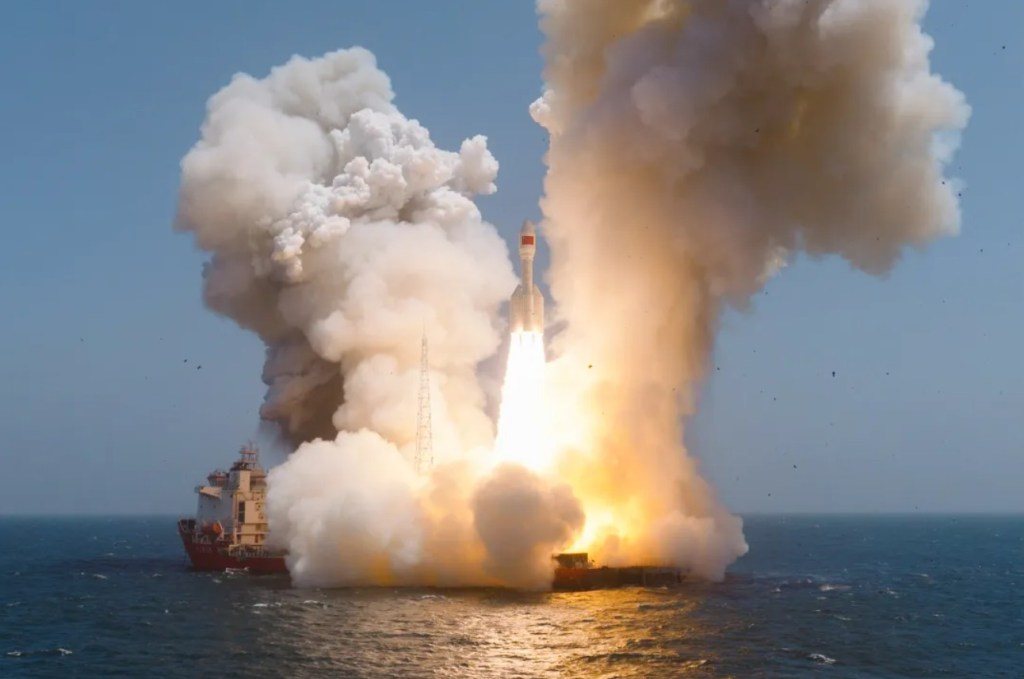
Chinese commercial launch company Orienspace successfully launched its third Gravity-1 solid rocket late Tuesday, sending nine satellites into orbit from a sea platform off the coast of Shanghai. The mission marks another milestone for the private aerospace firm, which has been steadily expanding its launch capabilities since its debut flight in early 2024.
The 30-meter-long Gravity-1 rocket lifted off from a mobile sea platform in the Yellow Sea, demonstrating the flexibility and cost-effectiveness of sea-based launch operations. The rocket, which is one of the largest solid-fuel launch vehicles developed by a Chinese private company, carried a mix of payloads for commercial and scientific purposes.
Orienspace, headquartered in Beijing, has positioned itself as a key player in China's rapidly growing commercial space sector. The company's Gravity-1 rocket is designed to deliver payloads of up to 4,000 kilograms to low Earth orbit, making it suitable for a wide range of satellite deployment missions. The rocket uses solid propellant, which allows for simpler logistics and faster launch preparation compared to liquid-fueled alternatives.
Tuesday's launch was the third flight of the Gravity-1 vehicle, following its maiden launch in January 2024 and a second mission later that year. Each successive flight has helped Orienspace refine its technology and operational procedures, bringing the company closer to its goal of offering reliable and affordable launch services to domestic and international customers.
The nine satellites deployed during this mission are expected to support various applications, including Earth observation, communications, and technology demonstration. While specific details about the individual payloads have not been fully disclosed, the mission underscores the growing demand for small satellite launches in China and globally.
Sea-based launches offer several advantages over traditional land-based launches. They allow rockets to be launched from equatorial or near-equatorial waters, which can improve payload capacity and reduce fuel consumption. They also provide greater flexibility in launch azimuths and reduce the risk of debris falling over populated areas. China has been actively developing sea launch capabilities, with both state-owned and private companies conducting missions from mobile platforms at sea.
Orienspace's success with the Gravity-1 rocket highlights the rapid progress of China's commercial space industry, which has seen a surge in activity over the past few years. The Chinese government has encouraged private investment in space, leading to the emergence of several startups focused on launch vehicles, satellite manufacturing, and space applications. Companies like Orienspace, Galactic Energy, and iSpace are competing to capture a share of the growing market for small satellite launches.
The global demand for small satellite launches has increased significantly, driven by the rise of mega-constellations for communications and Earth observation. Companies such as SpaceX, Rocket Lab, and others have demonstrated the viability of dedicated small satellite launch services, and Chinese firms are eager to compete in this space. Orienspace's Gravity-1 rocket, with its relatively high payload capacity and solid-fuel simplicity, is well-suited to meet this demand.
Tuesday's mission also demonstrates the reliability of the Gravity-1 rocket, which has now completed three successful flights. Each mission has provided valuable data that engineers can use to improve the vehicle's performance and prepare for future upgrades. Orienspace has indicated that it is working on a larger, more powerful version of the rocket, as well as a reusable upper stage, to further reduce launch costs and increase competitiveness.
The launch comes amid a broader push by China to expand its space capabilities, both for civilian and military purposes. The country has established its own space station, conducted lunar and Mars missions, and is planning to send astronauts to the Moon by the end of the decade. Commercial launch providers like Orienspace are expected to play a key role in supporting these ambitious goals by providing cost-effective access to space for a variety of payloads.
As the commercial space industry continues to evolve, sea-based launches are likely to become more common. The ability to launch from mobile platforms at sea offers operational flexibility that can be particularly valuable for missions requiring specific orbital inclinations or for customers who need rapid launch turnaround. Orienspace's latest success is a testament to the viability of this approach and a sign of the growing maturity of China's private space sector.