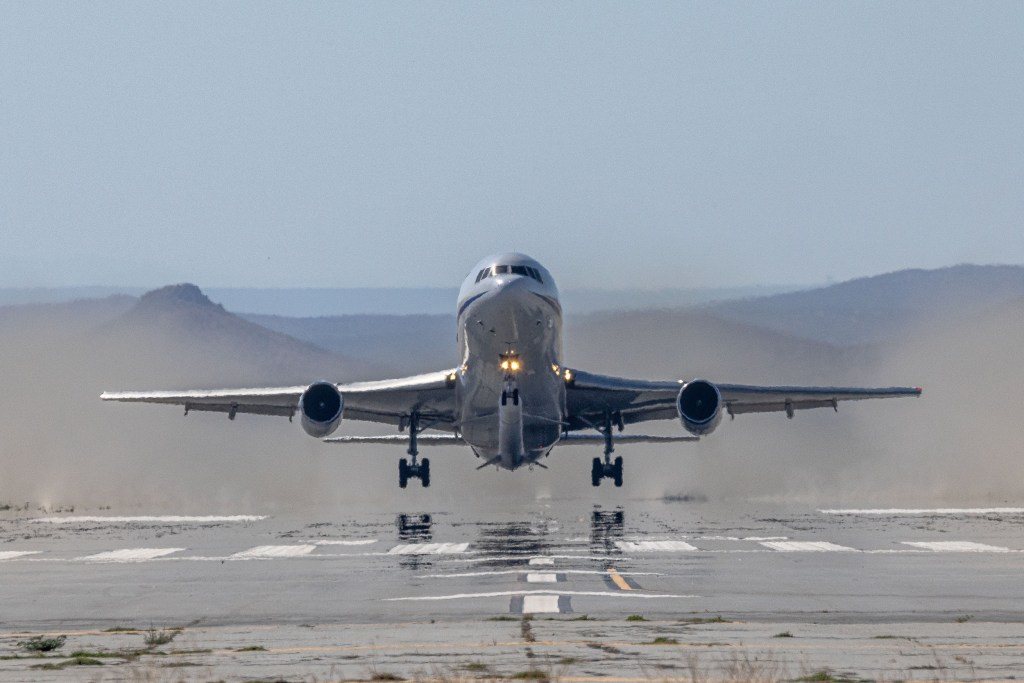
A Northrop Grumman Pegasus XL rocket lifted off from Cape Canaveral, Florida, on Tuesday, carrying out a mission to reboost NASA’s Swift Gamma-Ray Burst Explorer satellite. The flight, which may be the final operational launch of the Pegasus rocket, aimed to extend the life of the aging astrophysics observatory by raising its orbit.
The Pegasus XL, a three-stage, air-launched rocket, was released from a modified L-1011 carrier aircraft over the Atlantic Ocean. After a brief free fall, its first stage ignited, propelling the rocket toward orbit. The mission, designated the Swift Reboost Mission, was designed to boost the altitude of the Swift spacecraft, which has been in orbit since 2004. Swift, a NASA mission with international participation, is used to study gamma-ray bursts, the most powerful explosions in the universe, as well as other transient cosmic phenomena.
Swift was launched into a low-Earth orbit and has gradually descended over the years due to atmospheric drag. Without a reboost, the spacecraft would eventually re-enter Earth’s atmosphere and burn up, ending its scientific operations. The reboost maneuver, performed by the Pegasus rocket’s upper stage, raised Swift’s orbit by several dozen kilometers, giving it enough altitude to continue operating for several more years. NASA officials confirmed that the maneuver was successful, and Swift is now in a stable orbit.
The Pegasus rocket has been in service since 1990 and has launched more than 40 missions, primarily carrying small satellites and scientific payloads. It is unique among orbital rockets because it is launched from an aircraft, allowing it to be deployed from various locations and reducing the need for large ground-based launch pads. However, the rocket has become increasingly expensive and less competitive compared to newer, reusable launch vehicles. Northrop Grumman, the manufacturer, has not announced any future Pegasus launches, and industry analysts widely expect this to be the final flight of the vehicle.
The Swift mission itself has been a cornerstone of high-energy astrophysics for nearly two decades. It has detected and localized thousands of gamma-ray bursts, providing critical data for understanding the formation of black holes, the evolution of stars, and the nature of dark energy. The reboost will allow Swift to continue its observations, particularly in coordination with other space-based and ground-based observatories. The spacecraft carries three instruments: the Burst Alert Telescope, the X-Ray Telescope, and the Ultraviolet/Optical Telescope, which together provide rapid, multi-wavelength follow-up of transient events.
The successful reboost also underscores the importance of orbital maintenance for aging satellites. Many spacecraft in low-Earth orbit face the same gradual decay, and without periodic boosts, they eventually become unusable. The Pegasus rocket’s ability to deliver a precise orbital adjustment made it an ideal choice for this mission, even as its commercial prospects have dimmed. The launch also highlights the ongoing value of dedicated small-launch vehicles for specialized tasks, even as the industry shifts toward larger, reusable rockets.
For NASA, the extended life of Swift means continued access to a unique scientific asset. The agency has invested heavily in the mission, and the reboost represents a cost-effective way to maximize that investment. The mission also serves as a reminder of the challenges of operating long-duration space missions, where orbital decay and hardware aging are constant concerns. Swift’s instruments remain in good health, and the spacecraft is expected to continue producing valuable data for years to come.
The Pegasus rocket’s legacy is significant. It pioneered the air-launch concept, which has since been adopted by other companies, such as Virgin Orbit, though with mixed success. The rocket has launched a variety of payloads, including NASA’s NuSTAR X-ray telescope, the IRIS solar observatory, and several small satellites for the U.S. military and other customers. Its retirement would mark the end of an era in small satellite launch, though the need for such vehicles remains, as evidenced by the growing number of small satellite constellations and dedicated rideshare missions.
In the broader context of spaceflight, the Swift reboost mission demonstrates the versatility of existing launch systems and the importance of maintaining scientific infrastructure in orbit. As the space industry evolves, such missions may become more common, with companies like Northrop Grumman and others offering orbital servicing capabilities. For now, the successful reboost of Swift ensures that one of NASA’s most productive astrophysics missions will continue to explore the universe’s most violent and mysterious events.
130