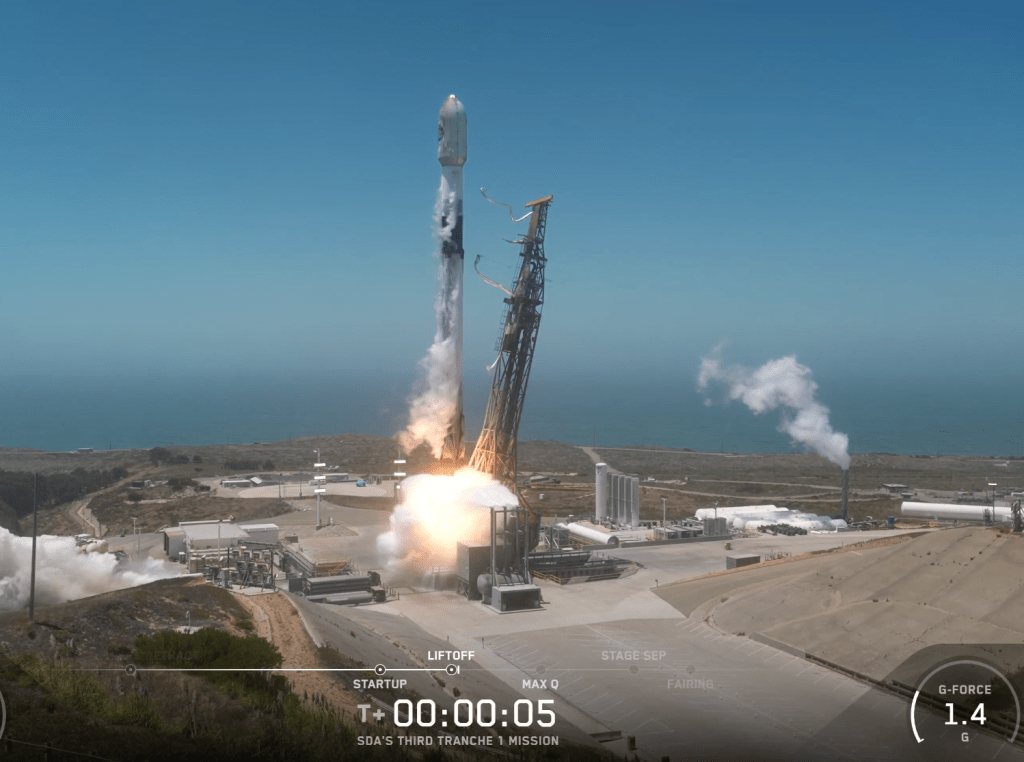
SpaceX has launched 21 satellites for the Space Development Agency (SDA), marking a significant milestone in the deployment of a new military data network. The mission, which lifted off from Cape Canaveral Space Force Station in Florida, placed the satellites into low Earth orbit as part of the SDA's Tranche 1 Transport Layer constellation.
With this launch, the SDA has now placed half of its planned Tranche 1 constellation in orbit. The Transport Layer is designed to provide resilient, low-latency military data connectivity, supporting a range of defense applications including missile warning, targeting, and beyond-line-of-sight communications. The network is intended to replace older, less flexible satellite systems with a modern, mesh-based architecture.
The 21 satellites were built by York Space Systems, a Denver-based manufacturer that specializes in small satellite platforms. Each satellite is equipped with optical inter-satellite links, allowing them to communicate directly with one another in space without relying on ground stations. This capability is central to the SDA's vision of a proliferated, distributed network that can quickly adapt to changing operational needs.
The Tranche 1 constellation, when fully deployed, will consist of approximately 150 satellites. The SDA plans to achieve full operational capability by late 2025 or early 2026. The agency, established in 2019, is tasked with accelerating the Pentagon's adoption of commercial space technologies and fielding new capabilities in two-year cycles, a departure from traditional military space programs that often take a decade or more to develop.
This launch is part of a broader effort by the U.S. Department of Defense to modernize its space-based infrastructure. The SDA's approach emphasizes small, mass-produced satellites that can be launched frequently and replaced quickly, reducing vulnerability to enemy attacks. The Tranche 1 network is expected to serve as a backbone for joint all-domain command and control, enabling seamless data sharing across the Army, Navy, Air Force, and Marine Corps.
York Space Systems has been a key contractor for the SDA, winning multiple contracts to build satellites for the Transport Layer. The company's S-CLASS satellite platform is designed for rapid production and low cost, aligning with the agency's goal of fielding hundreds of satellites in short order. Other contractors, including Lockheed Martin and Northrop Grumman, are also building satellites for the constellation.
The launch was conducted aboard a Falcon 9 rocket, which lifted off at 7:52 p.m. Eastern time. The rocket's first stage successfully landed on a drone ship in the Atlantic Ocean, marking its 10th flight. The satellites were deployed approximately 90 minutes after liftoff, and the SDA confirmed that all 21 spacecraft had made initial contact with ground controllers.
The SDA's Tranche 1 program has faced some delays due to supply chain issues and technical challenges, but the agency remains on track to meet its deployment targets. The next batch of satellites is expected to launch later this year, further expanding the network's coverage and capacity.
Military analysts have praised the SDA's approach as a necessary shift in space strategy, arguing that traditional geostationary satellites are too vulnerable to anti-satellite weapons. The proliferated constellation model, by contrast, distributes risk across many small satellites, making it harder for an adversary to disable the network entirely. The Tranche 1 Transport Layer is seen as a critical step toward achieving this vision.
Beyond military applications, the technology developed for the Transport Layer could have civilian uses, such as improving global internet connectivity and disaster response communications. However, the primary focus remains on national security, with the SDA emphasizing the need for resilient, low-latency data links in contested environments.
121