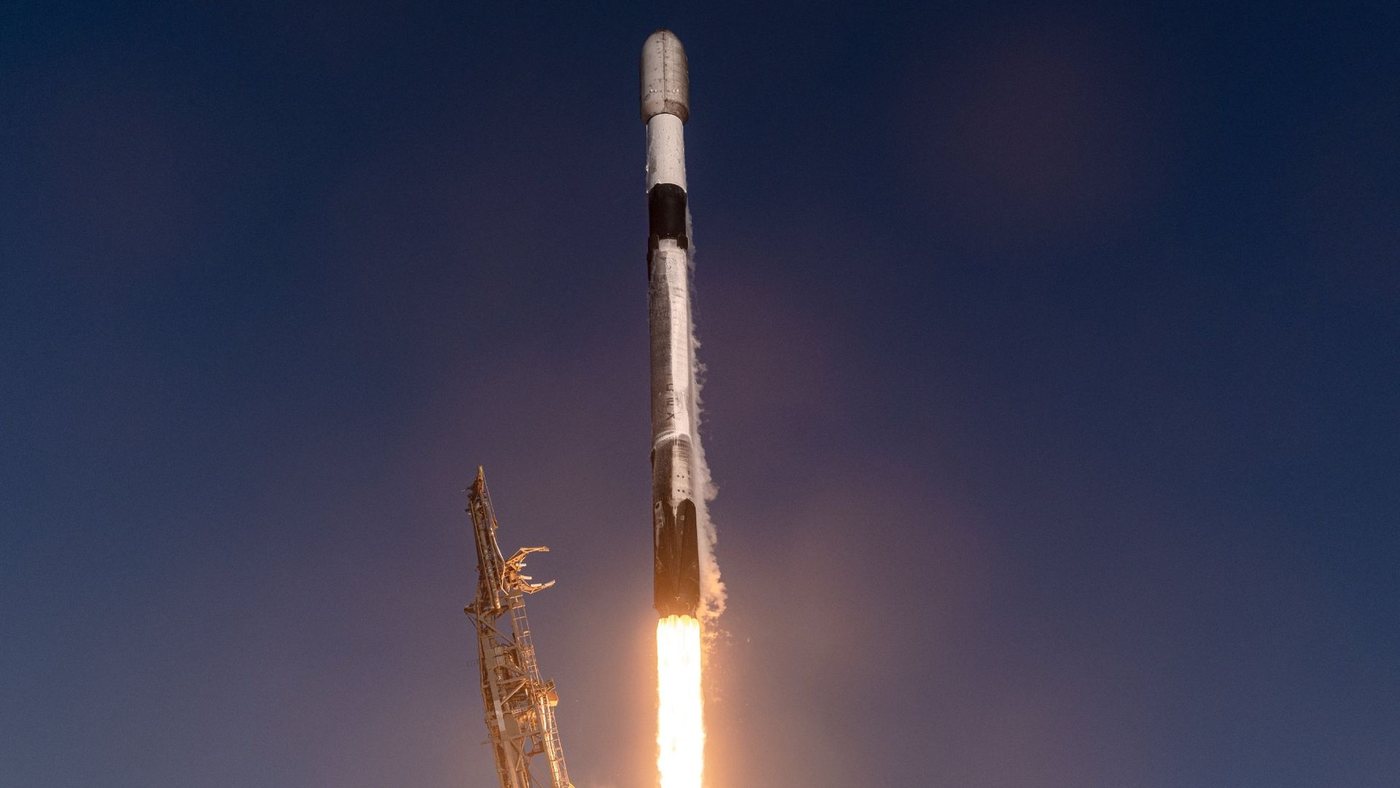
SpaceX's early Monday launch of 21 data transport satellites for the U.S. Space Development Agency was scrubbed in the final minute of the countdown, delaying a mission that marks the fourth production flight for the agency's military communications constellation.
The Falcon 9 rocket was set to lift off at 4:17 a.m. EDT from Vandenberg Space Force Base in California, carrying the Tranche 1 Transport Layer A mission, known as T1TL-A. The launch was called off as the rocket was shifting into its automated startup sequence. The mission is now listed as no earlier than 4:17 a.m. EDT Tuesday. No additional information about the scrub has been released.
The 21 satellites were manufactured by Northrop Grumman and delivered to Vandenberg on Sept. 28. They are the latest batch in the Space Development Agency's Proliferated Warfighter Space Architecture, a broad constellation designed to support the U.S. military and its allies with space-based capabilities including missile tracking and secure communications.
T1TL-A is the fourth mission sending production satellites into orbit for the SDA. Previous launches include T1TL-B on Sept. 10, 2025, T1TL-C on Oct. 15, 2025, and T1TL-E on July 16, 2026. The mission is one of 23 awarded to SpaceX under the National Security Space Launch Phase 2 contract, which was awarded in August 2020 and is managed by the U.S. Space Force's Space Systems Command.
When complete, Tranche 1 is expected to begin providing operational capabilities to the Department of Defense in 2027. The full Tranche 1 constellation is planned to include 126 Transport Layer satellites, 28 Tracking Layer satellites, and four missile defense demonstration spacecraft.
The SDA has said the Transport Layer will ultimately consist of between 300 and 500 satellites in low Earth orbit, at altitudes from 750 kilometers to 1,200 kilometers. Once complete, 95 percent of the globe will be in view of at least two T1TL satellites at any given time, according to the agency.
The upcoming flight will be the sixth for booster B1103 and SpaceX's 117th mission of 2026. The booster is expected to attempt a return to launch site landing about seven and a half minutes after liftoff.
17