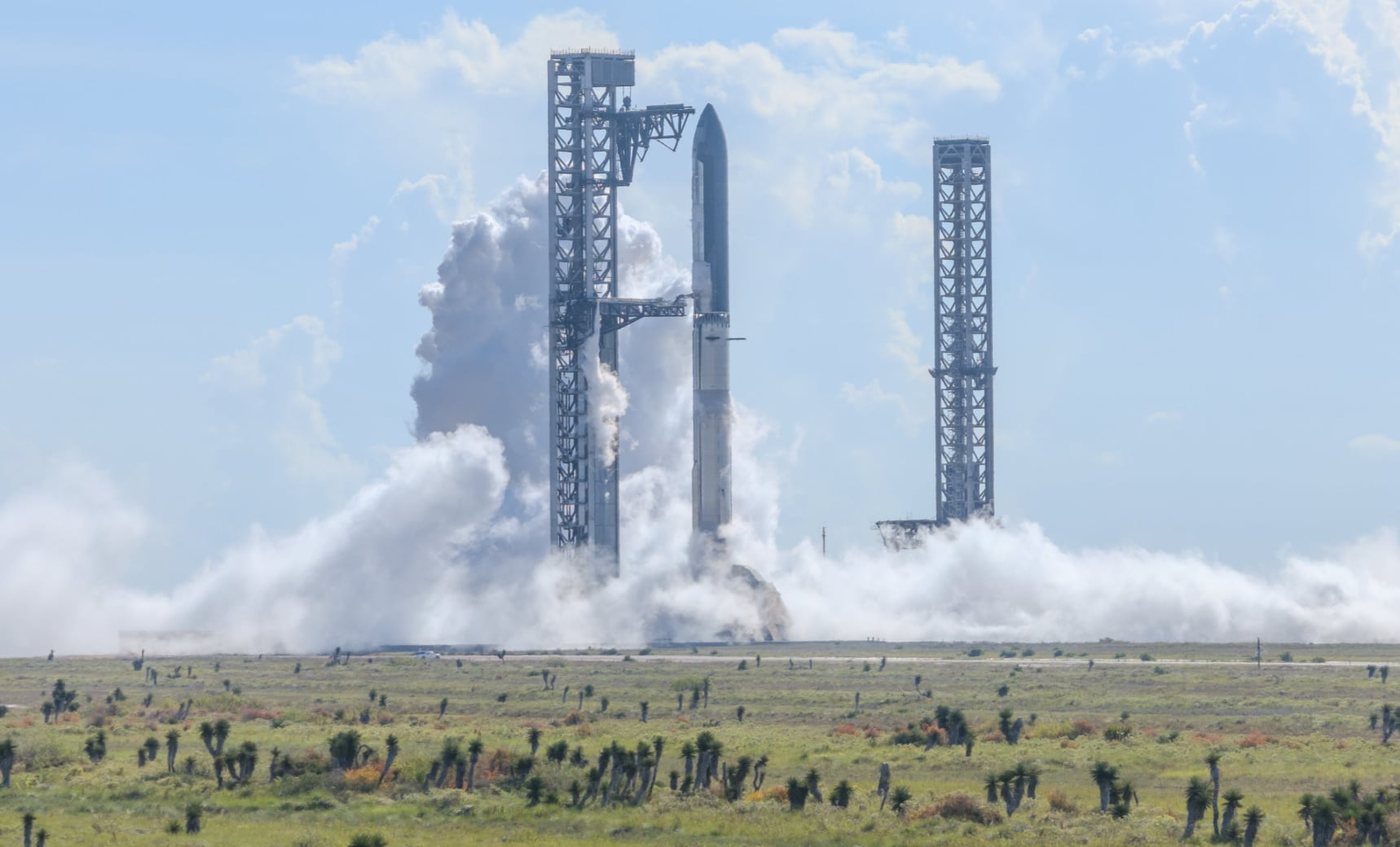
SpaceX is waiting on a launch license for Starship Flight 14, the first Version 3 mission intended to reach orbit, after Booster 21 and Ship 41 completed a full wet dress rehearsal at Starbase. Both stages were loaded with propellant, the count ran to just before engine ignition without an apparent hold at the optional T-minus 60-second mark, and the launch mount's top-deck water deluge started and shut down seconds later. From the outside, the test appeared to go well.
Ship 41, already loaded with 26 Starlink V3 satellites, was destacked from Booster 21 on Friday but remained at the launch site. A full stack standing nearly a week before the planned launch had raised questions about timing, but SpaceX said teams were using the regulatory pause to run an extra rehearsal. Earlier Starship versions rarely scrubbed close to launch; with Version 3, the first two flights have each seen a scrub of some kind. The extra pad time also put the launch mount back into use more than two months after the last flight.
Approval could still arrive at any time, including over the weekend, so a Monday launch remains possible even without a license in hand. The opening of the current window is 7:15 a.m. local time at Starbase, which could produce a sunrise launch.
Beyond Flight 14, a near-term manifest is already pointing to the next two flights in close succession. The dates come from presentation slides posted through the CADENA air traffic management system, which flags upcoming events, weather, and other factors that could affect air traffic across North and South America. The briefing dwells on the airspace impact of Flight 14 next week and notes other space activity, including Falcon launches, but it also lists additional high-profile missions.
Those entries put Starship Flight 15 no earlier than Oct. 19 and another Starship launch, Starlink Group 30-1, no earlier than Oct. 30. Flight 15 is understood to be the next Starbase mission after Flight 14 and the flight that could restore catching, possibly of both vehicles. Starlink Group 30-1 is expected to be the first Starship launch from Launch Complex 39A in Florida; as with Flight 14, that East Coast mission has been given a Starlink designation, in this case 30-1 rather than 31-1.
The dates should be treated cautiously. SpaceX still needs a clean Flight 14 outcome; the Flight 15 vehicles still require their own engine testing, and some of the slide dates may already be days or weeks old. Extra regulatory approval, including for a possible ship catch on Flight 15, could push the schedule further. A Florida launch would also require vehicles to be moved east and the pad to be fully activated. SpaceX tested LC-39A's top-deck deluge system for the first time Thursday night, a sign the pad is getting closer, but it still lacks a license to fly Starship from 39A.
Those October targets are likely to spread out in the weeks ahead. They only hold if Flight 14 does what Version 3 has not done yet: get through the count, reach orbit, and bring a working ship home through reentry. Until that happens, the manifest is a sketch. Flight 14 remains the key focus to set the stage for the next milestones.
Coverage plans for Flight 14 include launch coverage beginning at T-minus 4 hours and continuing through payload deployment. If Starship is approved to remain in orbit, coverage would then shift to an orbital stakeout stream through the vehicle's nearly eight-hour coast before deorbit and reentry. Dedicated deorbit, entry, and splashdown coverage would begin about 30 minutes before the deorbit burn.
20